I can understand what to do if a stranger talks to me.
📖 Let Us Begin!
Safety means keeping ourselves safe from harm. We must follow safety rules every day.
There are safety rules for the road, for home, and for school. These rules help us stay safe and healthy.
Let us learn the important safety rules!
Road Safety Rules
Roads can be dangerous. We must follow these rules:
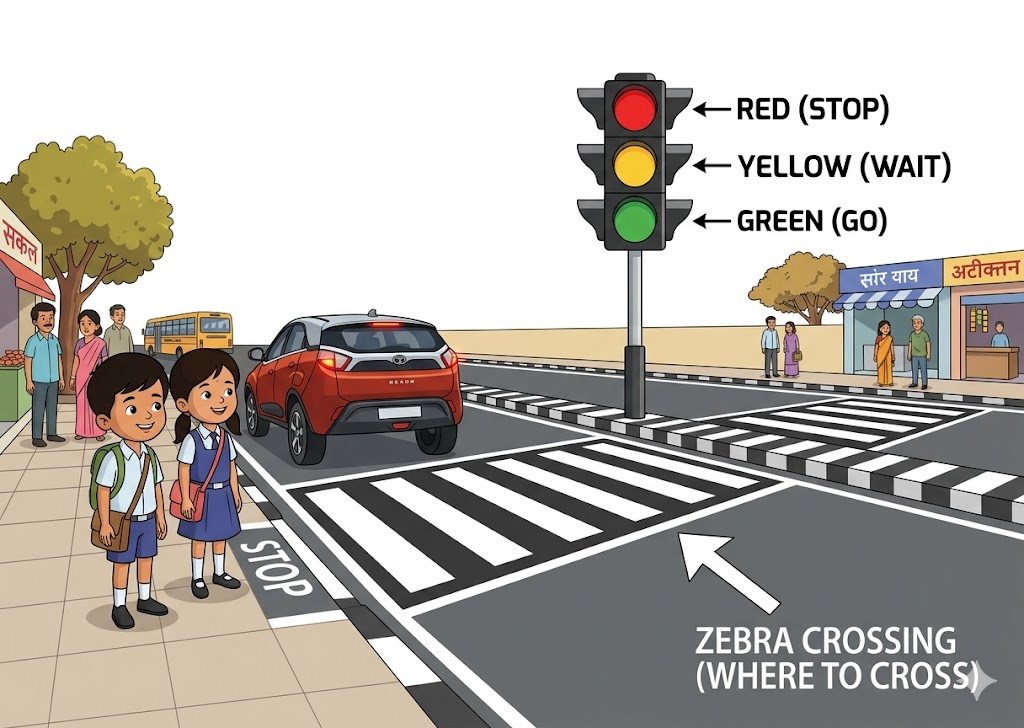
Always walk on the footpath. Cross the road only at a zebra crossing. Look left, then right, then left again before crossing. Obey traffic lights — red means stop, green means go, yellow means wait. Never run on the road. Always hold an adult's hand when crossing.
Ravi always looks both ways before crossing the road. His mother taught him: "Left, right, left — then cross!" This keeps him safe.
Traffic Light Colour
What It Means
What We Do
🔴 Red
Stop
Stand still and wait
🟡 Yellow
Get ready / Wait
Do not cross yet — get ready
🟢 Green
Go
Cross the road safely
More Road Safety Rules:
Always use the footpath or pavement — never walk on the road.
Cross only at a zebra crossing or a pedestrian crossing.
Look left → right → left before crossing.
Never run across the road.
Hold an adult's hand when crossing a busy road.
Do not play on the road.
If there is no footpath, walk on the right side of the road facing traffic.
Safety at Home
Our home can also have dangers. Follow these rules:
Do not touch electrical switches with wet hands. Do not play with fire or matchsticks. Do not touch sharp knives or scissors without an adult. Do not lean out of windows. Do not open the door to strangers when alone at home. Tell an adult if you see something dangerous.
Danger at Home
Safety Rule
Electrical switches and sockets
Never touch with wet hands. Electricity and water are dangerous together.
Fire, matchsticks, candles
Never play with fire. Only adults should light matchsticks or candles.
Sharp objects (knives, scissors)
Keep away from children. Ask an adult for help.
Climbing on furniture
Do not climb on chairs, tables, or shelves — you may fall.
Medicines and cleaning liquids
Never touch or drink medicines without an adult's permission.
Strangers at the door
Do not open the door to strangers when alone at home.
Know your home address and your parents' phone numbers. If there is an emergency, you can call for help or tell someone where you live.
Safety at School
We must also be safe at school:
Walk, do not run, in the corridors. Do not push or shove other children. Use the staircase carefully — hold the railing. Do not throw things in the classroom. Listen to your teacher's instructions. Tell your teacher if someone is hurt.
Walk — do not run — in corridors and on stairs.
Do not push or shove classmates on the stairs or in the corridor.
Always hold the railing when going up or down stairs.
Listen carefully to your teacher's instructions.
Do not talk to strangers near the school gate.
Tell a teacher immediately if someone hurts you or makes you feel unsafe.
Do not bring sharp objects or dangerous things to school.
Wait for your parent or guardian at the school gate — do not leave alone.
Meena always holds the railing on the stairs. She knows that running on stairs can cause a bad fall. Safety first!
Stranger Danger
A stranger is someone we do not know. We must be careful with strangers.
Never go anywhere with a stranger. Never take food, gifts, or money from a stranger. If a stranger makes you feel scared, shout loudly and run to a trusted adult. Always tell your parents or teacher if a stranger talks to you.
Meena's mother told her: "If anyone you do not know asks you to come with them, say NO loudly and run to a safe place!"
Water Safety
Water can be dangerous too. Follow these rules near water:
Never swim alone — always have an adult with you.
Do not go near deep water (rivers, ponds, lakes) without an adult.
Do not play near wells, open drains, or flooded areas.
Learn to swim — it is an important life skill.
If someone falls into water, shout for help immediately — do not jump in unless you know how to swim.
Never push anyone near water.
Arjun's father took him to the swimming pool. He always swims with his father watching. He never goes near the deep end alone. Water safety keeps us alive!
Emergency Numbers
In an emergency, we can call for help. Learn these important numbers:
Service
Phone Number
When to Call
🚔 Police
100
If there is a crime or you feel unsafe
🚒 Fire Brigade
101
If there is a fire
🚑 Ambulance
102
If someone is seriously hurt or ill
🆘 Emergency (All)
112
Any emergency — police, fire, or ambulance
Remember: 112 is the single emergency number in India. You can call it from any phone, even without a SIM card. Always tell the person your name and where you are.
📝 Key Words
Word
Meaning
Safety
Being protected from harm or danger
Zebra crossing
Striped lines on the road where people cross safely
Traffic light
Coloured lights that control traffic on roads
Stranger
A person we do not know
Footpath
A path for people to walk on, beside the road
Emergency
A sudden dangerous situation that needs quick action
Ambulance
A vehicle that takes sick or injured people to hospital
Railing
A bar on the side of stairs to hold for support
⭐ Key Points to Remember
Always walk on the footpath and cross at a zebra crossing.
Look left → right → left before crossing the road.
Red light = Stop. Yellow light = Wait. Green light = Go.
Do not touch electrical switches with wet hands.
Do not play with fire, matchsticks, or sharp objects.
Walk carefully in school corridors. Do not run or push.
Never go anywhere with a stranger. Say NO loudly and run to safety.
Never swim alone or go near deep water without an adult.
Emergency numbers: Police 100, Fire 101, Ambulance 102, Emergency 112.
Know your home address and your parents' phone numbers.
✏️ Practice Questions
A. Fill in the Blanks
1. We should cross the road at a crossing.
2. Red light means .
3. Do not touch electrical switches with hands.
4. A person we do not know is called a .
5. We should walk on the , not on the road.
6. The emergency number in India is .
7. Never swim — always have an adult with you.
8. Yellow traffic light means .
B. Multiple Choice Questions
1. What does a green traffic light mean?
(a) Stop(b) Wait(c) Go(d) Run
2. What should you do if a stranger asks you to go with them?
(a) Go with them(b) Say NO and run to a safe place(c) Take their gift(d) Stay quiet
3. What should you do in school corridors?
(a) Run fast(b) Push others(c) Walk carefully(d) Shout loudly
4. Which number do you call for an ambulance?
(a) 100(b) 101(c) 102(d) 112
5. What should you do before crossing the road?
(a) Run quickly(b) Look left, right, left(c) Close your eyes(d) Look only right
C. True or False
1. We should run on the road to cross quickly.
2. Red traffic light means stop.
3. It is safe to touch electrical switches with wet hands.
4. We should never swim alone.
5. We can take gifts from strangers.
D. Short Answer Questions
1. Write two road safety rules.
2. Write two safety rules for home.
3. What should you do if a stranger talks to you?
4. Write the three traffic light colours and what each means.
5. Write two water safety rules.
6. What is the emergency phone number in India? What is it used for?
E. Match the Following
Column A
Column B
1. Red traffic light
(a) 102
2. Ambulance number
(b) Stop
3. Zebra crossing
(c) Walk, do not run
4. School corridor rule
(d) Safe place to cross the road
5. Fire Brigade number
(e) 101
🎨 Fun Activity -- Safety Pledge
Read this safety pledge aloud and then sign your name:
I promise to:
1. Always walk on the footpath.
2. Cross the road only at a zebra crossing.
3. Never go with a stranger.
4. Tell a trusted adult if I feel unsafe.
My name:
Want a printable worksheet? Switch to Worksheet View, then print.
EVS / Science
Safety Rules
Class 2 | CBSE / NCERT / ICSE
Name: Class / Sec: Date:
🎯 Learning Objectives
I can follow road safety rules.
I can say how to stay safe at home.
I can follow safety rules at school.
I can understand what to do if a stranger talks to me.
📖 Let Us Begin!
Safety means keeping ourselves safe from harm. We must follow safety rules every day.
There are safety rules for the road, for home, and for school. These rules help us stay safe and healthy.
Let us learn the important safety rules!
Road Safety Rules
Roads can be dangerous. We must follow these rules:
Ravi always looks both ways before crossing the road. His mother taught him: "Left, right, left — then cross!" This keeps him safe.
Traffic Light Colour
What It Means
What We Do
🔴 Red
Stop
Stand still and wait
🟡 Yellow
Get ready / Wait
Do not cross yet — get ready
🟢 Green
Go
Cross the road safely
More Road Safety Rules:
Always use the footpath or pavement — never walk on the road.
Cross only at a zebra crossing or a pedestrian crossing.
Look left → right → left before crossing.
Never run across the road.
Hold an adult's hand when crossing a busy road.
Do not play on the road.
If there is no footpath, walk on the right side of the road facing traffic.
Safety at Home
Our home can also have dangers. Follow these rules:
Danger at Home
Safety Rule
Electrical switches and sockets
Never touch with wet hands. Electricity and water are dangerous together.
Fire, matchsticks, candles
Never play with fire. Only adults should light matchsticks or candles.
Sharp objects (knives, scissors)
Keep away from children. Ask an adult for help.
Climbing on furniture
Do not climb on chairs, tables, or shelves — you may fall.
Medicines and cleaning liquids
Never touch or drink medicines without an adult's permission.
Strangers at the door
Do not open the door to strangers when alone at home.
Know your home address and your parents' phone numbers. If there is an emergency, you can call for help or tell someone where you live.
EVS / Science
Safety Rules (continued)
Class 2 | CBSE / NCERT / ICSE
Name: Class / Sec: Date:
Safety at School
We must also be safe at school. Walk, do not run, in the corridors. Do not push or shove other children. Use the staircase carefully — hold the railing.
Walk — do not run — in corridors and on stairs.
Do not push or shove classmates on the stairs or in the corridor.
Always hold the railing when going up or down stairs.
Listen carefully to your teacher's instructions.
Do not talk to strangers near the school gate.
Tell a teacher immediately if someone hurts you or makes you feel unsafe.
Do not bring sharp objects or dangerous things to school.
Wait for your parent or guardian at the school gate — do not leave alone.
Meena always holds the railing on the stairs. She knows that running on stairs can cause a bad fall. Safety first!
Stranger Danger
A stranger is someone we do not know. We must be careful with strangers.
Never go anywhere with a stranger.
Never take food, gifts, or money from a stranger.
If a stranger makes you feel scared, shout loudly and run to a trusted adult.
Always tell your parents or teacher if a stranger talks to you.
Meena's mother told her: "If anyone you do not know asks you to come with them, say NO loudly and run to a safe place!"
Water Safety
Water can be dangerous too. Follow these rules near water:
Never swim alone — always have an adult with you.
Do not go near deep water (rivers, ponds, lakes) without an adult.
Do not play near wells, open drains, or flooded areas.
Learn to swim — it is an important life skill.
If someone falls into water, shout for help immediately — do not jump in unless you know how to swim.
Never push anyone near water.
Arjun's father took him to the swimming pool. He always swims with his father watching. He never goes near the deep end alone. Water safety keeps us alive!
Emergency Numbers
In an emergency, we can call for help. Learn these important numbers:
Service
Phone Number
When to Call
🚔 Police
100
If there is a crime or you feel unsafe
🚒 Fire Brigade
101
If there is a fire
🚑 Ambulance
102
If someone is seriously hurt or ill
🆘 Emergency (All)
112
Any emergency — police, fire, or ambulance
Remember: 112 is the single emergency number in India. You can call it from any phone, even without a SIM card. Always tell the person your name and where you are.
📝 Key Words
Word
Meaning
Safety
Being protected from harm or danger
Zebra crossing
Striped lines on the road where people cross safely
Traffic light
Coloured lights that control traffic on roads
Stranger
A person we do not know
Footpath
A path for people to walk on, beside the road
Emergency
A sudden dangerous situation that needs quick action
Ambulance
A vehicle that takes sick or injured people to hospital
Railing
A bar on the side of stairs to hold for support
⭐ Key Points to Remember
Always walk on the footpath and cross at a zebra crossing.
Look left → right → left before crossing the road.
Red light = Stop. Yellow light = Wait. Green light = Go.
Do not touch electrical switches with wet hands.
Do not play with fire, matchsticks, or sharp objects.
Walk carefully in school corridors. Do not run or push.
Never go anywhere with a stranger. Say NO loudly and run to safety.
Never swim alone or go near deep water without an adult.
Emergency numbers: Police 100, Fire 101, Ambulance 102, Emergency 112.
Know your home address and your parents' phone numbers.
EVS / Science
Safety Rules — Practice Questions
Class 2
Name: Class / Sec: Date:
A. Fill in the Blanks
1. We should cross the road at a crossing.
2. Red light means .
3. Do not touch electrical switches with hands.
4. A person we do not know is called a .
5. We should walk on the , not on the road.
6. The emergency number in India is .
7. Never swim — always have an adult with you.
8. Yellow traffic light means .
B. Multiple Choice Questions
1. What does a green traffic light mean?
(a) Stop(b) Wait(c) Go(d) Run
2. What should you do if a stranger asks you to go with them?
(a) Go with them(b) Say NO and run to a safe place(c) Take their gift(d) Stay quiet
3. What should you do in school corridors?
(a) Run fast(b) Push others(c) Walk carefully(d) Shout loudly
4. Which number do you call for an ambulance?
(a) 100(b) 101(c) 102(d) 112
5. What should you do before crossing the road?
(a) Run quickly(b) Look left, right, left(c) Close your eyes(d) Look only right
C. True or False
1. We should run on the road to cross quickly.
2. Red traffic light means stop.
3. It is safe to touch electrical switches with wet hands.
4. We should never swim alone.
5. We can take gifts from strangers.
D. Short Answer Questions
1. Write two road safety rules.
2. Write two safety rules for home.
3. What should you do if a stranger talks to you?
4. Write the three traffic light colours and what each means.
5. Write two water safety rules.
6. What is the emergency phone number in India? What is it used for?
E. Match the Following
Column A
Column B
1. Red traffic light
(a) 102
2. Ambulance number
(b) Stop
3. Zebra crossing
(c) Walk, do not run
4. School corridor rule
(d) Safe place to cross the road
5. Fire Brigade number
(e) 101
🎨 Fun Activity — Safety Pledge
Read this safety pledge aloud and then sign your name:
I promise to:
1. Always walk on the footpath.
2. Cross the road only at a zebra crossing.
3. Never go with a stranger.
4. Tell a trusted adult if I feel unsafe.
My name:
You are viewing the Worksheet layout. Click Print to save as PDF or print on A4 paper.