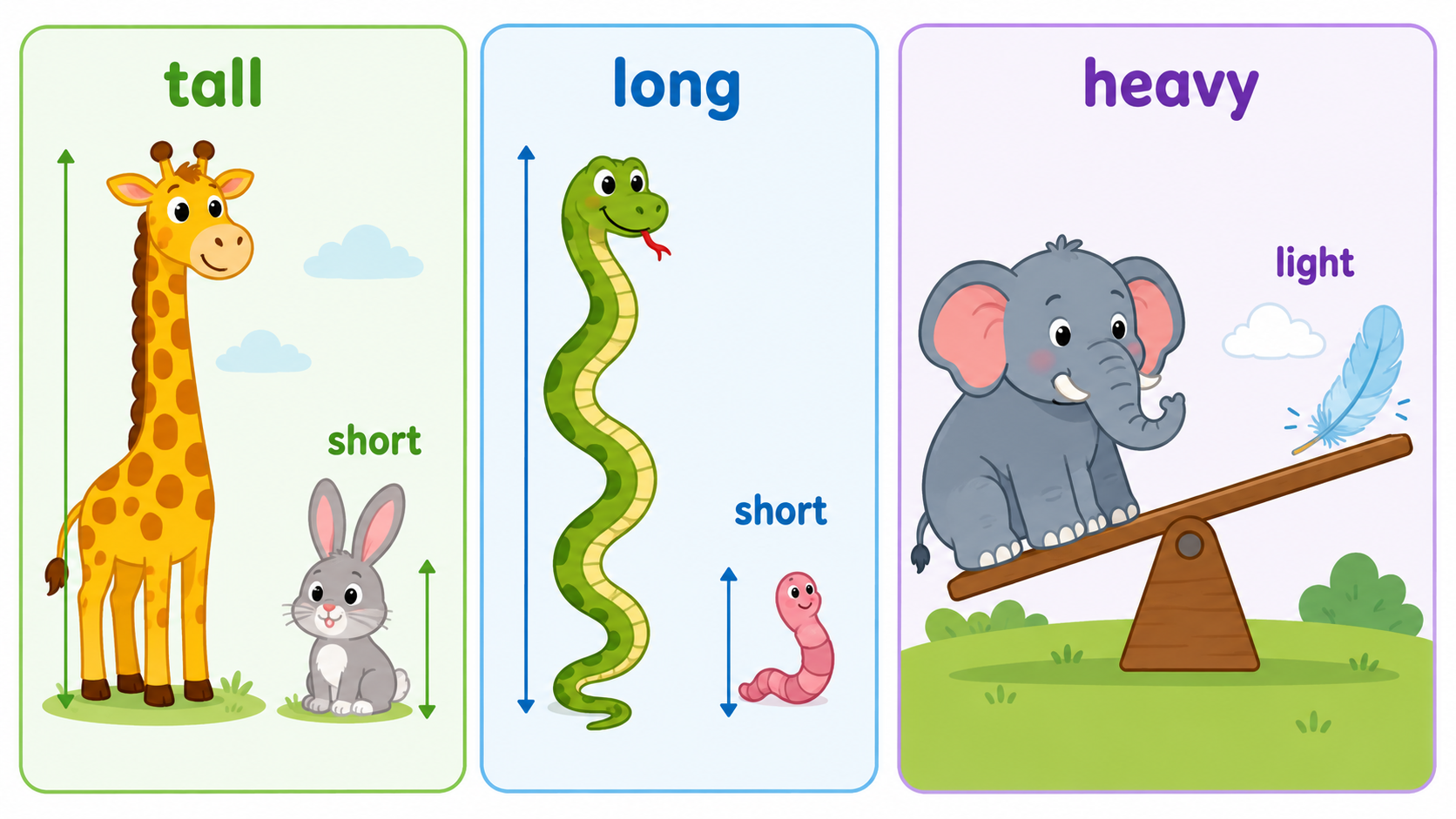
Compare lengths using words: long, short, tall, taller, shorter.
Compare weights using words: heavy, light, heavier, lighter.
Compare capacity using words: full, empty, more, less.
Measure length using non-standard units like hand spans, pencils, and steps.
Understand why we need standard units of measurement.
📖 Let Us Begin!
Ravi wants to know if his cricket bat is longer than Meena's skipping rope. He places them side by side and compares. We compare things every day! We compare how long, how tall, how heavy, or how much water a container can hold. This is called measurement.
In India, shopkeepers measure cloth in metres, vegetables in kilograms, and milk in litres. Let us learn about measurement step by step!
Comparing Lengths and Heights
We use words like long, short, tall, taller, shorter, longer to compare lengths and heights.
Examples:
A train is longer than an auto-rickshaw.
A coconut tree is taller than a tulsi plant.
A pencil is shorter than a cricket bat.
Arjun is taller than his younger sister Priya.
How to compare: Place objects side by side with one end lined up. The one that sticks out more is longer or taller.
Remember: "Long" and "short" are for things lying flat (like a rope). "Tall" and "short" are for things standing up (like a person or a tree).
Comparing Weights
We use words like heavy, light, heavier, lighter to compare weights.
Examples:
A watermelon is heavier than a guava.
A bag of rice (5 kg) is heavier than a bag of chips.
A feather is lighter than a cricket ball.
An elephant is heavier than a dog.
How to compare: Hold one object in each hand. The hand that goes down holds the heavier object. We can also use a simple balance (weighing scale).
Comparing Capacity
Capacity means how much liquid a container can hold. We use words like full, empty, more, less.
Examples:
A bucket holds more water than a glass.
A spoon holds less water than a jug.
Amma's cooking pot is full of dal.
After drinking, Ravi's glass is empty.
Think about it: Which holds more water — a lota (small pot) or a balti (bucket)? The bucket holds more because it has a bigger capacity!
Measuring with Non-Standard Units
Before rulers were invented, people used their hands, feet, and other objects to measure. These are called non-standard units.
Non-Standard Unit
How to Use
Example
Hand span
Stretch your thumb and little finger apart
The desk is 6 hand spans long
Foot length
Place one foot in front of the other
The room is 15 foot lengths long
Pencil
Place pencils end to end
The book is 2 pencils long
Steps (pace)
Walk and count your steps
The playground is 50 steps long
Example: Sita measured her desk using her hand span. The desk was 8 hand spans long.
Arjun measured the same desk. It was only 6 hand spans long! Why the difference? Because Arjun's hand is bigger than Sita's hand!
This is why we need standard units like centimetres (cm) and metres (m). A centimetre is the same for everyone — whether you are in Delhi, Mumbai, or Kolkata!
Standard Units (Introduction)
Standard units are the same for everyone. Here are some common ones:
What We Measure
Standard Unit
Tool Used
Length / Height
Centimetre (cm), Metre (m)
Ruler, Measuring tape
Weight
Gram (g), Kilogram (kg)
Weighing scale
Capacity (liquid)
Millilitre (mL), Litre (L)
Measuring cup
Fun facts:
Your pencil is about 15 cm long.
A cricket pitch is 22 metres long.
A packet of chips weighs about 30 grams.
A bottle of water holds 1 litre.
📝 Key Words
Word
Meaning
Length
How long or short something is
Height
How tall or short something is
Weight
How heavy or light something is
Capacity
How much liquid a container can hold
Non-standard unit
An everyday object used to measure (hand span, pencil, step)
Standard unit
A fixed unit like centimetre, kilogram, or litre
Compare
To look at two things and see which is more or less
⭐ Key Points to Remember
Long and short describe length. Tall and short describe height.
Heavy and light describe weight.
Full and empty describe capacity.
To compare lengths, place objects side by side with one end lined up.
Non-standard units (hand span, pencil) can be used to measure, but they give different answers for different people.
Standard units like centimetres, kilograms, and litres are the same for everyone.
We use a ruler to measure length, a weighing scale for weight, and a measuring cup for capacity.
✏️ Practice Questions
A. Fill in the Blanks
1. A giraffe is than a dog. (taller / shorter)
2. A feather is than a stone. (heavier / lighter)
3. A bucket holds water than a cup. (more / less)
4. We use a to measure length in standard units.
5. A hand span is a unit of measurement. (standard / non-standard)
6. A cricket bat is than a pencil. (longer / shorter)
7. We measure weight in and .
8. A train is than an auto-rickshaw. (longer / shorter)
9. When a glass has no water, it is . (full / empty)
10. The standard unit for measuring liquid is .
B. Choose the Correct Answer (MCQ)
1. Which is heavier?
a) A leafb) A brickc) A feather
2. Which word describes height?
a) Heavyb) Tallc) Long
3. Why do we need standard units?
a) They look niceb) Everyone's hand is differentc) They are cheaper
4. Which holds more water?
a) A spoonb) A bucketc) A cup
5. Which is a non-standard unit?
a) Centimetreb) Hand spanc) Kilogram
C. Short Answer / Word Problems
1. Name two objects in your home that are longer than your pencil.
2. Measure your maths book using your hand span. How many hand spans long is it?
3. Name one thing that is heavier than your school bag and one thing that is lighter.
4. Priya measured a table with her pencil. It was 5 pencils long. Arjun measured the same table with his pencil. It was 4 pencils long. Why did they get different answers?
5. Arrange from shortest to tallest: coconut tree, tulsi plant, sunflower plant.
D. True or False
1. A ruler is used to measure weight.
2. A hand span is a standard unit of measurement.
3. A bus is longer than a bicycle.
4. A mug holds more water than a tank.
5. Centimetre is a standard unit of length.
E. Match the Following
Column A
Column B
1. Length
a) Kilogram
2. Weight
b) Litre
3. Capacity
c) Centimetre
4. Ruler
d) How much a container holds
5. Weighing scale
e) Measures length
🎨 Activity: Measure with a Pencil
Use your pencil as a measuring unit. Measure 5 objects in your home or classroom. Write the name of each object and how many pencils long it is. Which object is the longest? Which is the shortest?
Want a printable worksheet? Switch to Worksheet View, then print.
Mathematics
Measurement
Class 2 | CBSE / NCERT / ICSE
Name: Class / Sec: Date:
🎯 Learning Objectives
Compare lengths using words: long, short, tall, taller, shorter.
Compare weights using words: heavy, light, heavier, lighter.
Compare capacity using words: full, empty, more, less.
Measure length using non-standard units like hand spans, pencils, and steps.
Understand why we need standard units of measurement.
📖 Let Us Begin!
Ravi wants to know if his cricket bat is longer than Meena's skipping rope. He places them side by side and compares. We compare things every day! We compare how long, how tall, how heavy, or how much water a container can hold. This is called measurement.
In India, shopkeepers measure cloth in metres, vegetables in kilograms, and milk in litres. Let us learn about measurement step by step!
Comparing Lengths and Heights
We use words like long, short, tall, taller, shorter, longer to compare.
A train is longer than an auto-rickshaw.
A coconut tree is taller than a tulsi plant.
A pencil is shorter than a cricket bat.
Arjun is taller than his younger sister Priya.
"Long" and "short" are for things lying flat (like a rope). "Tall" and "short" are for things standing up (like a person or a tree).
Comparing Weights
We use words like heavy, light, heavier, lighter to compare weights.
A watermelon is heavier than a guava.
A bag of rice (5 kg) is heavier than a bag of chips.
A feather is lighter than a cricket ball.
Comparing Capacity
Capacity means how much liquid a container can hold.
A bucket holds more water than a glass.
A spoon holds less water than a jug.
After drinking, Ravi's glass is empty.
Measuring with Non-Standard Units
Non-Standard Unit
How to Use
Example
Hand span
Stretch thumb and little finger apart
Desk = 6 hand spans
Foot length
Place one foot in front of the other
Room = 15 foot lengths
Pencil
Place pencils end to end
Book = 2 pencils
Steps (pace)
Walk and count steps
Playground = 50 steps
Sita measured her desk — 8 hand spans. Arjun measured the same desk — only 6 hand spans. Why? Because Arjun's hand is bigger! This is why we need standard units like centimetres.
Standard Units (Introduction)
What We Measure
Standard Unit
Tool Used
Length / Height
Centimetre (cm), Metre (m)
Ruler, Measuring tape
Weight
Gram (g), Kilogram (kg)
Weighing scale
Capacity (liquid)
Millilitre (mL), Litre (L)
Measuring cup
Key Words
Word
Meaning
Length
How long or short something is
Height
How tall or short something is
Weight
How heavy or light something is
Capacity
How much liquid a container can hold
Non-standard unit
Everyday object used to measure
Standard unit
Fixed unit like cm, kg, or litre
Mathematics
Measurement (continued)
Class 2 | CBSE / NCERT / ICSE
Name: Class / Sec: Date:
⭐ Key Points to Remember
Long and short describe length. Tall and short describe height.
Heavy and light describe weight. Full and empty describe capacity.
To compare lengths, place objects side by side with one end lined up.
Non-standard units give different answers for different people.
Standard units like centimetres, kilograms, and litres are the same for everyone.
A. Fill in the Blanks
1. A giraffe is than a dog. (taller / shorter)
2. A feather is than a stone. (heavier / lighter)
3. A bucket holds water than a cup. (more / less)
4. We use a to measure length in standard units.
5. A hand span is a unit of measurement.
6. A cricket bat is than a pencil. (longer / shorter)
7. We measure weight in and .
8. A train is than an auto-rickshaw. (longer / shorter)
9. When a glass has no water, it is . (full / empty)
10. The standard unit for measuring liquid is .
B. Choose the Correct Answer (MCQ)
1. Which is heavier?
a) A leafb) A brickc) A feather
2. Which word describes height?
a) Heavyb) Tallc) Long
3. Why do we need standard units?
a) They look niceb) Everyone's hand is differentc) They are cheaper
4. Which holds more water?
a) A spoonb) A bucketc) A cup
5. Which is a non-standard unit?
a) Centimetreb) Hand spanc) Kilogram
Mathematics
Measurement (practice)
Class 2 | CBSE / NCERT / ICSE
Name: Class / Sec: Date:
C. Short Answer / Word Problems
1. Name two objects in your home that are longer than your pencil.
2. Measure your maths book using your hand span. How many hand spans long is it?
3. Name one thing heavier than your school bag and one thing lighter.
4. Priya measured a table with her pencil — 5 pencils long. Arjun measured the same table — 4 pencils long. Why different answers?
5. Arrange from shortest to tallest: coconut tree, tulsi plant, sunflower plant.
D. True or False
1. A ruler is used to measure weight.
2. A hand span is a standard unit of measurement.
3. A bus is longer than a bicycle.
4. A mug holds more water than a tank.
5. Centimetre is a standard unit of length.
E. Match the Following
Column A
Column B
1. Length
a) Kilogram
2. Weight
b) Litre
3. Capacity
c) Centimetre
4. Ruler
d) How much a container holds
5. Weighing scale
e) Measures length
🎨 Activity: Measure with a Pencil
Use your pencil as a measuring unit. Measure 5 objects and record below:
Object
Length (in pencils)
1.
pencils
2.
pencils
3.
pencils
4.
pencils
5.
pencils
The longest object is: The shortest object is:
You are viewing the Worksheet layout. Click Print to save as PDF or print on A4 paper.