Numbers 1 to 100
Learning Objectives
- Count forward from 1 to 100.
- Count backward from 100 to 1.
- Write numbers in order on a number grid.
- Find the number that comes just before or just after a given number.
- Identify 1-digit and 2-digit numbers.
Let Us Begin!
Ravi has a big jar of marbles. He wants to count them all. He starts from 1 and counts up to 100. Can you count with him?
Numbers from 1 to 100 are all around us — on clocks, on pages of books, on house numbers, on bus numbers, and even on cricket scoreboards! Let us learn to read, write, and use these numbers.
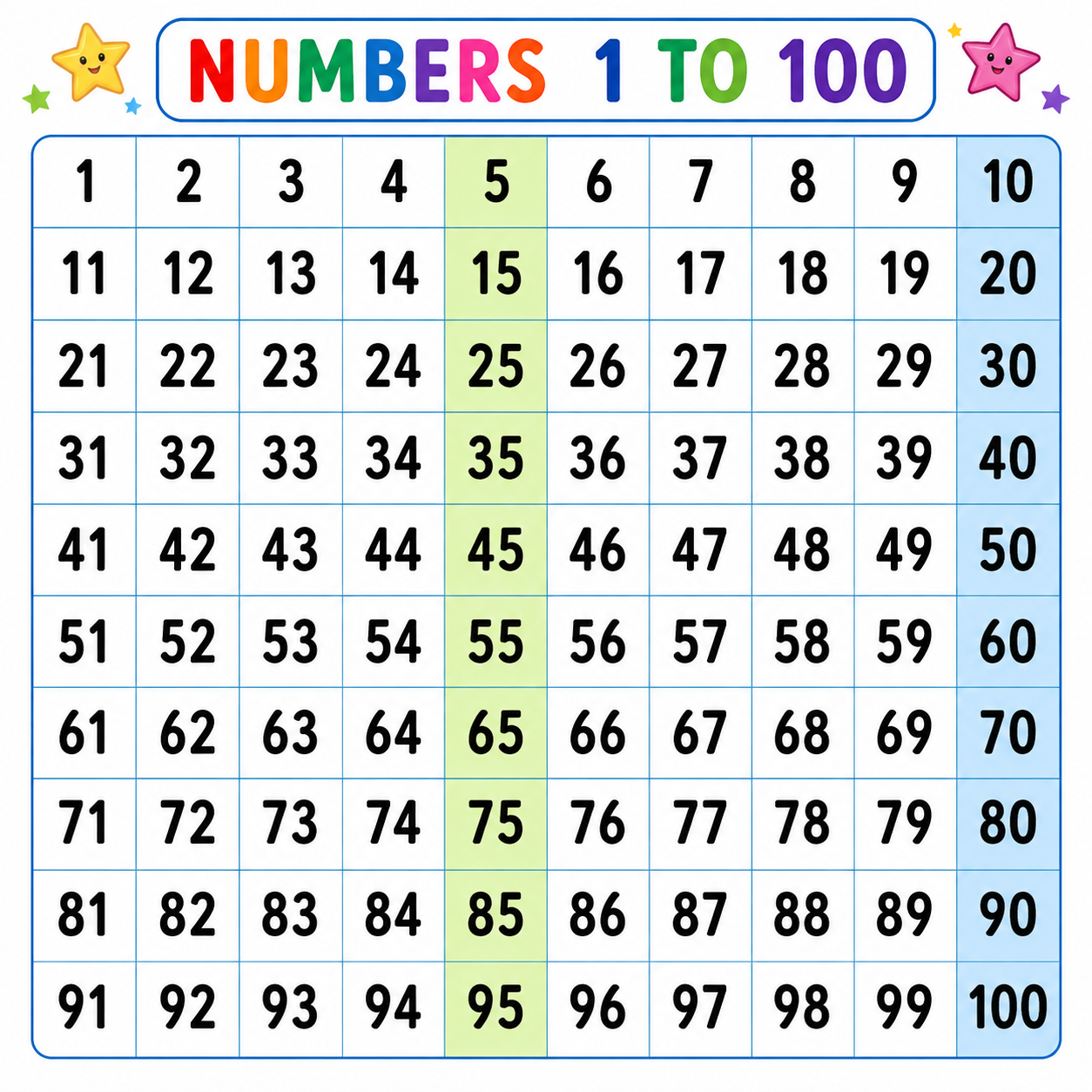
Number Grid: 1 to 100
Here is the complete number grid from 1 to 100. Each row has 10 numbers:
| 1 | 2 | 3 | 4 | 5 | 6 | 7 | 8 | 9 | 10 |
| 11 | 12 | 13 | 14 | 15 | 16 | 17 | 18 | 19 | 20 |
| 21 | 22 | 23 | 24 | 25 | 26 | 27 | 28 | 29 | 30 |
| 31 | 32 | 33 | 34 | 35 | 36 | 37 | 38 | 39 | 40 |
| 41 | 42 | 43 | 44 | 45 | 46 | 47 | 48 | 49 | 50 |
| 51 | 52 | 53 | 54 | 55 | 56 | 57 | 58 | 59 | 60 |
| 61 | 62 | 63 | 64 | 65 | 66 | 67 | 68 | 69 | 70 |
| 71 | 72 | 73 | 74 | 75 | 76 | 77 | 78 | 79 | 80 |
| 81 | 82 | 83 | 84 | 85 | 86 | 87 | 88 | 89 | 90 |
| 91 | 92 | 93 | 94 | 95 | 96 | 97 | 98 | 99 | 100 |
Counting Forward
We count forward when we go from a smaller number to a bigger number. Each time we add 1.
Example 2: 45, 46, 47, 48, 49, 50
Example 3: 91, 92, 93, 94, 95, 96, 97, 98, 99, 100
Step-by-step: To count forward from any number, just add 1 each time.
76 → 77 → 78 → 79 → 80 → 81 → 82...
After 76 comes 77. After 79 comes 80 (a new ten!).
Counting Backward
We count backward when we go from a bigger number to a smaller number. Each time we take away 1.
Example 2: 50, 49, 48, 47, 46, 45
Example 3: 100, 99, 98, 97, 96, 95
Step-by-step: To count backward from any number, subtract 1 each time.
33 → 32 → 31 → 30 → 29 → 28...
Before 33 comes 32. Before 30 comes 29.
Before and After
The number just before a number is 1 less. The number just after a number is 1 more.
Before 25 is 24. After 25 is 26.
Before 60 is 59. After 60 is 61.
Before 100 is 99. After 1 is 2.
Before 50 is 49. After 89 is 90.
Quick trick: "Before" means subtract 1. "After" means add 1.
| Number | Just Before | Just After |
|---|---|---|
| 15 | 14 | 16 |
| 30 | 29 | 31 |
| 48 | 47 | 49 |
| 71 | 70 | 72 |
| 99 | 98 | 100 |
1-Digit and 2-Digit Numbers
Numbers 1 to 9 have only one digit. They are called 1-digit numbers.
Numbers 10 to 99 have two digits. They are called 2-digit numbers.
The number 100 has three digits!
1-digit numbers: 1, 2, 3, 4, 5, 6, 7, 8, 9
2-digit numbers: 10, 11, 12, ... 97, 98, 99
3-digit number: 100
Fun Patterns in the Number Grid
Look at the number grid and find these patterns:
- All numbers ending in 0 are in the last column: 10, 20, 30, 40...
- All numbers ending in 5 are in the 5th column: 5, 15, 25, 35...
- Going down a column, each number is 10 more: 3, 13, 23, 33, 43...
- The smallest 1-digit number is 1. The largest is 9.
- The smallest 2-digit number is 10. The largest is 99.
Key Words
| Word | Meaning |
|---|---|
| Count forward | Going from a small number to a big number: 1, 2, 3... |
| Count backward | Going from a big number to a small number: 10, 9, 8... |
| Before | The number that comes just before (1 less) |
| After | The number that comes just after (1 more) |
| Number grid | A chart showing numbers 1 to 100 in rows of 10 |
| 1-digit number | A number with one digit (1 to 9) |
| 2-digit number | A number with two digits (10 to 99) |
- Numbers 1 to 100 go in order: 1, 2, 3 ... 98, 99, 100.
- Counting forward means going up: 1 more each time.
- Counting backward means going down: 1 less each time.
- The number just before is always 1 less.
- The number just after is always 1 more.
- Numbers 1–9 are 1-digit numbers. Numbers 10–99 are 2-digit numbers.
- The number grid has 10 rows and 10 columns.
Practice Questions
| Column A | Column B |
|---|---|
| 1. Number after 79 | (a) 49 |
| 2. Number before 50 | (b) 100 |
| 3. Largest 2-digit number | (c) 80 |
| 4. Smallest 1-digit number | (d) 99 |
| 5. Largest number from 1 to 100 | (e) 1 |
Draw a 10×10 grid on paper. Write numbers 1 to 100 in the boxes. Then:
- Colour all numbers ending in 0 (10, 20, 30...) in red.
- Colour all numbers ending in 5 (5, 15, 25...) in blue.
- Circle the number that is your age.
What pattern do you see with the red numbers? What about the blue numbers?
Want a printable worksheet? Switch to Worksheet View, then print.