Adjectives (Describing Words)
Learning Objectives
- Understand what an adjective is and how it describes a noun.
- Learn different types of adjectives — size, colour, shape, number, quality, and taste.
- Use adjectives before nouns and after "is/are" in sentences.
- Identify adjectives in sentences and passages.
- Understand comparison of adjectives (big – bigger – biggest).
- Use adjectives to make writing more interesting and descriptive.
- Apply adjectives in Indian everyday contexts.
What Is an Adjective?
Look at these two sentences:
1. I saw a dog.
2. I saw a big, brown, friendly dog.
Which sentence gives you a better picture? The second one! The words big, brown, and friendly tell us more about the dog. These words are called adjectives.
An adjective is a word that describes a noun (a naming word). It tells us what kind, how many, what colour, what size, or what shape something is. Adjectives make our sentences more interesting and help the reader imagine things clearly.
How Adjectives Work
Adjectives always describe nouns (naming words). They answer questions like:
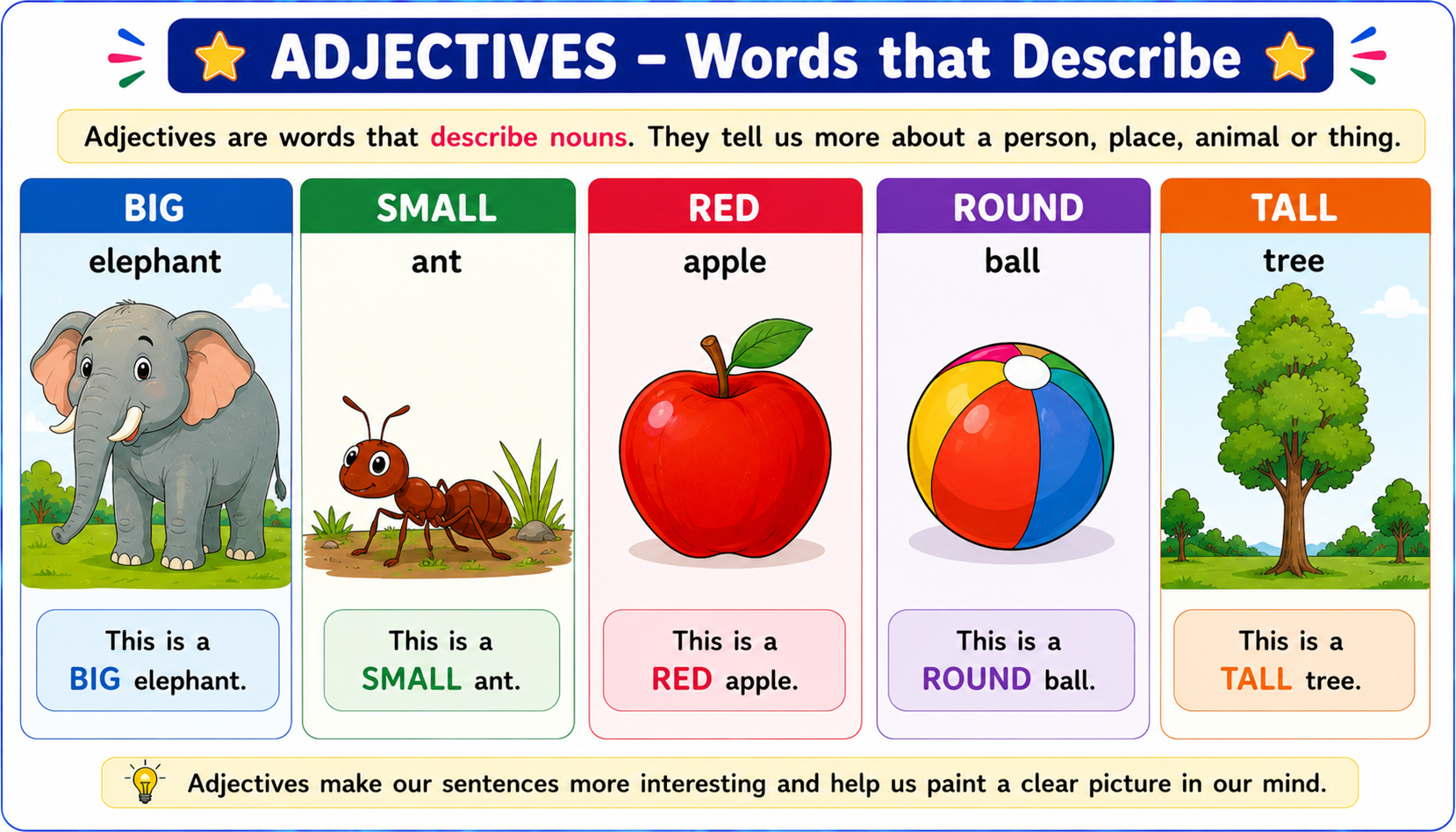
- What kind? → a beautiful rangoli, a kind teacher
- What colour? → a red apple, a blue sky
- What size? → a tall coconut tree, a small ant
- What shape? → a round ball, a square box
- How many? → five bananas, many stars
- What taste? → a sweet mango, a spicy samosa
Meena wore a beautiful dress. (What kind of dress? → beautiful)
Ravi has three pencils. (How many pencils? → three)
The tall coconut tree swayed in the wind. (What size? → tall)
Amma made spicy samosas for the party. (What taste? → spicy)
Types of Adjectives
Adjectives can be grouped into different types based on what they describe:
| Type | What It Tells | Examples |
|---|---|---|
| Size | How big or small | big, small, tall, short, long, tiny, huge, thin, fat, wide |
| Colour | What colour | red, blue, green, yellow, white, black, orange, pink, golden, brown |
| Shape | What shape | round, square, flat, oval, pointed, curved, triangular, straight |
| Number | How many | one, two, five, ten, many, few, several, some, all, no |
| Quality | What kind / nature | beautiful, kind, brave, clever, lazy, honest, naughty, gentle, strong |
| Taste | How it tastes | sweet, sour, salty, spicy, bitter, tasty, delicious, bland |
1. Adjectives of Size
These adjectives tell us how big or small something is.
The big elephant walked slowly through the forest.
A tiny ant carried a grain of rice on its back.
The tall coconut tree touched the clouds.
Riya has a short pencil and a long ruler.
The huge banyan tree in our school gives cool shade.
2. Adjectives of Colour
These adjectives tell us the colour of a noun.
The red rose bloomed in the garden.
Arjun flew a colourful kite on Makar Sankranti.
The green parrot sat on the mango tree.
Sita wore a yellow salwar on Basant Panchami.
The blue sky looked beautiful after the rain.
Our national flag has saffron, white, and green stripes.
3. Adjectives of Shape
These adjectives tell us the shape of a noun.
The round roti was soft and warm.
Amma gave me a square piece of barfi.
The oval mirror hung on the wall.
The flat dosa was crispy and golden.
The triangular samosa smelled delicious.
4. Adjectives of Number
These adjectives tell us how many things there are.
I have five fingers on each hand.
Many children played in the park.
There are twelve months in a year.
Some mangoes fell from the tree.
Several birds sat on the electric wire.
There are no clouds in the sky today.
5. Adjectives of Quality
These adjectives tell us the nature or quality of a noun — what kind of person, animal, or thing it is.
Gandhiji was a brave and honest leader.
The beautiful rangoli decorated the doorstep.
My grandmother is very kind and gentle.
The clever fox tricked the crow.
Ravi is a hardworking student.
The naughty monkey stole the bananas.
6. Adjectives of Taste
These adjectives tell us how something tastes.
The sweet mango is my favourite fruit.
Amma made spicy samosas for Diwali.
The sour lemon made my face twist.
The salty chips were crunchy and tasty.
The bitter medicine helped me get well.
Grandma's delicious kheer had cardamom and almonds.
Image: Objects with Adjective Labels
Position of Adjectives in a Sentence
Adjectives can appear in two positions in a sentence:
1. Before the Noun
The adjective comes just before the noun it describes.
The clever girl solved the puzzle. (clever → before "girl")
A colourful kite flew high in the sky. (colourful → before "kite")
I ate a sweet laddu. (sweet → before "laddu")
2. After "is" / "are" / "was" / "were"
The adjective comes after the verb "is," "are," "was," or "were."
The mango is sweet. (sweet → after "is")
The flowers are beautiful. (beautiful → after "are")
The samosa was spicy. (spicy → after "was")
The kites were colourful. (colourful → after "were")
Comparison of Adjectives (Degrees)
When we compare things, adjectives change their form. There are three degrees of comparison:
| Positive (one thing) | Comparative (two things) | Superlative (three or more) |
|---|---|---|
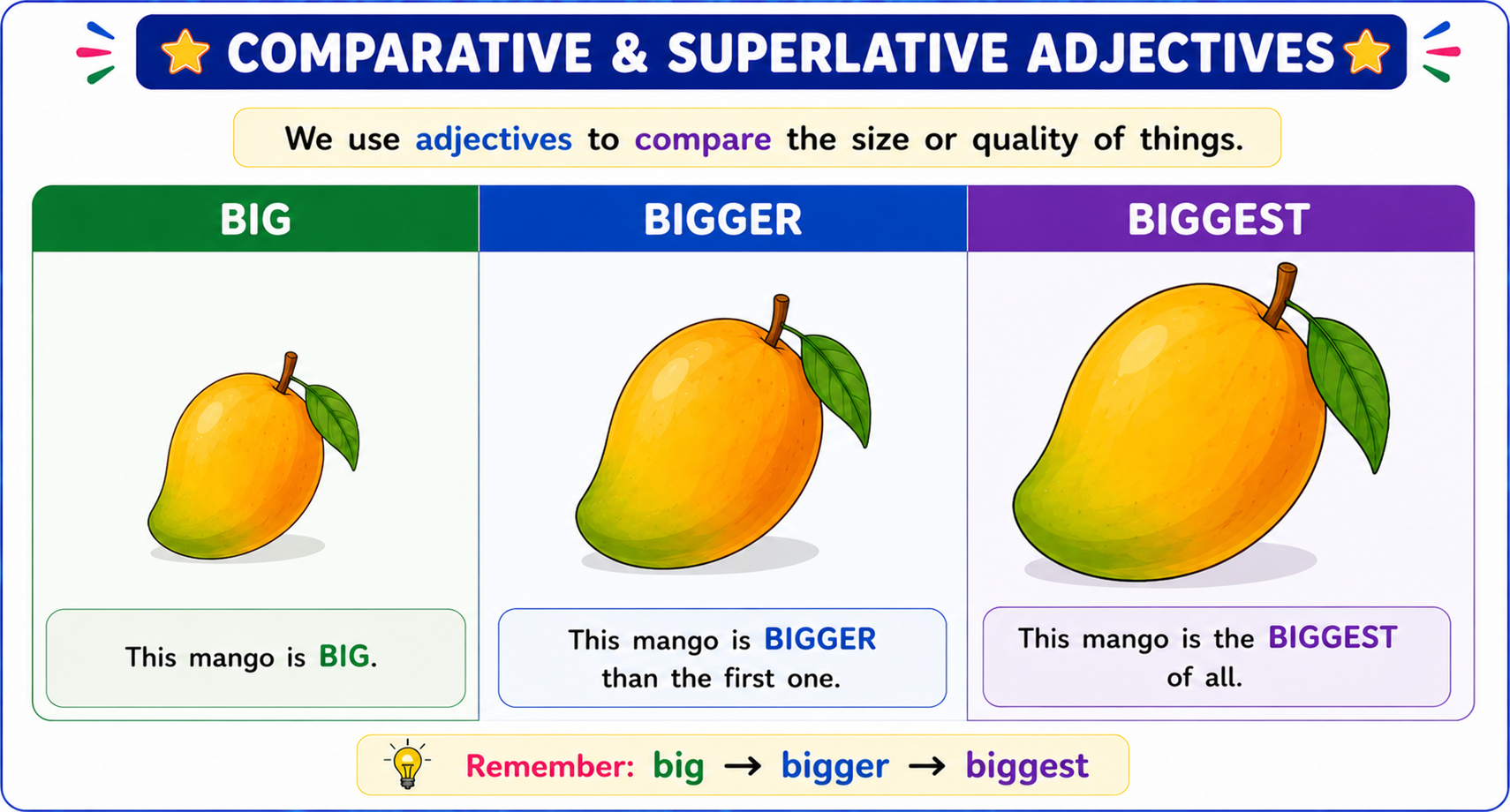
| big | bigger | biggest |
| tall | taller | tallest |
| small | smaller | smallest |
| sweet | sweeter | sweetest |
| fast | faster | fastest |
| kind | kinder | kindest |
| long | longer | longest |
| short | shorter | shortest |
Rules for forming comparatives and superlatives:
- Short adjectives: add -er (comparative) and -est (superlative). E.g., tall → taller → tallest
- Adjectives ending in "e": add -r and -st. E.g., large → larger → largest
- Adjectives ending in "y": change "y" to "i" and add -er / -est. E.g., happy → happier → happiest
- Short adjectives with one vowel + one consonant: double the last letter. E.g., big → bigger → biggest
Positive: The mango is sweet.
Comparative: This mango is sweeter than that one.
Superlative: This is the sweetest mango in the basket.
Positive: Ravi is tall.
Comparative: Arjun is taller than Ravi.
Superlative: Karan is the tallest boy in the class.
Image: Comparison Chart
Adjectives in Indian Life
We use adjectives every day to describe things around us. Here are some examples from Indian life:
| Noun | Adjective + Noun | Type of Adjective |
|---|---|---|
| samosa | spicy samosa | Taste |
| coconut tree | tall coconut tree | Size |
| rangoli | beautiful rangoli | Quality |
| kite | colourful kite | Quality / Colour |
| mango | sweet mango | Taste |
| Ganga | long river Ganga | Size |
| peacock | beautiful peacock | Quality |
| diya | small diya | Size |
| Taj Mahal | white Taj Mahal | Colour |
| laddoo | round laddoo | Shape |
📝 Key Words
| Word | Meaning |
|---|---|
| Adjective | A word that describes a noun (naming word) |
| Noun | A naming word — person, place, animal, or thing |
| Describe | To tell more about something — its colour, size, shape, etc. |
| Positive | The simple form of an adjective (big, tall, sweet) |
| Comparative | Used to compare two things (bigger, taller, sweeter) |
| Superlative | Used to compare three or more things (biggest, tallest, sweetest) |
| Quality | The nature or character of something (beautiful, kind, brave) |
| Degree | The level or form of comparison of an adjective |
⭐ Key Points to Remember
- An adjective is a describing word that tells us more about a noun.
- Adjectives answer: What kind? What colour? What size? What shape? How many? What taste?
- Types of adjectives: size, colour, shape, number, quality, taste.
- Adjectives can come before a noun (a red ball) or after is/are (the ball is red).
- We compare adjectives using three degrees: positive, comparative, superlative.
- For short adjectives, add -er (comparative) and -est (superlative).
- Adjectives make our sentences more interesting and descriptive.
- Every sentence can be improved by adding the right adjective!
✍️ Practice Questions
🎨 Fun Activity
Adjective Hunt!
Look around your home or classroom. Find 10 objects and write one adjective for each. Fill in the table below:
| Object (Noun) | Adjective | Full Phrase |
|---|---|---|
| Example: chair | wooden | a wooden chair |
| 1. | ||
| 2. | ||
| 3. | ||
| 4. | ||
| 5. | ||
| 6. | ||
| 7. | ||
| 8. | ||
| 9. | ||
| 10. |
Bonus: Now use any 3 of your adjective phrases to write 3 complete sentences!
Want a printable worksheet? Switch to the Worksheet View, then print.