Nouns
Learning Objectives
- Understand what a noun is and identify nouns in sentences.
- Differentiate between Common Nouns and Proper Nouns.
- Learn the capital letter rule for Proper Nouns.
- Identify and use Collective Nouns correctly.
- Understand Abstract Nouns — things we cannot see or touch.
- Identify nouns used as subjects and objects in sentences.
- Use nouns from Indian daily life in speaking and writing.
Introduction
Look around you. Everything has a name! The book on your desk, your friend Ravi, the city of Delhi, and even the feeling of happiness when you score well in a test — all these are nouns.
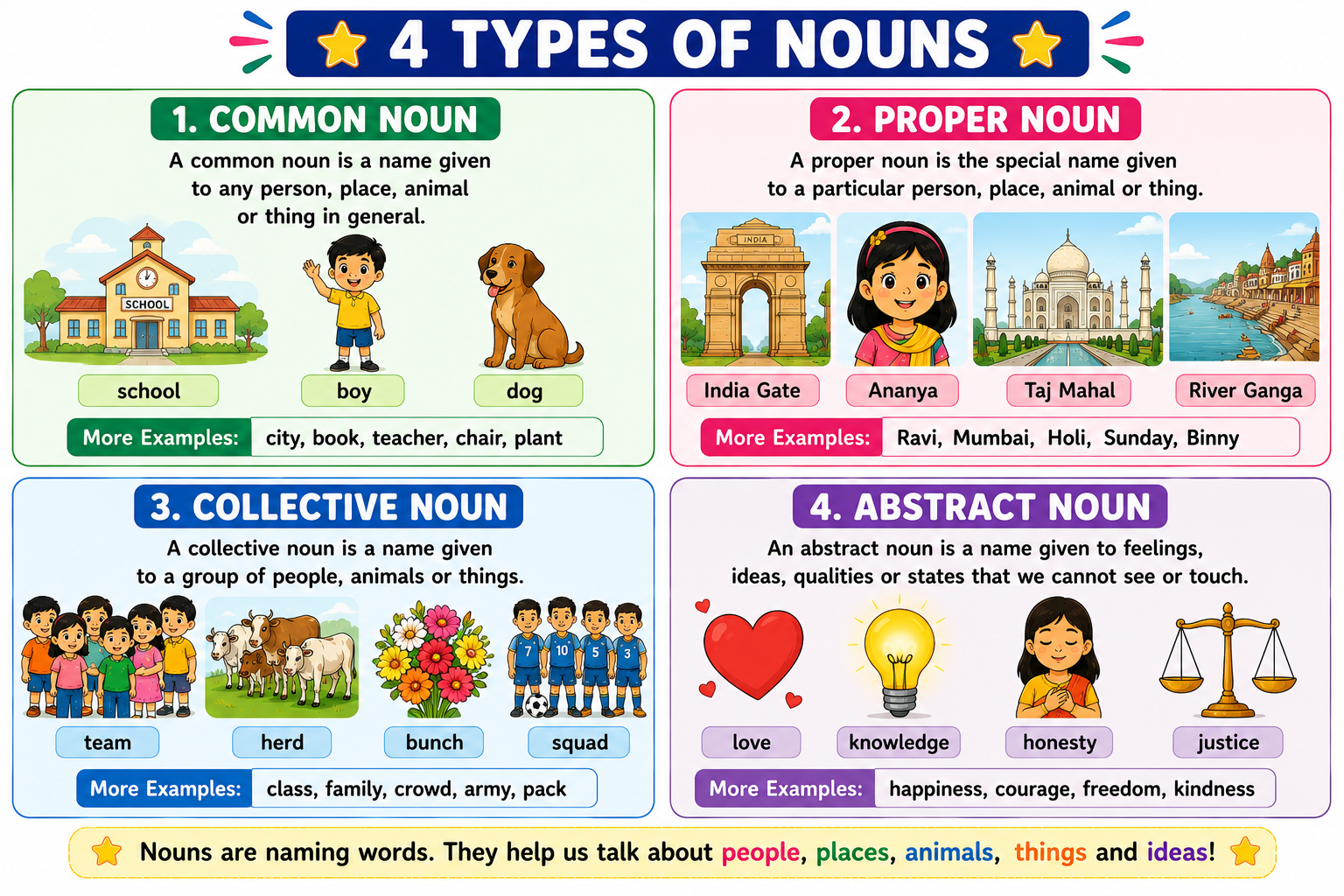
A noun is a naming word. It is the name of a person, place, animal, or thing. Without nouns, we cannot talk about anything! In Class 3, we will learn four types of nouns: Common Nouns, Proper Nouns, Collective Nouns, and Abstract Nouns.
What Is a Noun?
A noun is a word that names a person, place, animal, or thing. It is also called a naming word.
| Category | Examples |
|---|---|
| Person | Ravi, Meena, teacher, doctor, mother, farmer, Sita |
| Place | Delhi, school, Ganga, market, Taj Mahal, temple |
| Animal | peacock, elephant, tiger, parrot, cow, monkey |
| Thing | diya, rangoli, cricket bat, book, mango, train |
- Sita reads a book. (person, thing)
- The peacock dances in the garden. (animal, place)
- Ravi visited the Taj Mahal in Agra. (person, place, place)
- The elephant drinks water from the river. (animal, thing, place)
Common Nouns
A common noun is a general name for any person, place, animal, or thing. It does not name any particular one. Common nouns do not begin with a capital letter (unless they start a sentence).
- Persons: boy, girl, teacher, doctor, king, farmer
- Places: city, river, school, country, temple, market
- Animals: bird, fish, dog, cat, horse, snake
- Things: book, pen, lamp, ball, train, flower
In the sentence "The boy went to the market", the words boy and market are common nouns because they do not tell us which boy or which market.
Proper Nouns
A proper noun is the special name of a particular person, place, animal, or thing. Proper nouns always begin with a capital letter.
| Common Noun | Proper Noun |
|---|---|
| boy | Ravi, Arjun |
| girl | Meena, Sita |
| city | Delhi, Mumbai, Kolkata |
| river | Ganga, Yamuna, Brahmaputra |
| country | India, Japan, France |
| festival | Diwali, Holi, Eid, Christmas |
| monument | Taj Mahal, Red Fort, Qutub Minar |
| animal (pet) | Tommy (dog), Sheru (horse) |
Proper nouns ALWAYS start with a capital letter, no matter where they appear in a sentence.
- ✅ Meena lives in Delhi.
- ✅ We celebrate Diwali in October or November.
- ✅ The Ganga flows through Varanasi.
- ❌ meena lives in delhi. (Wrong! No capital letters.)
Common Nouns vs Proper Nouns
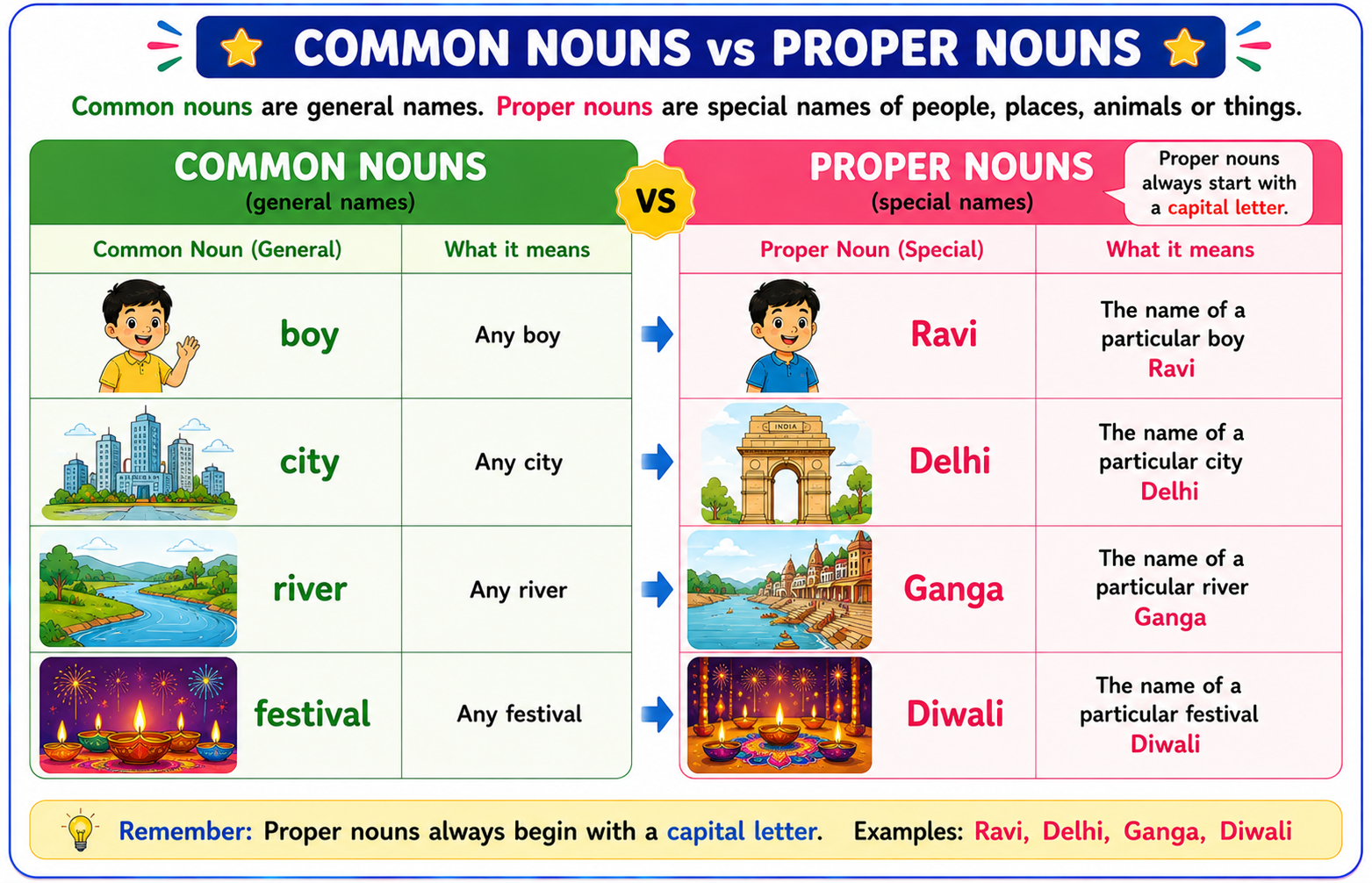
Here is an easy way to remember the difference:
| Feature | Common Noun | Proper Noun |
|---|---|---|
| What it names | Any person, place, animal, or thing | A particular/special one |
| Capital letter | No (unless starting a sentence) | Always starts with a capital letter |
| Example (person) | boy, girl, teacher | Ravi, Meena, Mrs. Sharma |
| Example (place) | city, river, park | Delhi, Ganga, Nehru Park |
| Example (thing) | book, game, festival | Ramayana, Cricket, Diwali |
Collective Nouns
A collective noun is a word that names a group or collection of people, animals, or things. Even though it talks about many, it is treated as one group.
| Collective Noun | What It Means |
|---|---|
| a flock of birds | a group of birds flying together |
| a bunch of grapes | many grapes together on a stem |
| a team of players | a group of players playing together |
| a herd of elephants | a group of elephants walking together |
| a pack of wolves | a group of wolves hunting together |
| a swarm of bees | a large group of bees flying together |
| a bouquet of flowers | a bunch of flowers tied together |
| a class of students | a group of students studying together |
| a fleet of ships | a group of ships sailing together |
| a library of books | a large collection of books |
| a crowd of people | many people gathered in one place |
| an army of soldiers | a large group of soldiers |
- A flock of birds flew over the Taj Mahal.
- Ravi bought a bunch of bananas from the market.
- The Indian cricket team won the match.
- A herd of elephants crossed the road in Kerala.
- Meena saw a swarm of bees near the mango tree.
Abstract Nouns
An abstract noun is the name of something that we cannot see, touch, hear, smell, or taste. It names a feeling, quality, idea, or state.
We can feel happiness, but we cannot hold it in our hands. We know what courage means, but we cannot put it in a box. These are abstract nouns!
| Type | Abstract Nouns |
|---|---|
| Feelings | happiness, sadness, anger, love, fear, joy, excitement |
| Qualities | courage, honesty, kindness, beauty, bravery, wisdom |
| Ideas | freedom, truth, peace, friendship, knowledge, education |
| States | childhood, sleep, health, hunger, silence, darkness |
- Mahatma Gandhi believed in truth and peace.
- Meena felt great happiness when she won the prize.
- The soldiers showed courage and bravery.
- Kindness makes the world a better place.
- Ravi's honesty made his teacher proud.
Four Types of Nouns — Summary
| Type of Noun | What It Names | Examples |
|---|---|---|
| Common Noun | Any person, place, animal, or thing (general name) | boy, city, bird, book |
| Proper Noun | A particular person, place, or thing (special name) | Ravi, Delhi, Ganga, Diwali |
| Collective Noun | A group or collection | a flock of birds, a team of players |
| Abstract Noun | A feeling, quality, or idea (cannot be touched) | happiness, courage, freedom |
Nouns as Subjects and Objects
In a sentence, a noun can be used as a subject (the doer of the action) or an object (the receiver of the action).
Object = Who or what receives the action
| Sentence | Subject (Doer) | Object (Receiver) |
|---|---|---|
| Ravi reads a book. | Ravi | book |
| The teacher praised Meena. | teacher | Meena |
| Sita bought a diya. | Sita | diya |
| The elephant ate sugarcane. | elephant | sugarcane |
| Arjun hit the cricket ball. | Arjun | cricket ball |
| Mother made rangoli. | Mother | rangoli |
Nouns from Indian Daily Life
| Category | Common Nouns | Proper Nouns |
|---|---|---|
| Persons | boy, girl, teacher, king, leader | Ravi, Meena, Sita, Mahatma Gandhi, Nehru |
| Places | city, river, monument, state, mountain | Delhi, Ganga, Taj Mahal, Kerala, Himalayas |
| Animals | bird, animal, fish, snake | Peacock (national bird), Tiger (national animal) |
| Things | lamp, design, bat, sweet, flag | Diya, Rangoli, Cricket bat, Ladoo, Tiranga |
| Festivals | festival, celebration, holiday | Diwali, Holi, Eid, Pongal, Baisakhi |
Key Words
| Word | Meaning |
|---|---|
| Noun | A word that names a person, place, animal, or thing |
| Common Noun | A general name (boy, city, river) — no capital letter needed |
| Proper Noun | A special/particular name (Ravi, Delhi, Ganga) — always starts with a capital letter |
| Collective Noun | A word that names a group (a flock of birds, a team of players) |
| Abstract Noun | A word that names something you cannot touch or see (happiness, courage, love) |
| Subject | The noun that does the action in a sentence |
| Object | The noun that receives the action in a sentence |
Key Points to Remember
- A noun is a naming word — it names a person, place, animal, or thing.
- Common nouns are general names: boy, city, river, book.
- Proper nouns are special names and always start with a capital letter: Ravi, Delhi, Ganga.
- Collective nouns name a group: a flock of birds, a bunch of grapes, a team of players.
- Abstract nouns name feelings, qualities, or ideas that cannot be touched: happiness, courage, freedom.
- A noun used as a subject does the action. A noun used as an object receives the action.
- Days, months, festivals, names of people and places are all proper nouns.
- Every sentence must have at least one noun.
Practice Questions
| Column A | Column B |
|---|---|
| 1. a flock of | a. players |
| 2. a team of | b. grapes |
| 3. a bunch of | c. elephants |
| 4. a herd of | d. birds |
| 5. a swarm of | e. bees |
Activity
Read the paragraph below and find all the nouns. Then sort them into the correct column.
"Sita and Ravi went to Delhi during Diwali. They saw a flock of birds near the Ganga. Sita felt great happiness. They bought a bunch of flowers and lit a diya at the temple."
| Common Noun | Proper Noun | Collective Noun | Abstract Noun |
|---|---|---|---|
Want to use this as a worksheet? Switch to the A4 printable view.