Punctuation
Learning Objectives
- Students will understand what punctuation is and why it is important.
- Students will learn to use the full stop (.) correctly.
- Students will learn to use the question mark (?) correctly.
- Students will learn to use the exclamation mark (!) correctly.
- Students will learn to use the comma (,) correctly.
- Students will learn to use the apostrophe (') for contractions and possession.
- Students will apply capital letters at the beginning of sentences and for proper nouns.
Introduction
Imagine reading a book with no full stops, no commas, and no question marks. It would be very confusing! Punctuation marks are special signs we use in writing to make our sentences clear and easy to read. They tell us where to stop, where to pause, and how to read a sentence — whether it is a question, a statement, or something exciting!
What Is Punctuation?
Punctuation means using special marks in writing to make the meaning clear. Without punctuation, sentences run into each other and become confusing.
ravi went to school he met meena they played together
Ravi went to school. He met Meena. They played together.
The Full Stop (.)
A full stop (also called a period) comes at the end of a statement — a sentence that tells us something.
My name is Arjun.
India is a beautiful country.
The sun rises in the east.
We go to school every day.
Rule: Every statement ends with a full stop.
The Question Mark (?)
A question mark comes at the end of a question — a sentence that asks something.
What is your name?
Where do you live?
Did you finish your homework?
How many states are there in India?
Rule: Every question ends with a question mark.
The Exclamation Mark (!)
An exclamation mark comes at the end of a sentence that shows strong feelings — surprise, excitement, anger, or joy.
What a beautiful rainbow!
Hurray, we won the match!
Oh no, I forgot my lunch box!
How tall that building is!
Rule: Use an exclamation mark for strong feelings or surprise.
The Comma (,)
A comma is used to show a short pause in a sentence. It separates items in a list or parts of a sentence.
I bought apples, bananas, mangoes, and oranges.
Ravi, Meena, Sita, and Arjun are friends.
Yes, I will come.
No, I don't want it.
Ravi, please sit down.
Come here, Meena.
The Apostrophe (')
An apostrophe is used in two ways:
1. Contractions (short forms) — when two words are joined and some letters are left out:
| Full Form | Short Form (Contraction) |
|---|---|
| I am | I'm |
| do not | don't |
| cannot | can't |
| it is | it's |
| we will | we'll |
| she is | she's |
2. Possession (showing ownership) — to show that something belongs to someone:
Ravi's book (the book belongs to Ravi)
Meena's bag (the bag belongs to Meena)
The cat's tail (the tail of the cat)
Capital Letters
We use a capital letter (big letter) in these cases:
- At the beginning of every sentence.
- For names of people: Ravi, Meena, Arjun, Sita.
- For names of places: India, Delhi, Mumbai, Ganga.
- For days and months: Monday, January, March.
- For the word I (always capital).
My name is Sita. I live in Delhi.
We celebrate Diwali in October.
Summary Chart
| Punctuation Mark | Name | When to Use | Example |
|---|---|---|---|
| . | Full Stop | End of a statement | I like mangoes. |
| ? | Question Mark | End of a question | Do you like mangoes? |
| ! | Exclamation Mark | Strong feelings | What a big mango! |
| , | Comma | Pause, lists, names | I like mangoes, bananas, and apples. |
| ' | Apostrophe | Contractions, possession | Ravi's book / don't |
Image: Punctuation Characters
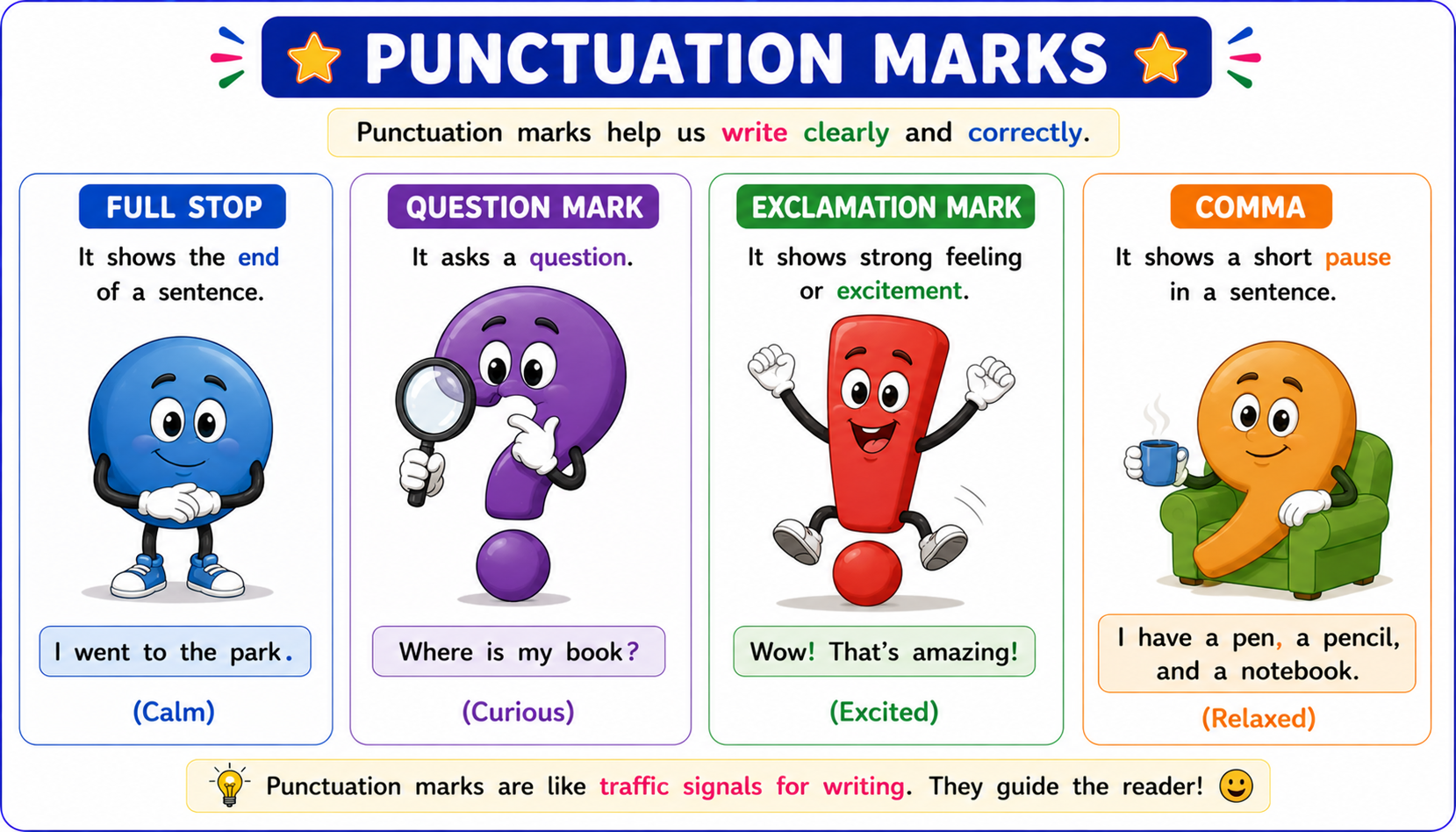
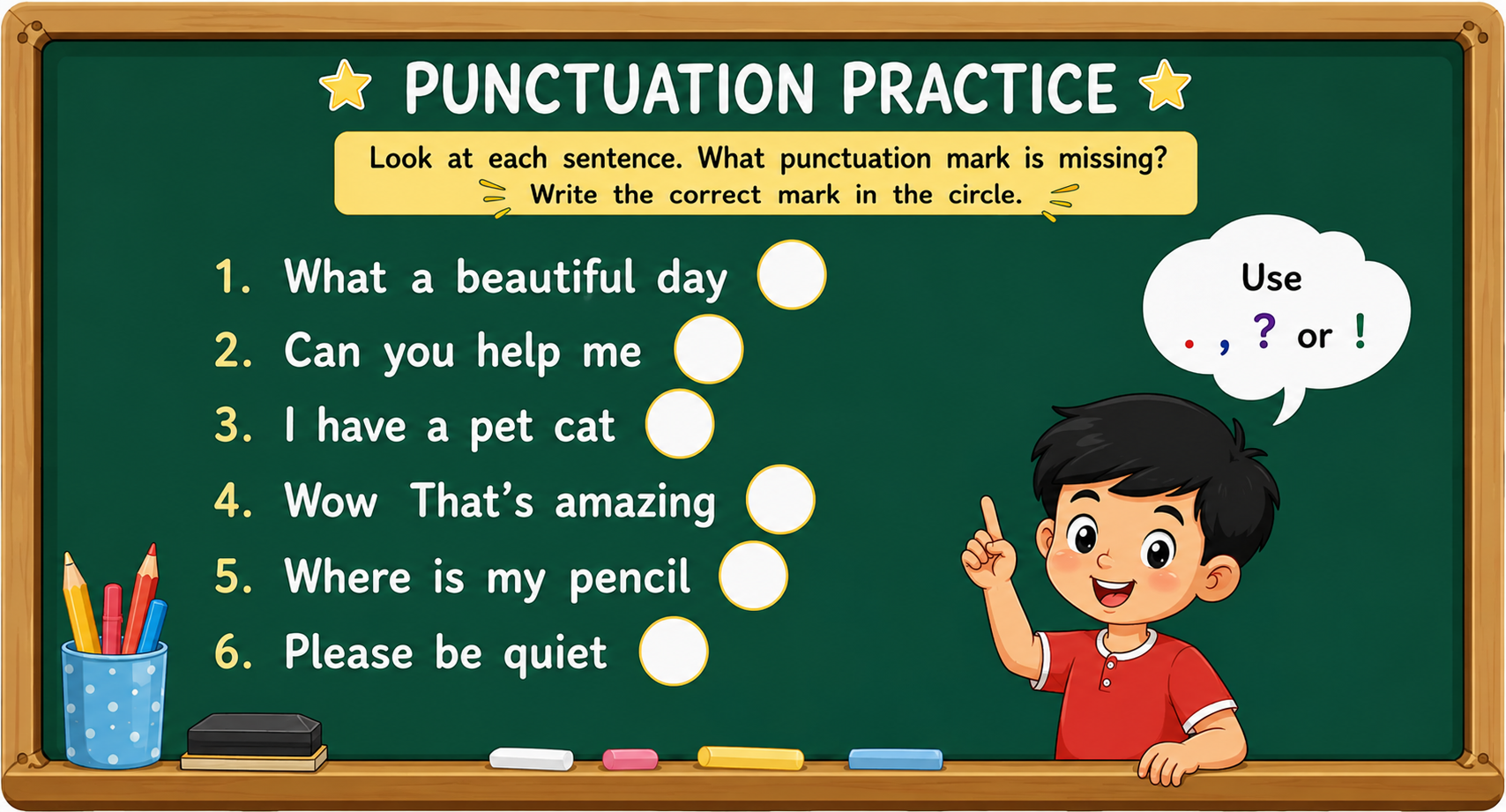
Image: Add the Missing Punctuation
Key Words
| Word | Meaning |
|---|---|
| Punctuation | Special marks used in writing to make meaning clear |
| Full stop (.) | Used at the end of a statement |
| Question mark (?) | Used at the end of a question |
| Exclamation mark (!) | Used for strong feelings or surprise |
| Comma (,) | Used for a pause or to separate items in a list |
| Apostrophe (') | Used for contractions and to show possession |
| Capital letter | A big letter used at the start of sentences and for names |
- Punctuation marks make our writing clear and easy to read.
- A full stop (.) ends a statement: I am Ravi.
- A question mark (?) ends a question: Where is Ravi?
- An exclamation mark (!) shows strong feelings: How beautiful!
- A comma (,) separates items in a list: apples, bananas, and mangoes.
- An apostrophe (') makes short forms (don't, can't) and shows ownership (Ravi's book).
- Always start a sentence with a capital letter.
Practice Questions
Read the paragraph below. It has 10 punctuation mistakes. Find them and rewrite the paragraph correctly.
ravi and meena went to the market they bought apples bananas and milk meena asked "do you want ice cream" ravi said "yes i love ice cream" what a fun day it was
Want a printable worksheet? Switch to the Worksheet View, then print.