English

Story Sequencing

Class 3 | Ages 8–9 | CBSE / NCERT / ICSE

🎯 Learning Objectives

📖 What is Story Sequencing?

Story sequencing means putting events or sentences in the correct order — the order in which they actually happen. Every story has a beginning, a middle, and an end. When we tell a story, we need to tell what happened first, what happened next, and what happened last.

Think about your morning routine: You wake up first, then you brush your teeth, next you take a bath, after that you eat breakfast, and finally you go to school. This is sequencing — putting events in order!

📋 Beginning, Middle, and End

Part of StoryWhat HappensExample (Making Chai)
BeginningThe story starts. We learn who, where, and what is about to happen.Amma decided to make chai for the family.
MiddleThe main events happen. Things change or problems occur.She boiled water, added tea leaves, sugar, and milk.
EndThe story finishes. The problem is solved or the activity is complete.She poured the hot chai into cups and everyone enjoyed it.

💡 Sequence Words

Sequence words are special words that tell us the order of events. They help the reader understand what happened first, next, and last.

Sequence WordWhen to UseExample
FirstThe very first thing that happensFirst, Ravi woke up early in the morning.
ThenThe next thing that happensThen, he brushed his teeth and washed his face.
NextAfter that eventNext, he wore his school uniform.
After thatFollowing the previous eventAfter that, he ate his breakfast of idli and chutney.
Finally / At lastThe last thing that happensFinally, he picked up his bag and went to school.

Other useful sequence words: before, later, soon, meanwhile, in the beginning, at the end, once, one day, the next day, afterwards
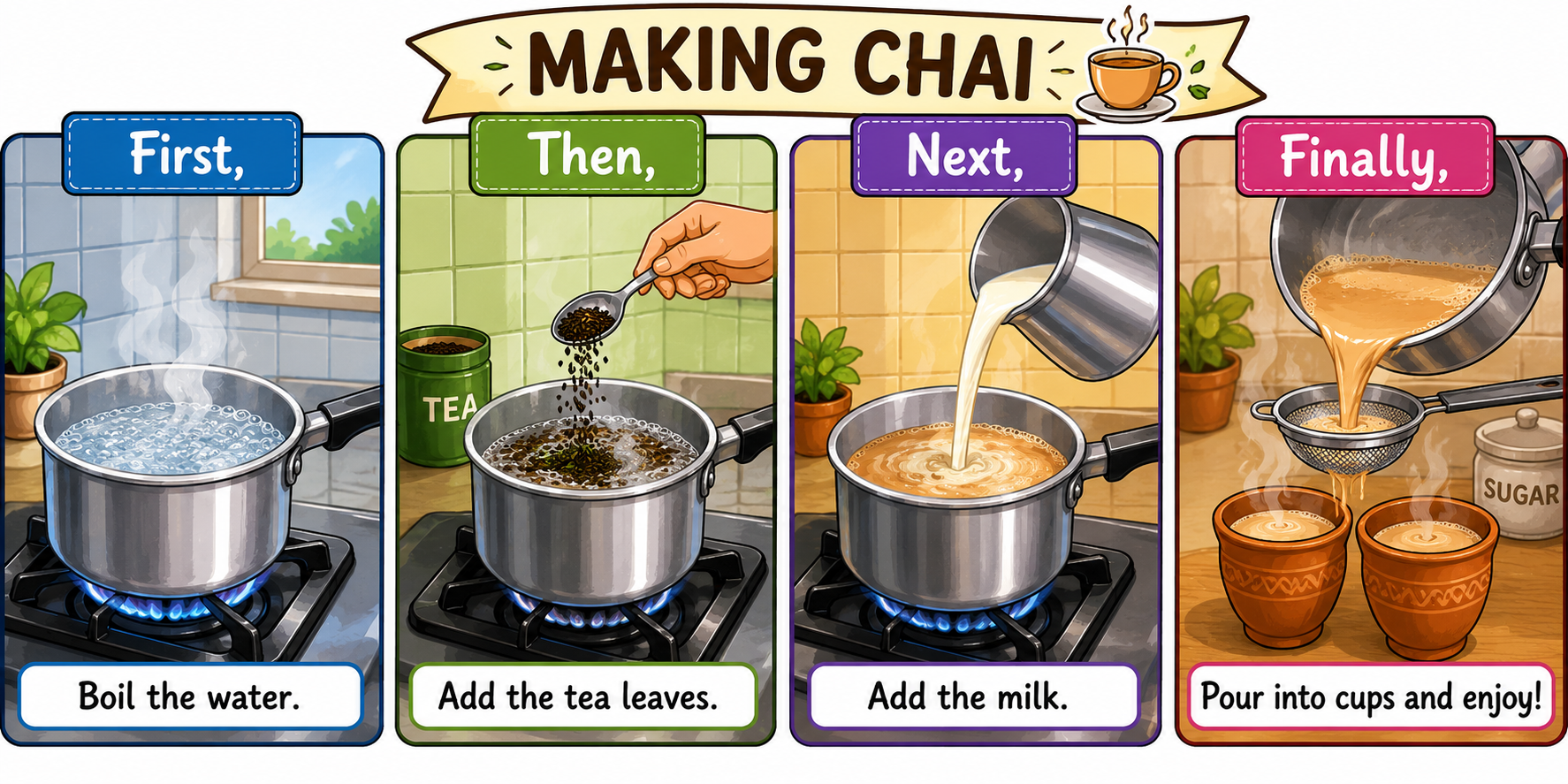
Four panels showing story sequence of making chai - boiling water, adding tea leaves, adding milk, pouring into cups

📗 Example 1: A Day at School

First, Meena woke up at 6:30 in the morning and got ready for school.

Then, her mother gave her a lunch box with rice, dal, and an apple.

Next, the school bus came and Meena sat with her best friend Priya.

After that, they reached school and the morning assembly began with a prayer.

Finally, classes started and Meena's favourite subject, English, was the first period.

📗 Example 2: Making Chai

First, Amma put water in a pot and placed it on the stove.

Then, she added two spoons of tea leaves and some sugar.

Next, she added milk and let it boil for two minutes.

After that, she strained the chai through a strainer into cups.

Finally, the whole family sat together and enjoyed the hot chai with biscuits.

📗 Example 3: Celebrating Diwali

First, the family cleaned the entire house and threw away old things.

Then, they went to the market and bought new clothes, sweets, and diyas.

Next, on Diwali evening, they made rangoli at the entrance and lit diyas all around the house.

After that, the family did Lakshmi Puja together and prayed for happiness.

Finally, they burst crackers, shared sweets with neighbours, and ate a delicious dinner.

📋 Putting Jumbled Sentences in Order

Sometimes you will be given sentences that are mixed up (jumbled). Your job is to read all the sentences, think about what happened first, next, and last, and then number them in the correct order.

Jumbled sentences:

( ) He ate his breakfast and picked up his school bag.

( ) Arjun woke up when his alarm rang at 6 AM.

( ) He walked to the bus stop and waited for the school bus.

( ) He brushed his teeth and took a bath.

( ) He reached school just before the bell rang.

Correct order: 2, 1 → Wait, let's think again...

Answer: (4) → (1) → (3) → (2) → (5)

Correct sequence: Woke up → Brushed teeth → Ate breakfast → Walked to bus stop → Reached school
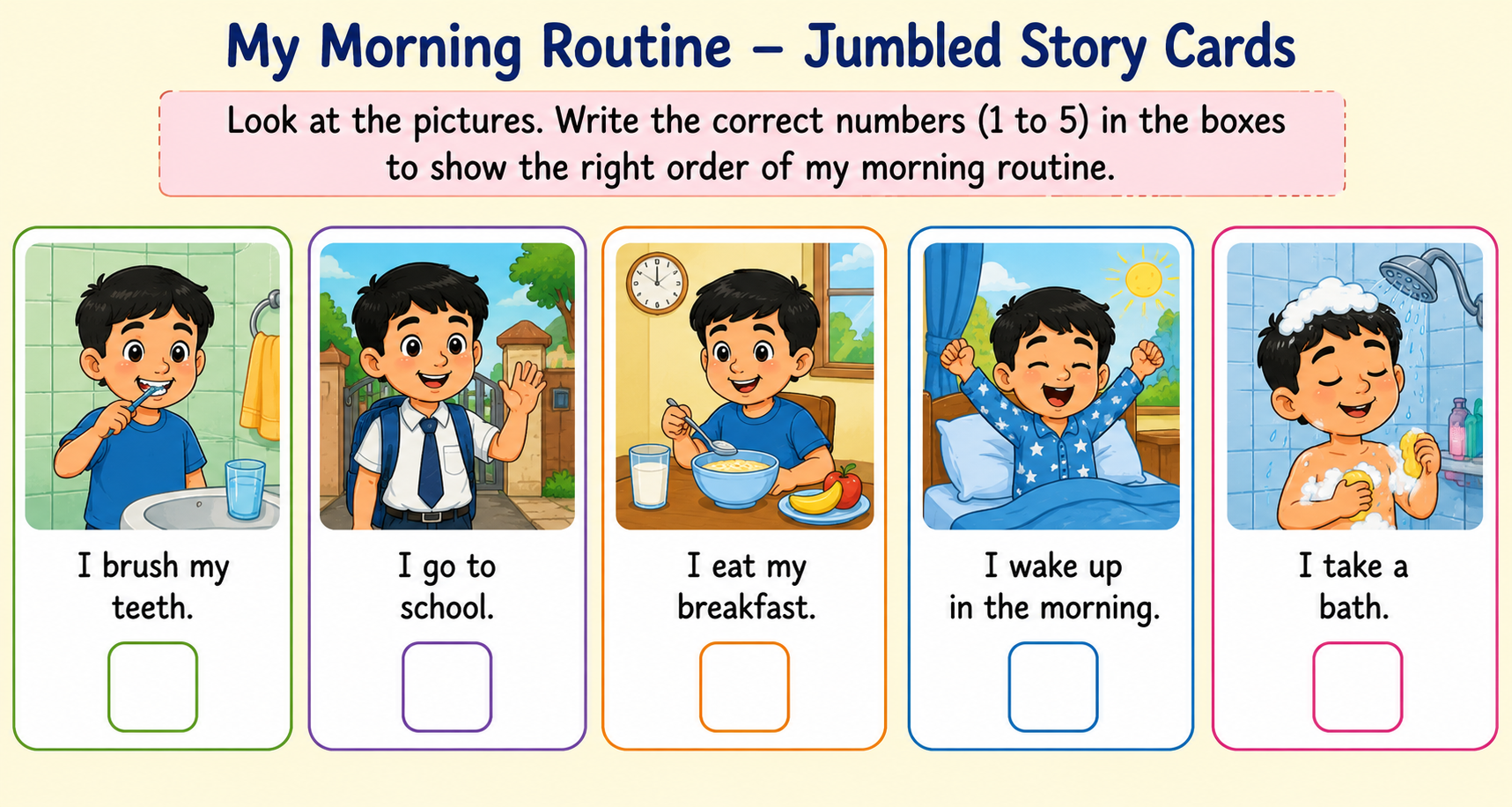
Jumbled story cards showing events of a morning routine for students to arrange in order

📝 Key Words

WordMeaning
SequenceThe order in which things happen (first, second, third...)
OrderArrangement from first to last
BeginningThe start of a story
MiddleThe main part of a story where events happen
EndThe finish or conclusion of a story
JumbledMixed up, not in the correct order
EventSomething that happens
LogicalMaking sense, in a sensible order
⭐ Key Points to Remember

✏️ Practice Questions

A. Fill in the Blanks (10 questions)
1. Story sequencing means putting events in the correct .
2. Every story has a beginning, , and end.
3. "" is the sequence word we use for the very first event.
4. "" is the sequence word we use for the last event.
5. "Then" and "next" tell us what happens the first event.
6. Jumbled sentences are sentences that are up.
7. Events should be in a order (making sense).
8. The beginning of a story tells us the story is about.
9. The of a story is where the main events happen.
10. Sequence words help the follow the story easily.
B. True or False (5 questions)
1. Story sequencing means writing events in any random order.
2. "Finally" is used for the last event in a sequence.
3. A story does not need a beginning.
4. "First" is used for the event that happens at the start.
5. Jumbled sentences are already in the correct order.
C. Choose the Correct Answer (5 questions)
1. Which sequence word comes first?
(a) Finally(b) Then(c) First(d) After that
2. Which sequence word is used for the last event?
(a) First(b) Next(c) Then(d) Finally
3. What are the three parts of a story?
(a) Top, bottom, side(b) Beginning, middle, end(c) First, second, third(d) Morning, afternoon, night
4. What does "jumbled" mean?
(a) In order(b) Mixed up(c) Very long(d) Very short
5. Which comes first in making chai?
(a) Pour into cups(b) Add milk(c) Boil water(d) Strain the tea
D. Arrange in Correct Order (5 questions)

Number these sentences 1 to 5 in the correct order:

Story: Planting a Seed

( ) Water the seed every day.
( ) Dig a small hole in the soil.
( ) A small plant grows out of the soil.
( ) Put the seed in the hole and cover it with soil.
( ) Get a seed and a pot with soil.
E. Write a Short Story Using Sequence Words (5 questions)
1. Write what you do after waking up using "First, Then, Next, After that, Finally."
2. What are sequence words? Give three examples.
3. What happens in the "beginning" of a story?
4. Write the steps of brushing your teeth using sequence words.
5. Why is it important to put events in the correct order?

🎨 Activity: My Festival Story

Think about a festival you celebrated recently (Diwali, Eid, Christmas, Holi, Pongal, or any other). Write a short story about how you celebrated it using sequence words. Write at least 5 sentences.

Use these words: First... Then... Next... After that... Finally...

Think about: What did you do first? What did you wear? What did you eat? Who was with you? What was the best part?

Want a printable worksheet? Switch to the Worksheet View, then print.

English

Story Sequencing

Class 3  |  CBSE / NCERT / ICSE
Name: Class / Sec: Date:
📖 What is Story Sequencing?

Story sequencing means putting events or sentences in the correct order — the order in which they actually happen. Every story has a beginning, a middle, and an end.

Think about your morning: You wake up first, then brush your teeth, next take a bath, after that eat breakfast, and finally go to school.

📋 Beginning, Middle, and End
PartWhat HappensExample (Making Chai)
BeginningStory starts — who, where, whatAmma decided to make chai.
MiddleMain events happenShe boiled water, added tea, sugar, milk.
EndStory finishesEveryone enjoyed the hot chai.
💡 Sequence Words
WordWhen to UseExample
FirstVery first eventFirst, Ravi woke up early.
ThenNext eventThen, he brushed his teeth.
NextAfter thatNext, he wore his uniform.
After thatFollowing eventAfter that, he ate breakfast.
FinallyLast eventFinally, he went to school.
Story sequence - making chai
📗 Example: Celebrating Diwali

First, the family cleaned the house and threw away old things.

Then, they went to the market and bought new clothes, sweets, and diyas.

Next, on Diwali evening, they made rangoli and lit diyas all around.

After that, the family did Lakshmi Puja together.

Finally, they burst crackers, shared sweets, and ate a delicious dinner.

📋 Putting Jumbled Sentences in Order

Read all sentences first, think about what happened first, next, and last, then number them in order.

Story sequence cards to arrange
📝 Key Words
WordMeaning
SequenceThe order in which things happen
OrderArrangement from first to last
BeginningThe start of a story
MiddleThe main part of a story
EndThe finish of a story
JumbledMixed up, not in correct order
EventSomething that happens
LogicalMaking sense, sensible order
⭐ Key Points to Remember
  • Story sequencing means putting events in the correct order.
  • Every story has a beginning, middle, and end.
  • Use sequence words: first, then, next, after that, finally.
  • Events happen in a logical order — think about what makes sense.
  • Read all jumbled sentences first, then decide the order.
  • Sequence words help the reader follow the story easily.
  • Practice with everyday activities: cooking, getting ready, festivals.
English

Story Sequencing (Practice)

Class 3  |  CBSE / NCERT / ICSE
Name: Class / Sec: Date:
A. Fill in the Blanks
1. Story sequencing means putting events in the correct .
2. Every story has a beginning, , and end.
3. "" is the sequence word for the very first event.
4. "" is the sequence word for the last event.
5. "Then" and "next" tell us what happens the first event.
6. Jumbled sentences are sentences that are up.
7. Events should be in a order.
8. The beginning tells us the story is about.
9. The is where the main events happen.
10. Sequence words help the follow the story.
B. True or False
1. Story sequencing means writing events in any random order.
2. "Finally" is used for the last event.
3. A story does not need a beginning.
4. "First" is used for the event at the start.
5. Jumbled sentences are already in correct order.
C. Choose the Correct Answer
1. Which sequence word comes first?
(a) Finally(b) Then(c) First(d) After that
2. Which word is used for the last event?
(a) First(b) Next(c) Then(d) Finally
3. What are the three parts of a story?
(a) Top, bottom, side(b) Beginning, middle, end(c) First, second, third(d) Morning, afternoon, night
4. What does "jumbled" mean?
(a) In order(b) Mixed up(c) Very long(d) Very short
5. Which comes first in making chai?
(a) Pour into cups(b) Add milk(c) Boil water(d) Strain the tea
D. Arrange in Correct Order (write 1–5)

Story: Planting a Seed

( ) Water the seed every day.
( ) Dig a small hole in the soil.
( ) A small plant grows out of the soil.
( ) Put the seed in the hole and cover it.
( ) Get a seed and a pot with soil.
E. Write Using Sequence Words
1. Write what you do after waking up (use First, Then, Next, After that, Finally).
2. What are sequence words? Give three examples.
3. What happens in the "beginning" of a story?
4. Write the steps of brushing your teeth using sequence words.
5. Why is it important to put events in the correct order?
🎨 Activity: My Festival Story

Write about a festival you celebrated using: First... Then... Next... After that... Finally...

You are viewing the Worksheet layout. Click Print to save as PDF or print on A4 paper.