Air Around Us
Learning Objectives
- I can explain that air is everywhere around us.
- I can describe the properties of air.
- I can name the gases that make up air.
- I can list the uses of air in daily life.
- I can explain what wind is and how it helps us.
- I can describe air pollution and ways to keep air clean.
Let Us Begin!
Can you see air? No! Can you hold air in your hands? No! But when you blow up a balloon, what fills it up? Air!
Air is all around us — inside our homes, in our classrooms, in the playground, and even inside an empty bottle. We cannot see it, taste it, or smell it, but we can feel it when the wind blows.
Without air, no living thing — not humans, not animals, not even plants — can survive. Let us learn more about this amazing thing called air!
What is Air?
Air is a mixture of gases that surrounds the Earth. This layer of air around the Earth is called the atmosphere. Air has no colour, no taste, and no smell. But it is real — it has weight and takes up space.
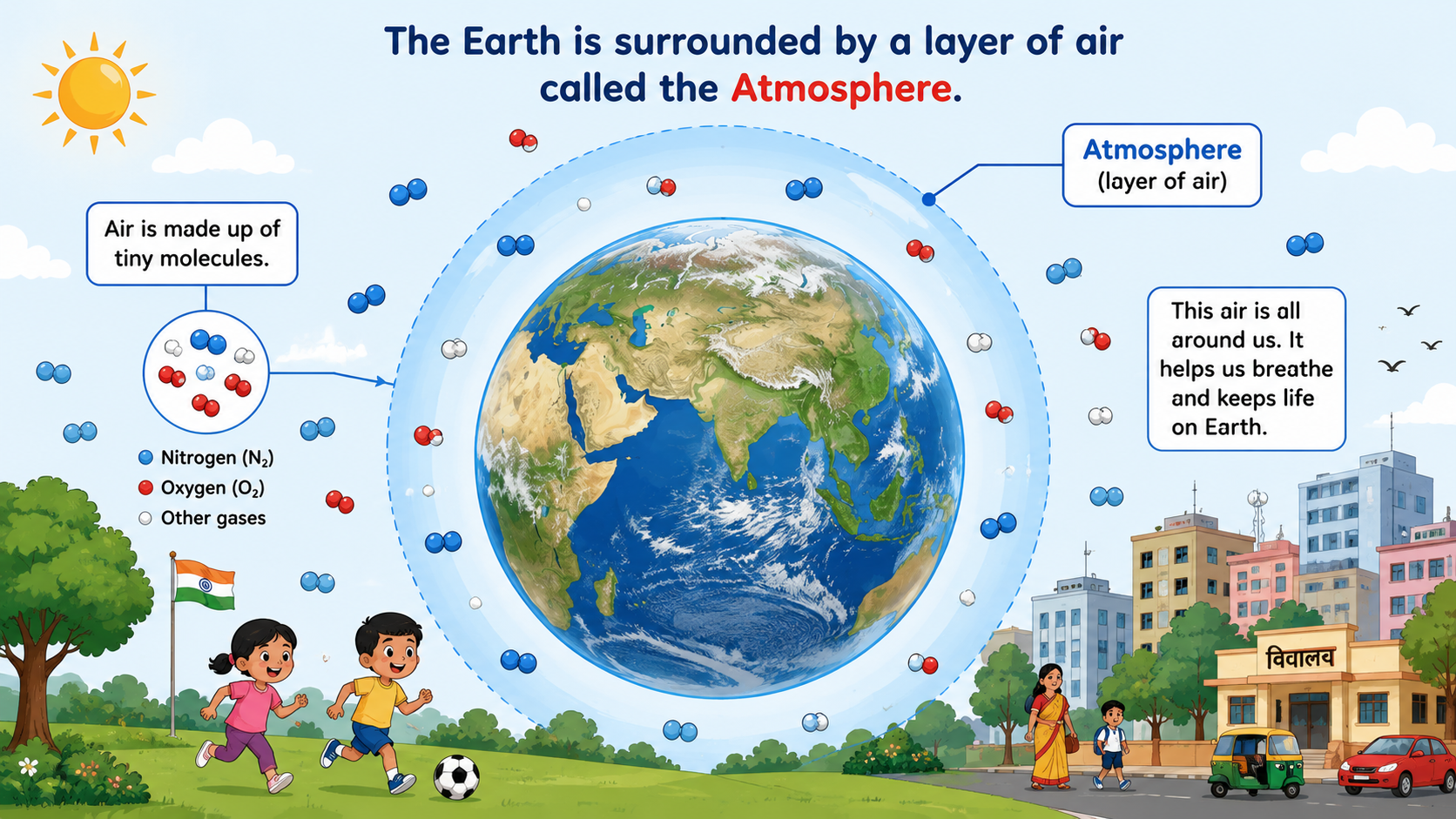
Air is Everywhere
Air fills every empty space around us. There is air:
- Inside our homes and classrooms
- Inside an empty glass or bottle
- Inside a football, bicycle tyre, and car tyre
- Inside a packet of chips (that's why it feels puffy!)
- Between the pages of a book
- In soil — earthworms breathe this air
- Dissolved in water — fish breathe this air
Properties of Air
Even though we cannot see air, it has many properties:
| Property | Explanation | How We Know |
|---|---|---|
| Air takes up space | Air fills any container it is in | Blow into a balloon — it gets bigger |
| Air has weight | Air is not weightless — it presses down on us | A blown-up balloon weighs more than a flat one |
| Air has no colour | We cannot see air | Look around — air is invisible |
| Air has no shape | Air takes the shape of its container | Air fills a round balloon or a square box |
| Air can be compressed | Air can be squeezed into a smaller space | Bicycle pump pushes air into a tyre |
| Air exerts pressure | Air pushes on things from all sides | Wind blows things away; air keeps tyres firm |
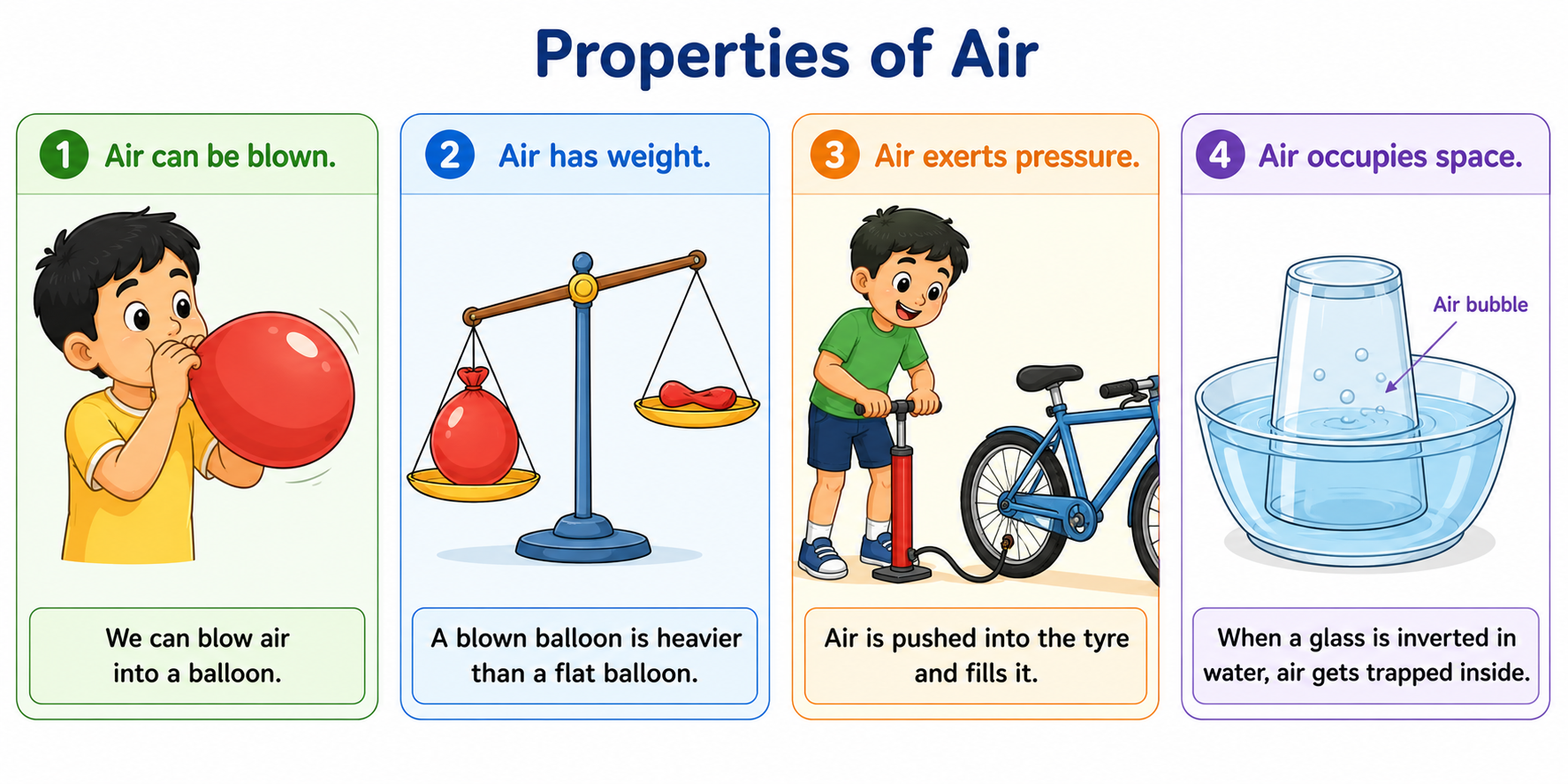
What you need: An empty glass, a bucket of water, a tissue paper.
What to do: Stick a tissue paper inside the bottom of the glass. Push the glass straight down (upside down) into the bucket of water. Pull it out.
What happens: The tissue stays dry! The air inside the glass did not let the water come in. This proves air takes up space.
What is Air Made Of?
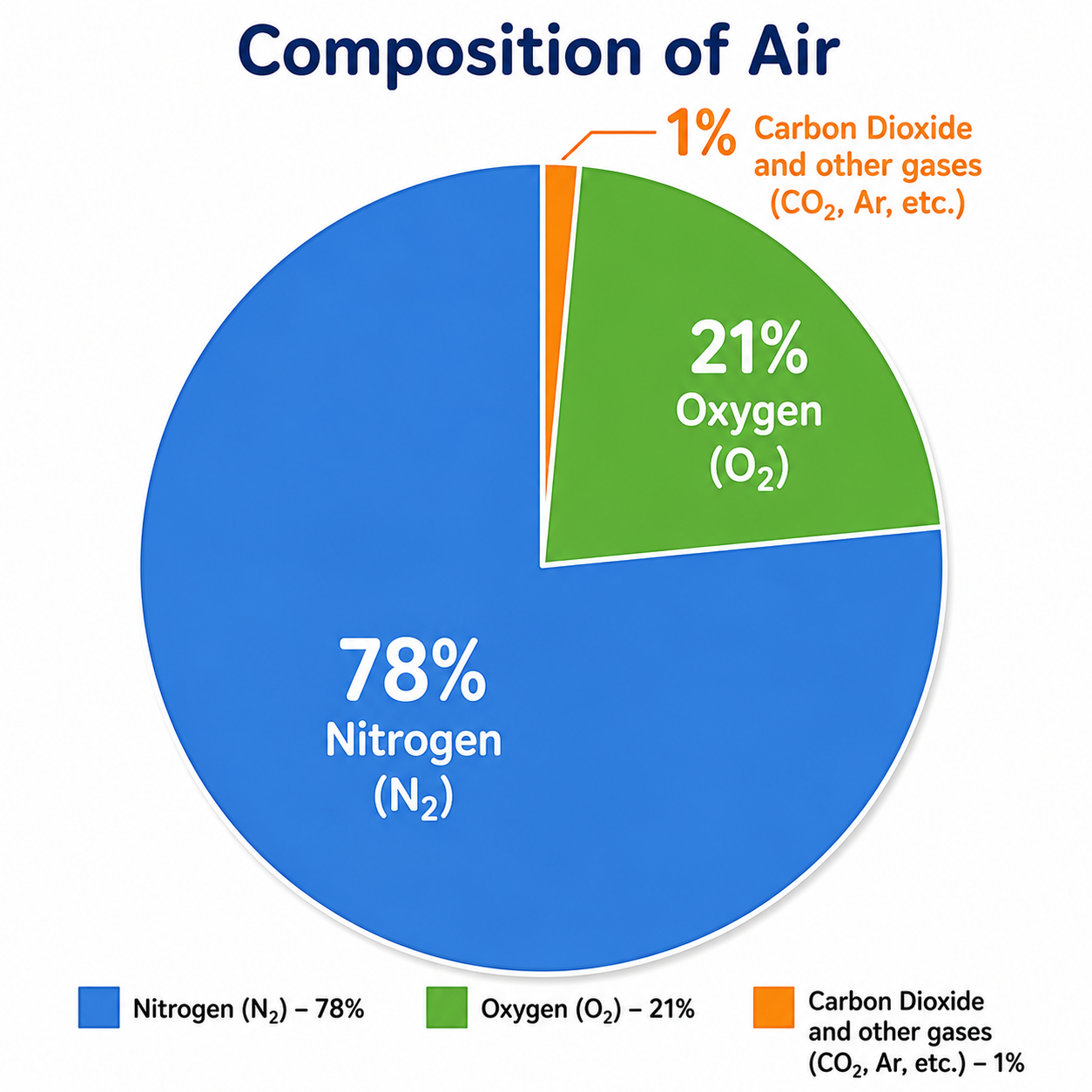
Air is not just one gas — it is a mixture of many gases. The main gases in air are:
| Gas | Amount in Air | What It Does |
|---|---|---|
| Nitrogen | About 78% (most of the air) | Helps plants grow; makes air less reactive |
| Oxygen | About 21% | We breathe oxygen to stay alive; fire needs oxygen to burn |
| Carbon Dioxide | A very small amount (0.04%) | Plants use it to make food; too much causes global warming |
| Water Vapour | Varies (depends on weather) | Forms clouds, fog, and dew |
| Other gases | Very tiny amounts | Argon, neon, helium — used in lights and balloons |
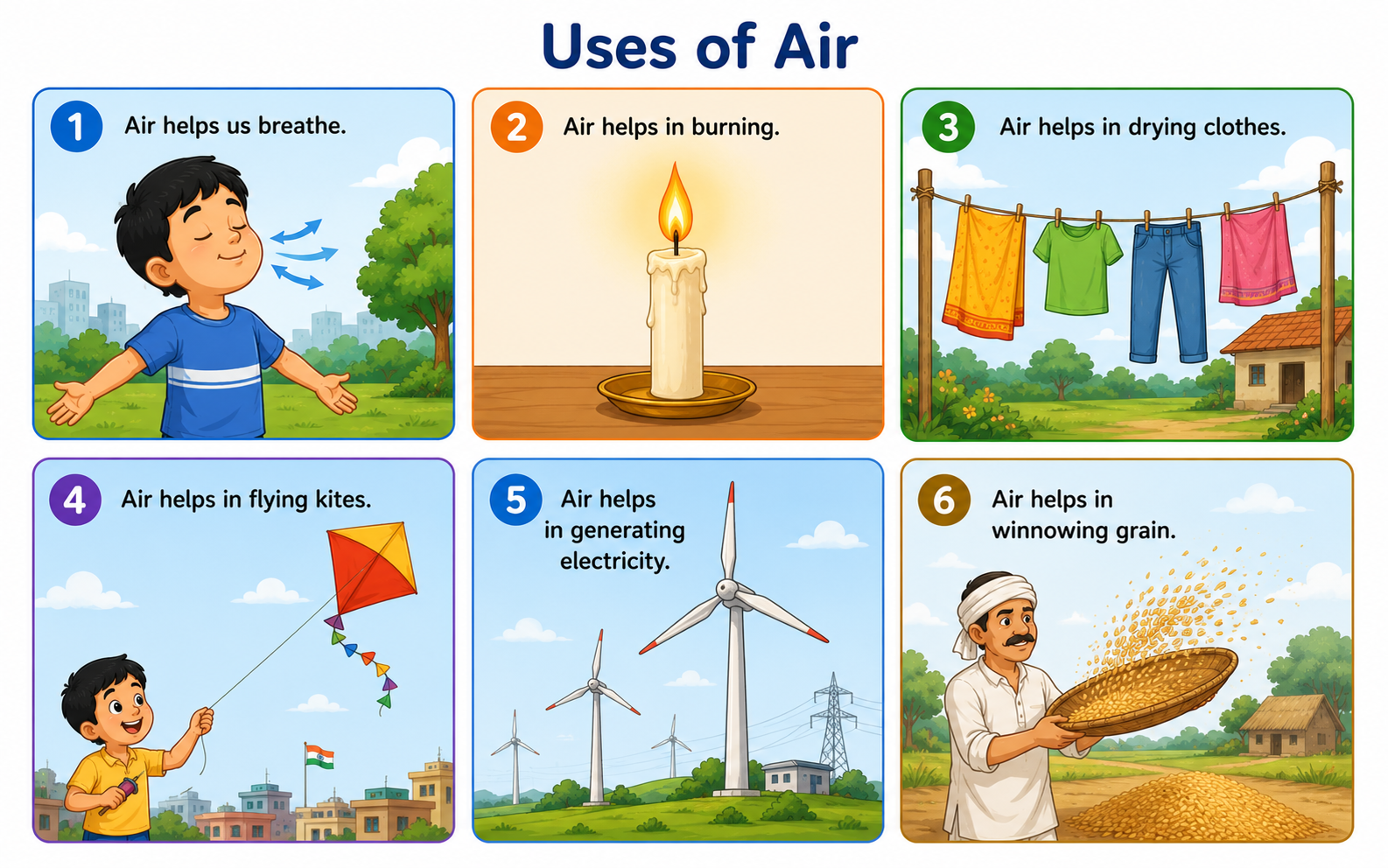
Uses of Air
Air is useful in many ways in our daily life:
| Use | How Air Helps | Example |
|---|---|---|
| Breathing | All living things need oxygen from air to breathe | We breathe about 15 times per minute |
| Burning | Fire needs oxygen from air to burn | A candle goes out if covered with a glass (no air) |
| Drying clothes | Moving air carries away moisture | Clothes dry faster on a windy day |
| Flying kites | Wind lifts kites into the sky | Makar Sankranti kite festival in Gujarat |
| Wind energy | Windmills convert wind into electricity | Wind farms in Rajasthan and Tamil Nadu |
| Sailing boats | Wind pushes the sails of boats | Boats in Kerala's backwaters |
| Filling tyres | Compressed air keeps tyres firm | Bicycle, car, and bus tyres |
| Musical instruments | Air vibrates to make sound | Flute, shehnai, harmonium |
| Spreading seeds | Wind carries seeds to new places | Dandelion seeds fly in the wind |
| Winnowing | Farmers use wind to separate grain from husk | Traditional farming in Indian villages |
Wind — Moving Air
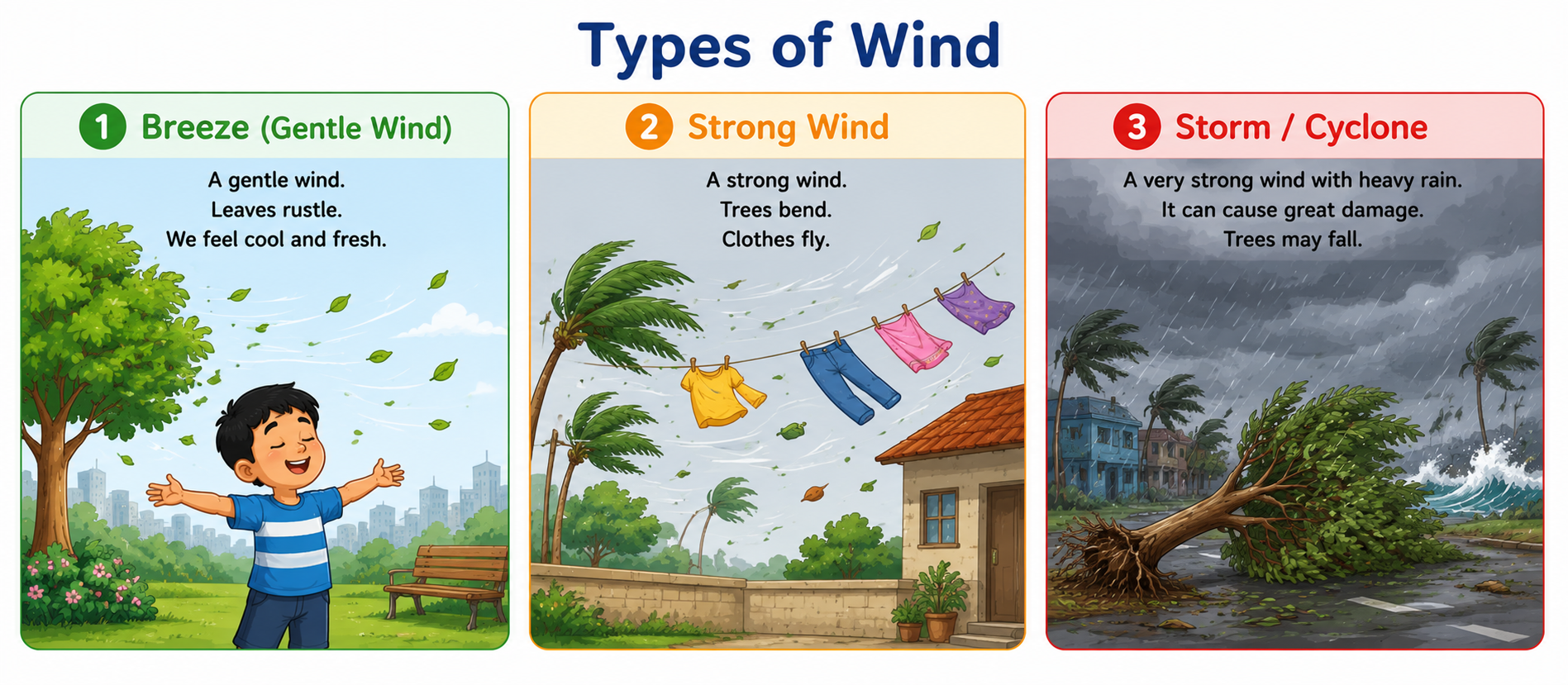
When air moves from one place to another, we call it wind. Wind is caused when the Sun heats the air unevenly — warm air rises up and cool air rushes in to take its place.
| Type of Wind | Speed | What It Does |
|---|---|---|
| Breeze | Gentle, slow | Feels pleasant; rustles leaves |
| Strong wind | Fast | Bends trees; blows things away |
| Storm / Cyclone | Very fast, dangerous | Uproots trees; damages houses |
How Wind Helps Us:
- Dries our clothes on the clothesline
- Helps kites fly during festivals
- Turns windmills to generate electricity
- Helps birds glide in the sky
- Carries pollen from flower to flower (pollination)
- Spreads seeds to new places
- Sailors use wind to move their boats
When Wind is Harmful:
- Strong storms can uproot trees and damage houses
- Cyclones cause flooding and destruction (Cyclone Fani hit Odisha in 2019)
- Dust storms reduce visibility and cause accidents
- Strong winds can spread forest fires
Air Pollution
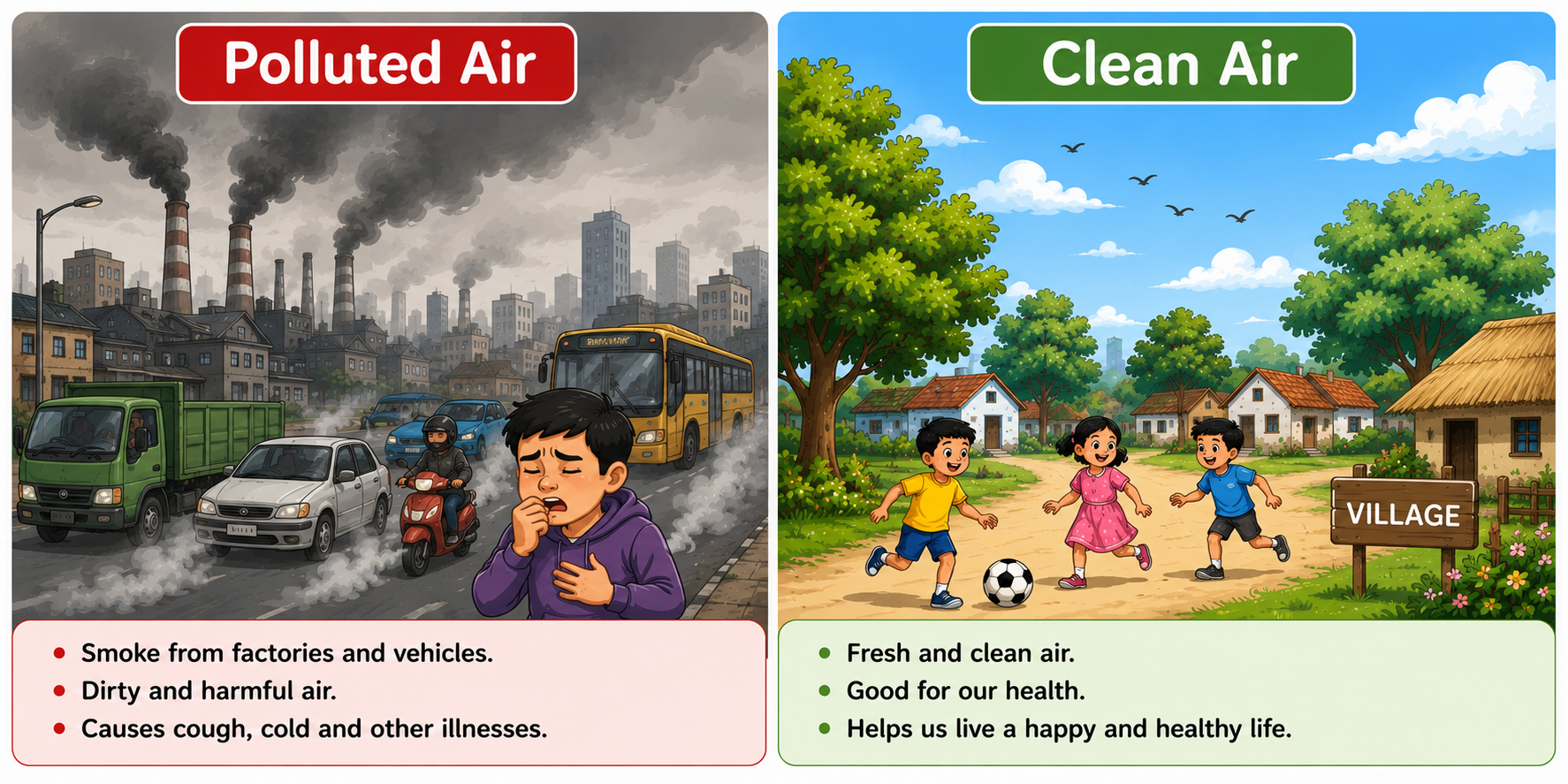
When harmful gases, smoke, and dust mix with air, it becomes polluted. Polluted air is dirty air that is harmful to breathe.
Causes of Air Pollution:
| Cause | How It Pollutes Air |
|---|---|
| Vehicle smoke | Cars, buses, trucks release harmful gases from their exhaust pipes |
| Factory smoke | Factories release smoke and chemicals into the air |
| Burning garbage | Burning waste releases toxic smoke |
| Firecrackers | Crackers during Diwali release smoke and harmful particles |
| Cutting trees | Fewer trees means less oxygen and more carbon dioxide |
| Dust from construction | Building work creates dust that mixes with air |
Effects of Air Pollution:
- Causes coughing, asthma, and breathing problems
- Makes eyes water and itch
- Harms plants and animals
- Creates smog (smoky fog) in cities like Delhi in winter
- Causes global warming (Earth getting hotter)
How to Keep Air Clean:
- 🌳 Plant more trees — trees absorb carbon dioxide and give oxygen
- 🚲 Walk or cycle for short distances instead of using cars
- 🚌 Use public transport (bus, metro) instead of private cars
- 🚫 Do not burn garbage or plastic
- 🎆 Use fewer firecrackers during festivals
- 🏭 Keep factories away from homes and schools
- 💨 Use CNG (Compressed Natural Gas) vehicles — they pollute less
- 🌿 Grow indoor plants — they clean the air inside homes
Interesting Facts About Air
- 🌍 The atmosphere (layer of air) extends about 480 km above the Earth's surface.
- 💨 The fastest wind ever recorded was 408 km/h during a cyclone in Australia.
- 🏔️ As we go higher (like on mountains), air becomes thinner and harder to breathe.
- 🐟 Fish breathe oxygen that is dissolved in water — they use gills, not lungs.
- 🎈 Hot air is lighter than cold air — that's how hot air balloons fly!
- 🇮🇳 India has wind farms in Rajasthan, Tamil Nadu, Gujarat, and Karnataka that generate electricity from wind.
Key Words
| Word | Meaning |
|---|---|
| Air | A mixture of gases that surrounds the Earth |
| Atmosphere | The layer of air around the Earth |
| Oxygen | The gas we breathe in to stay alive (21% of air) |
| Nitrogen | The most abundant gas in air (78%) |
| Carbon Dioxide | Gas breathed out by animals; used by plants to make food |
| Water Vapour | Water in gas form present in air; forms clouds |
| Wind | Air that is moving from one place to another |
| Breeze | A gentle, light wind |
| Storm | A very strong and dangerous wind |
| Pollution | When harmful things mix with air and make it dirty |
| Compressed air | Air squeezed into a small space (like in tyres) |
| Winnowing | Using wind to separate grain from husk |
- Air is everywhere but we cannot see, taste, or smell it.
- Air takes up space, has weight, can be compressed, and exerts pressure.
- Air is made of Nitrogen (78%), Oxygen (21%), and small amounts of other gases.
- We use air for breathing, burning, drying clothes, flying kites, wind energy, and more.
- Wind is moving air. A gentle wind is a breeze; a strong wind is a storm.
- Air pollution is caused by vehicle smoke, factory smoke, burning garbage, and firecrackers.
- We can keep air clean by planting trees, using cycles, and not burning waste.
Practice Questions
| Column A | Column B |
|---|---|
| 1. Oxygen | a. Most abundant gas in air |
| 2. Nitrogen | b. Moving air |
| 3. Wind | c. Gas needed for breathing |
| 4. Carbon Dioxide | d. Separating grain from husk |
| 5. Winnowing | e. Gas used by plants to make food |
Activity 1: Air Takes Up Space
Take an empty glass. Stick a tissue paper inside the bottom. Push the glass upside down into a bucket of water. Pull it out. Is the tissue wet or dry? Write your observation: _______________
Activity 2: Air Has Weight
Take two balloons. Blow air into one and leave the other flat. Tie them to the two ends of a ruler balanced on a pencil. Which side goes down? _______________
Activity 3: Feel the Wind
Make a simple pinwheel from paper. Hold it outside on a windy day. What happens? Draw your pinwheel below:
Want a printable worksheet? Switch to the Worksheet View, then print.