Birds
Learning Objectives
- I can name the body parts of a bird and their functions.
- I can describe different types of beaks and claws and what they tell us about a bird's food.
- I can classify birds based on their food habits and habitat.
- I can explain how birds build nests and why.
- I can describe bird migration and why birds travel long distances.
- I can name India's national bird and other common Indian birds.
Let Us Begin!
Have you ever watched a bird fly high in the sky? Birds are beautiful creatures with feathers and wings. They can fly, sing, and build amazing nests!
There are over 1,300 types of birds in India alone! From the tiny sparrow to the majestic peacock, each bird is unique and wonderful.
Let us learn about birds — their body, food, homes, and amazing abilities!
Body Parts of a Bird
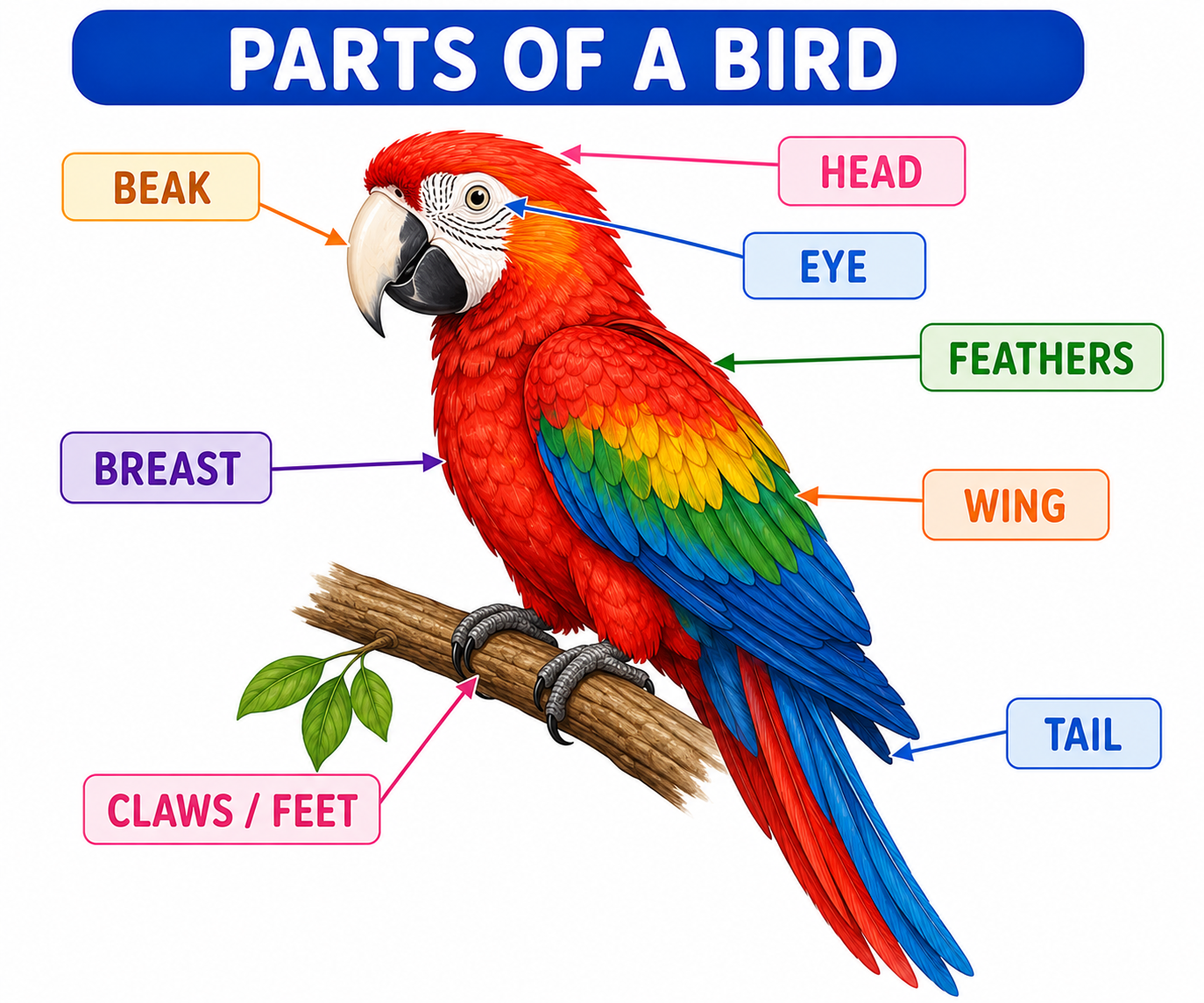
All birds have these special body parts:
| Body Part | Function |
|---|---|
| Feathers | Keep bird warm; help in flying; make bird colourful |
| Wings | Help the bird fly (some birds cannot fly — ostrich, penguin) |
| Beak (Bill) | Used to eat food, build nests, clean feathers, defend |
| Claws (Feet) | Help grip branches, catch food, walk, swim |
| Eyes | Very sharp eyesight — can see food from far away |
| Tail | Helps balance and steer while flying |
| Hollow bones | Light bones make flying easier |
Types of Beaks
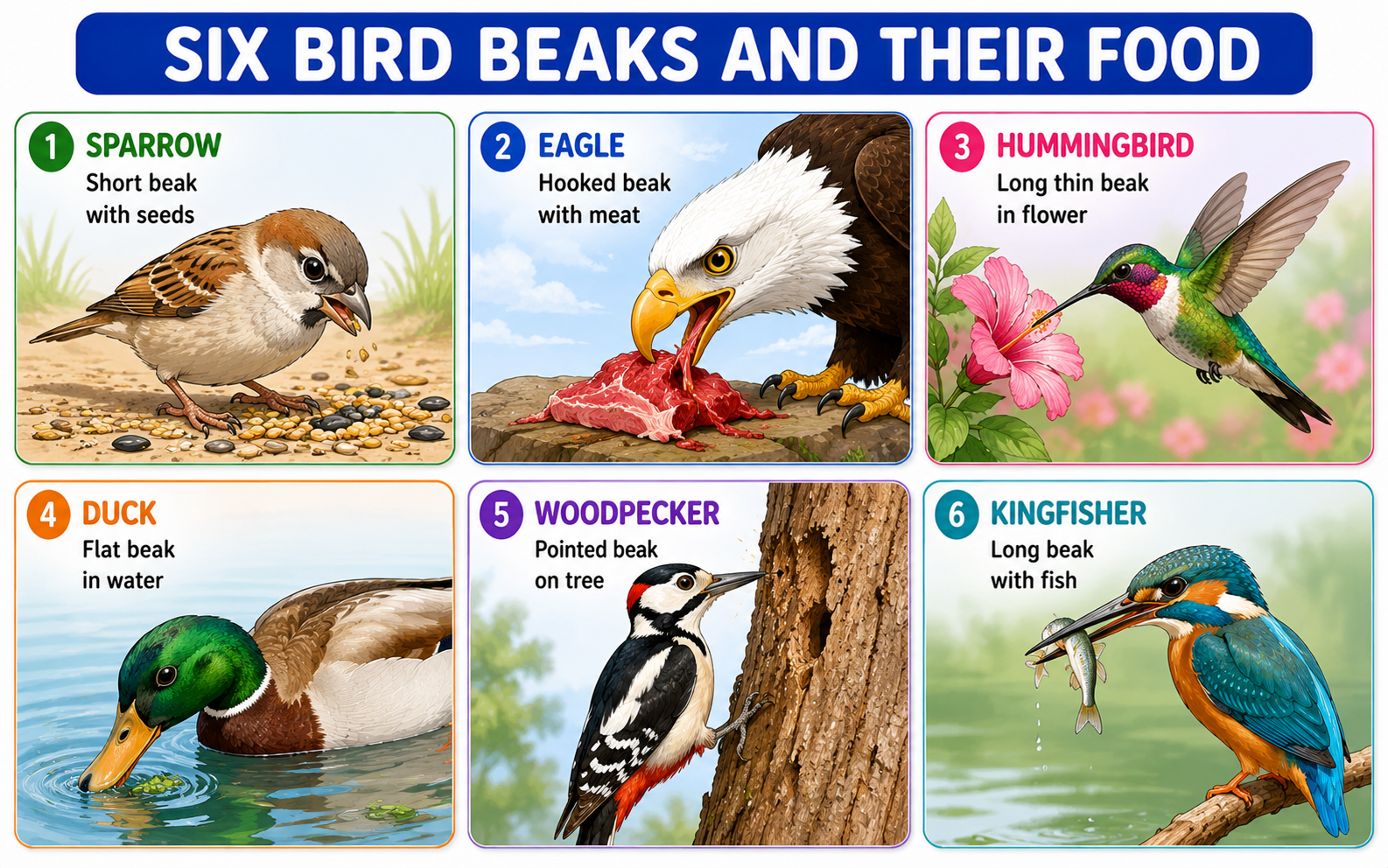
A bird's beak tells us what it eats! Different birds have different shaped beaks:
| Beak Type | Shape | What It Eats | Birds |
|---|---|---|---|
| Crushing beak | Short, strong, cone-shaped | Seeds and grains | Sparrow, Pigeon, Parrot |
| Tearing beak | Sharp, hooked, curved | Meat (flesh of animals) | Eagle, Hawk, Owl, Vulture |
| Probing beak | Long, thin, needle-like | Nectar from flowers | Hummingbird, Sunbird |
| Straining beak | Flat, broad with filters | Tiny creatures from water/mud | Duck, Flamingo |
| Chiselling beak | Strong, pointed, straight | Insects inside tree bark | Woodpecker |
| Catching beak | Long, pointed, sharp | Fish from water | Kingfisher, Heron, Crane |
Types of Claws (Feet)
| Claw Type | Shape | Used For | Birds |
|---|---|---|---|
| Perching claws | Three toes front, one back | Gripping branches | Sparrow, Crow, Mynah |
| Grasping claws | Strong, sharp, curved talons | Catching and killing prey | Eagle, Hawk, Owl |
| Swimming feet | Webbed (skin between toes) | Paddling in water | Duck, Swan, Pelican |
| Wading feet | Long, spread-out toes | Walking on mud without sinking | Crane, Heron, Flamingo |
| Scratching claws | Strong, blunt toes | Scratching ground for food | Hen, Peacock |
| Climbing claws | Two toes front, two back | Climbing tree trunks | Woodpecker, Parrot |
Bird Nests
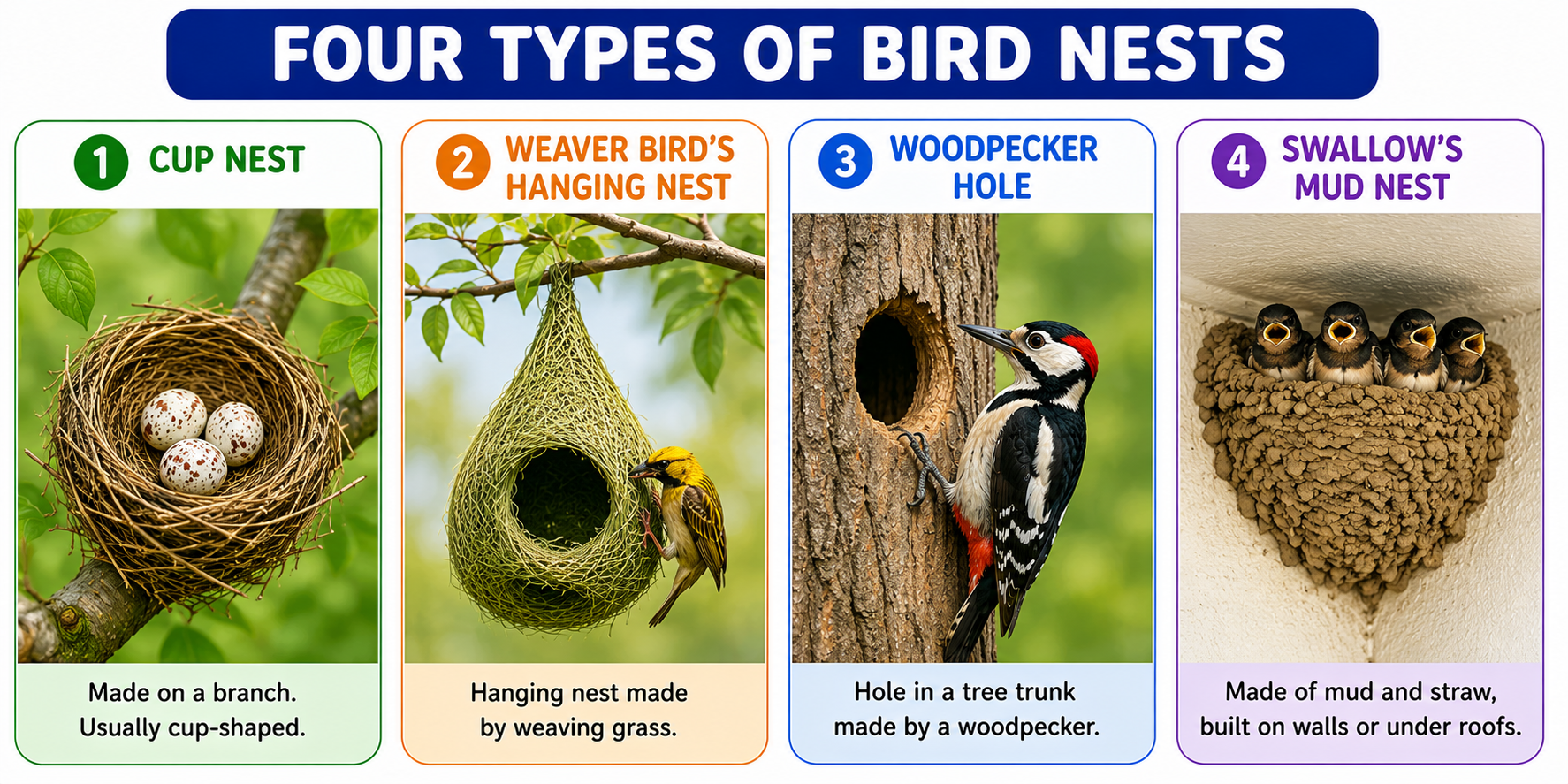
Birds build nests to lay eggs and raise their babies. Different birds build different types of nests:
| Nest Type | Made Of | Where | Bird |
|---|---|---|---|
| Cup-shaped nest | Twigs, grass, leaves | On tree branches | Robin, Sparrow |
| Hanging nest | Grass, plant fibres | Hangs from branches | Weaver bird (Baya) |
| Hole in tree | Pecks hole in trunk | Inside tree trunk | Woodpecker, Barbet |
| Ground nest | Pebbles, grass | On the ground | Hen, Ostrich |
| Mud nest | Mud and saliva | On walls, under roofs | Swallow |
| No nest (uses others') | — | Lays eggs in other birds' nests | Cuckoo (Koel) |
Common Indian Birds
| Bird | Special Feature | Food |
|---|---|---|
| 🦚 Peacock (National Bird) | Beautiful colourful tail feathers; dances in rain | Seeds, insects, small snakes |
| 🐦 Sparrow | Small, brown; lives near humans | Seeds, grains, insects |
| 🦅 Eagle | Sharp eyesight; flies very high | Fish, rats, snakes |
| 🦜 Parrot | Green with red beak; can mimic speech | Fruits, seeds, nuts |
| 🐦 Crow | Black; very clever; lives everywhere | Anything (omnivore) |
| 🦉 Owl | Active at night; can turn head almost fully | Rats, mice, insects |
| 🐦 Kingfisher | Bright blue and orange; dives for fish | Fish |
| 🐦 Pigeon | Grey; used to carry messages in old times | Seeds, grains |
| 🐦 Koel (Cuckoo) | Sweet singing voice; lays eggs in crow's nest | Fruits, insects |
| 🐦 Mynah | Black with yellow patch; can mimic sounds | Insects, fruits, grains |
Bird Migration
Migration means travelling long distances. Some birds fly thousands of kilometres to find food and warmer weather.
- In winter, many birds fly from cold countries (Siberia, Europe) to warm India.
- They come to places like Bharatpur (Rajasthan), Chilika Lake (Odisha), and Rann of Kutch (Gujarat).
- Examples of migratory birds: Siberian Crane, Flamingo, Painted Stork, Arctic Tern.
- They return to their home countries when summer comes.
Birds That Cannot Fly
| Bird | Where It Lives | Special Feature |
|---|---|---|
| Ostrich | Africa | Largest bird; runs very fast (70 km/h) |
| Penguin | Antarctica | Swims excellently; lives in extreme cold |
| Emu | Australia | Second largest bird; runs fast |
| Kiwi | New Zealand | Tiny wings; active at night |
Key Words
| Word | Meaning |
|---|---|
| Beak | Hard mouth part of a bird used for eating |
| Talons | Sharp, curved claws of birds of prey (eagle, hawk) |
| Feathers | Light covering on bird's body; helps fly and stay warm |
| Nest | Home built by birds to lay eggs and raise babies |
| Migration | Travelling long distances to find food or warmer weather |
| Webbed feet | Feet with skin between toes (for swimming) |
| Perching | Sitting on a branch |
| Hatching | Baby bird coming out of an egg |
- Birds have feathers, wings, beaks, claws, hollow bones, and a tail.
- A bird's beak shape tells us what it eats (crushing, tearing, probing, straining).
- Claws help birds perch, grasp prey, swim, wade, scratch, or climb.
- Birds build nests to lay eggs — cup nests, hanging nests, holes, mud nests.
- India's national bird is the Peacock.
- Migratory birds travel from cold countries to India in winter.
- Some birds cannot fly: Ostrich, Penguin, Emu, Kiwi.
Practice Questions
| Column A | Column B |
|---|---|
| 1. Eagle | a. Flat beak, swims |
| 2. Duck | b. Hooked beak, tears meat |
| 3. Woodpecker | c. Long beak, catches fish |
| 4. Kingfisher | d. Short beak, eats seeds |
| 5. Sparrow | e. Strong beak, pecks trees |
Activity 1: Bird Watching
Sit quietly in your garden or balcony for 15 minutes. Write the names of birds you see and what they are doing:
| Bird Name | Colour | What It Was Doing |
|---|---|---|
Activity 2: Draw your favourite bird and label its body parts (beak, wings, feathers, claws, tail).
Want a printable worksheet? Switch to the Worksheet View, then print.