Clothing — Clothes We Wear
Learning Objectives
- I can explain why we wear clothes.
- I can name different types of clothes worn in different seasons.
- I can identify materials from which clothes are made.
- I can describe traditional Indian clothes worn in different regions.
- I can explain how clothes are made from raw materials.
- I can describe how to take care of clothes properly.
Let Us Begin!
Look at what you are wearing right now. Is it a school uniform? A comfortable kurta? A pretty frock? Clothes are things we wear on our body every day.
People all over the world wear different types of clothes. The clothes we wear depend on the weather, the occasion, and the place we live in. In India, we have a beautiful variety of clothes — from sarees and dhotis to salwar-kameez and kurta-pyjamas!
Let us learn about why we wear clothes, what they are made of, and how different people in India dress differently.
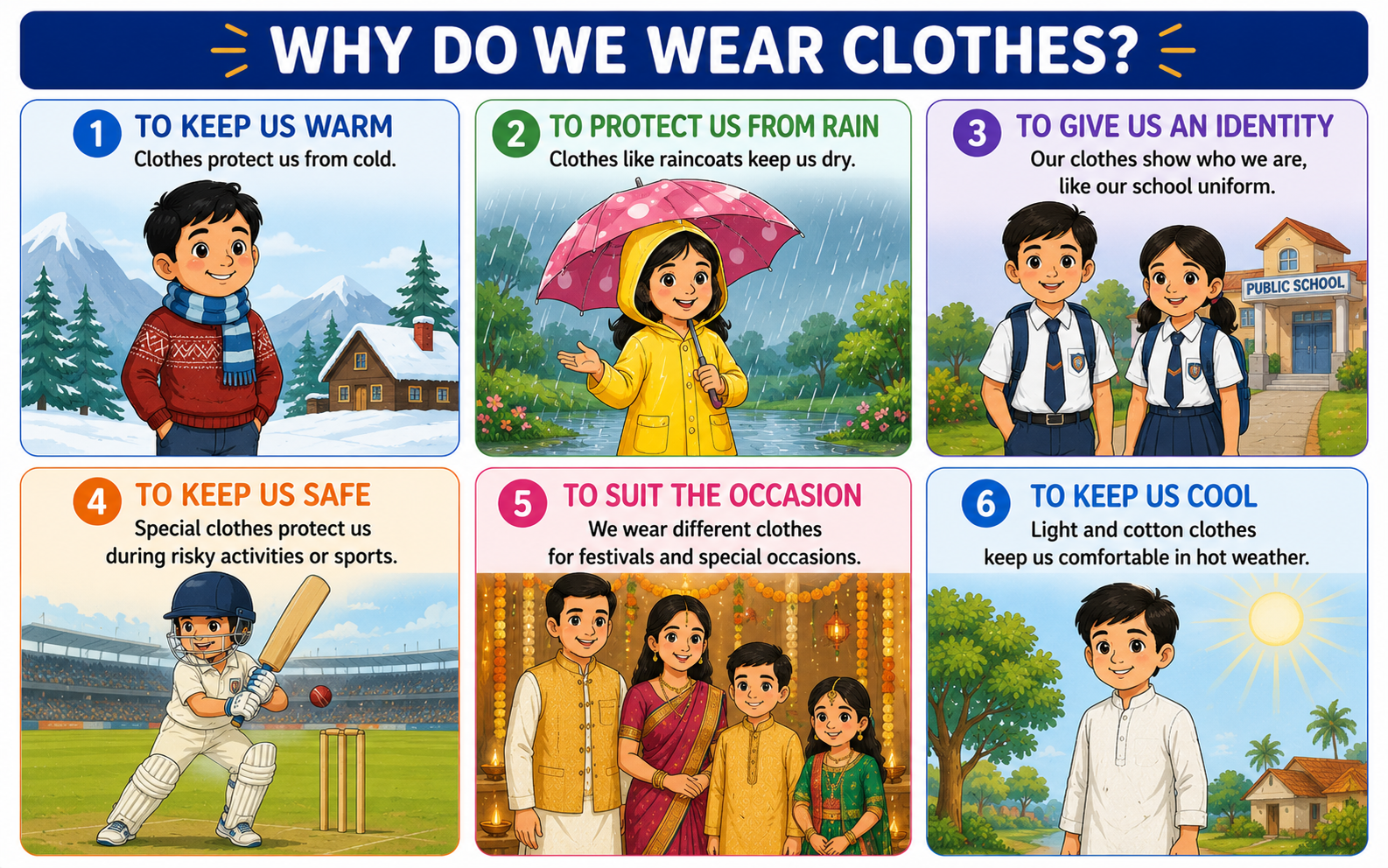
Why Do We Wear Clothes?
We wear clothes for many important reasons:
| Reason | Explanation | Example |
|---|---|---|
| Protection from weather | Clothes protect us from heat, cold, rain, and wind | Woollen sweater in winter; raincoat in monsoon |
| Protection from injuries | Clothes protect our skin from cuts, dust, and insect bites | Long sleeves protect from mosquitoes |
| Modesty and decency | Clothes cover our body properly | We wear proper clothes when going outside |
| For different occasions | We wear special clothes for special events | New clothes on Diwali; uniform for school |
| Safety | Some clothes protect us during work or sports | Helmet and pads for cricket; apron for cooking |
| Identity | Clothes show who we are or what we do | Doctor's white coat; police uniform |
Types of Clothes by Season
India has three main seasons, and we wear different clothes in each season:
☀️ Summer Clothes (March to June)
In summer, the weather is very hot. We wear light and loose clothes that let air pass through and keep us cool.
- Cotton kurta and pyjama
- Light cotton saree or salwar-kameez
- Shorts and T-shirts
- Frocks and skirts
- Sandals and open shoes
- Hats and caps to protect from the sun
Summer clothes are usually made of cotton — a light, airy fabric that absorbs sweat.
❄️ Winter Clothes (November to February)
In winter, the weather is cold. We wear thick and warm clothes that trap heat and keep our body warm.
- Woollen sweater and jacket
- Shawl and muffler (scarf)
- Woollen cap and gloves
- Thick socks and closed shoes or boots
- Blankets at night
Winter clothes are usually made of wool — a thick, warm fabric that comes from sheep.
🌧️ Rainy Season Clothes (July to September)
In the rainy season (monsoon), it rains a lot. We wear clothes that protect us from getting wet.
- Raincoat
- Waterproof jacket
- Gumboots (rubber boots)
- Umbrella (not a cloth, but protects from rain)
- Quick-drying clothes
Rainy season clothes are usually made of nylon or plastic — waterproof materials that do not let water pass through.
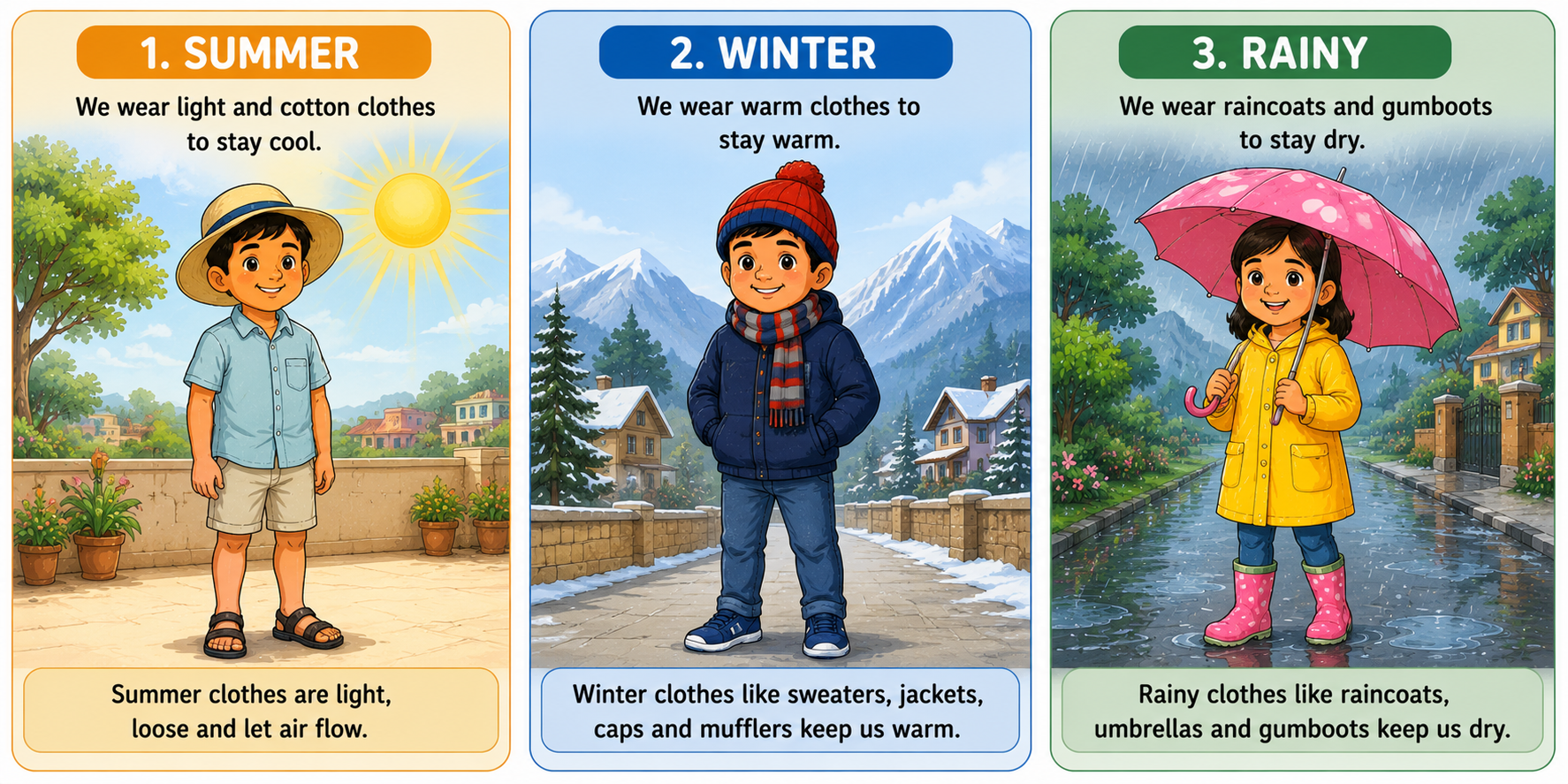
| Season | Weather | Type of Clothes | Material |
|---|---|---|---|
| Summer | Hot | Light, loose, thin | Cotton |
| Winter | Cold | Thick, warm, layered | Wool |
| Rainy | Wet | Waterproof | Nylon, Plastic |
Clothes from Different Materials
Clothes are made from different types of materials called fabrics. Some fabrics come from plants, some from animals, and some are made in factories.
| Material | Source | Properties | Used For |
|---|---|---|---|
| Cotton | Cotton plant (bolls) | Soft, light, absorbs sweat, airy | Summer clothes, shirts, sarees |
| Wool | Sheep, goat (Pashmina), yak | Thick, warm, traps heat | Sweaters, shawls, blankets |
| Silk | Silkworm (cocoon) | Smooth, shiny, expensive | Sarees, wedding clothes, ties |
| Jute | Jute plant (stem) | Rough, strong, cheap | Bags, mats, ropes |
| Nylon / Polyester | Factory (man-made from chemicals) | Strong, waterproof, quick-drying | Raincoats, sportswear, bags |
| Leather | Animal skin (cow, buffalo, goat) | Tough, durable, waterproof | Shoes, belts, jackets |
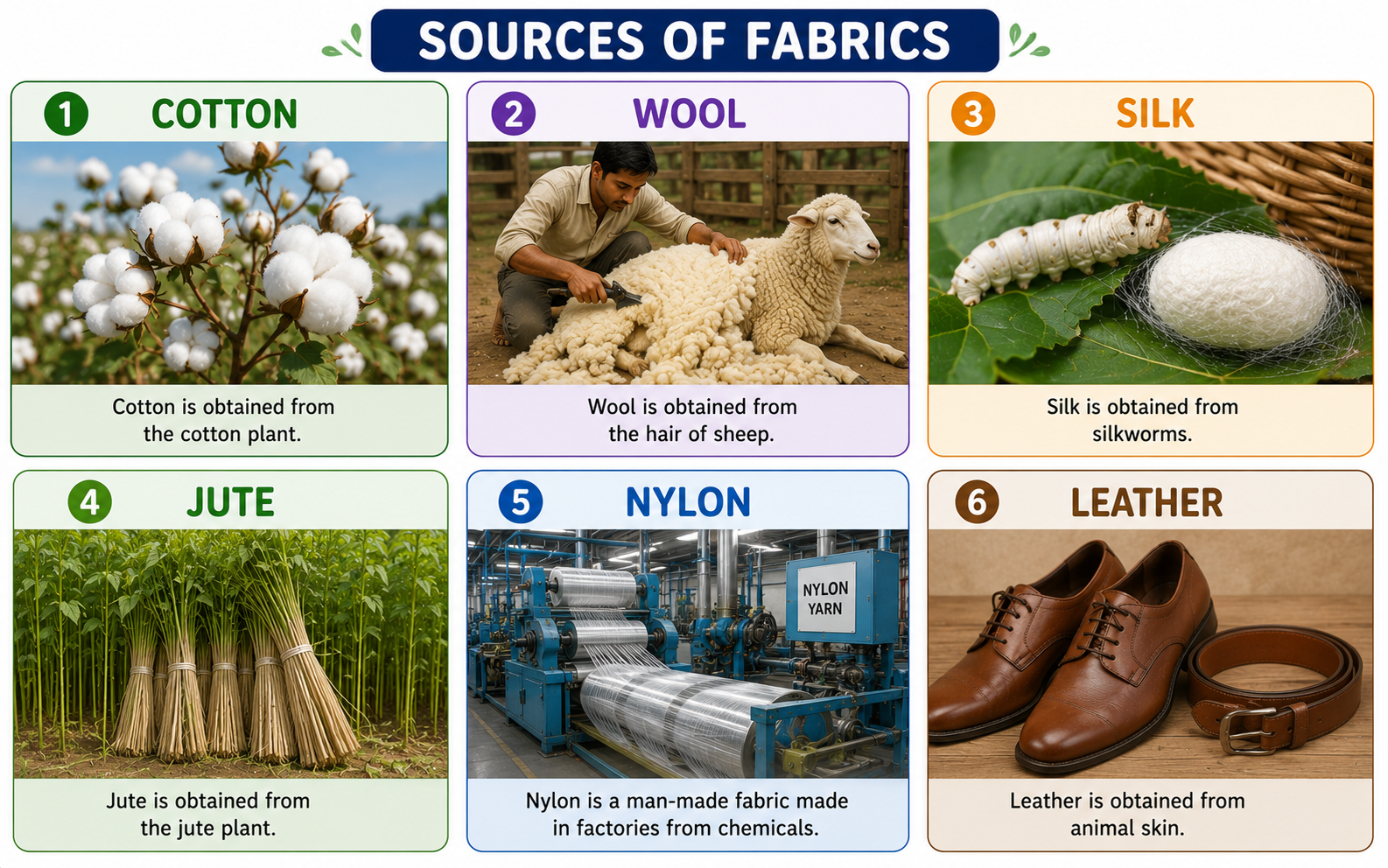
Natural fabrics come from plants or animals: Cotton (plant), Wool (sheep), Silk (silkworm), Jute (plant).
Man-made fabrics are made in factories from chemicals: Nylon, Polyester, Rayon.
Traditional Indian Clothes
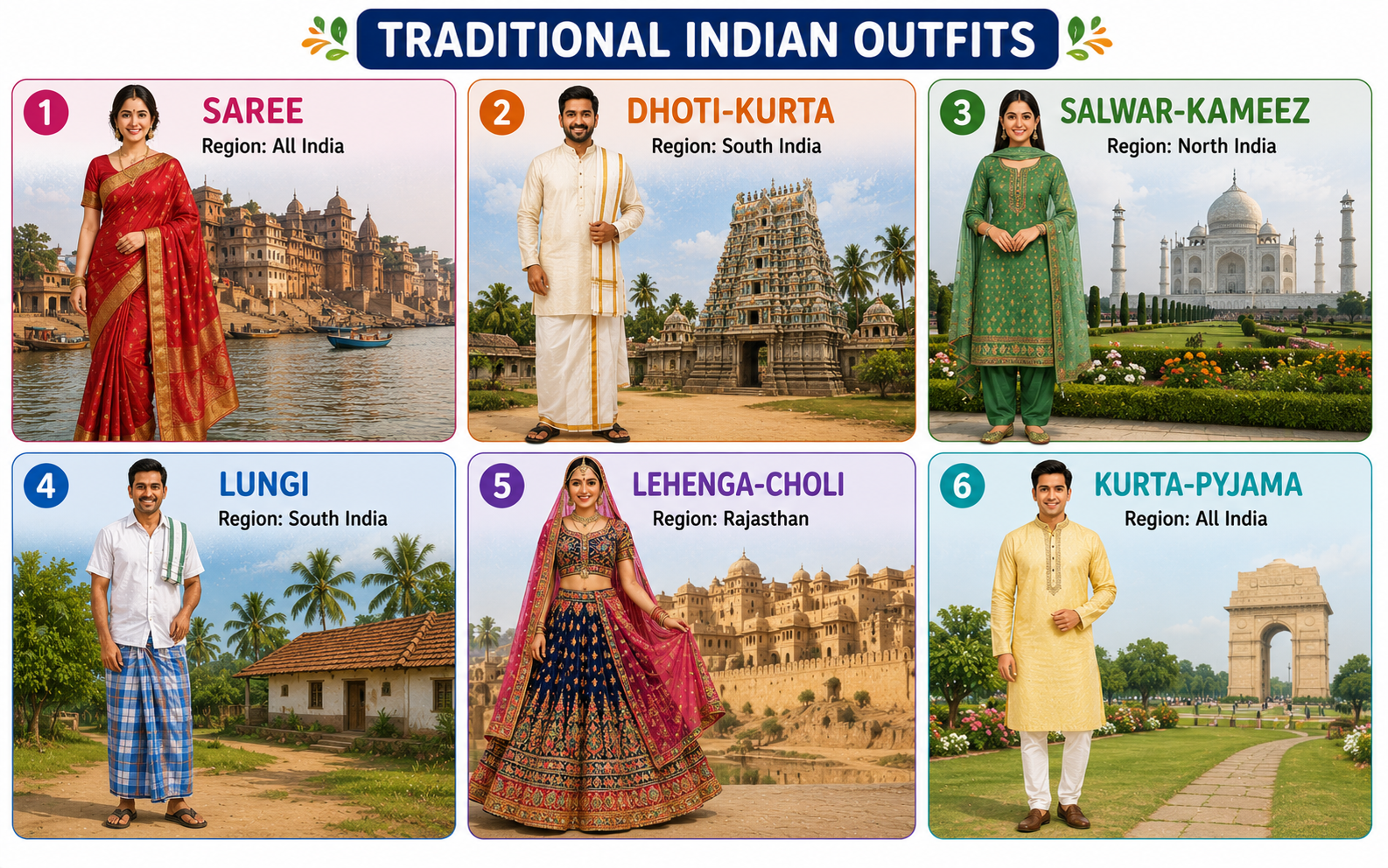
India is a land of many cultures. People in different parts of India wear different traditional clothes. Let us learn about some of them:
| Clothing | Worn By | Region / State |
|---|---|---|
| Saree | Women | All over India (different styles in each state) |
| Dhoti | Men | South India, Bengal, Bihar, UP |
| Kurta-Pyjama | Men | North India (Punjab, UP, Rajasthan) |
| Salwar-Kameez | Women | Punjab, North India |
| Lungi | Men | South India (Kerala, Tamil Nadu, Karnataka) |
| Lehenga-Choli | Women | Rajasthan, Gujarat (festivals and weddings) |
| Mekhela-Chador | Women | Assam (North-East India) |
| Phiran | Men and Women | Kashmir |
| Mundu | Men | Kerala |
| Ghagra-Choli | Women | Rajasthan, Gujarat |
Special Facts:
- The saree is worn differently in different states — Gujarati style, Bengali style, South Indian style, Maharashtrian style.
- Rajasthani clothes are very colourful with mirror work and embroidery.
- In Kashmir, people wear a Phiran (a long warm gown) to stay warm in extreme cold.
- During festivals, people wear new and special clothes — silk sarees for Diwali, white clothes for Eid, colourful clothes for Holi.
Clothes for Different Occasions
We wear different clothes for different activities and events:
| Occasion | What We Wear | Why |
|---|---|---|
| School | School uniform | Shows equality; easy to identify students |
| Sports / Exercise | T-shirt, shorts, track pants, sports shoes | Comfortable and allows free movement |
| Festivals / Weddings | New clothes, silk sarees, sherwanis, lehengas | To look special and celebrate |
| Sleeping | Night suit, loose pyjamas | Comfortable for resting |
| Swimming | Swimsuit / swimming costume | Light and quick-drying in water |
| Rainy day outing | Raincoat, gumboots | To stay dry |
Taking Care of Clothes
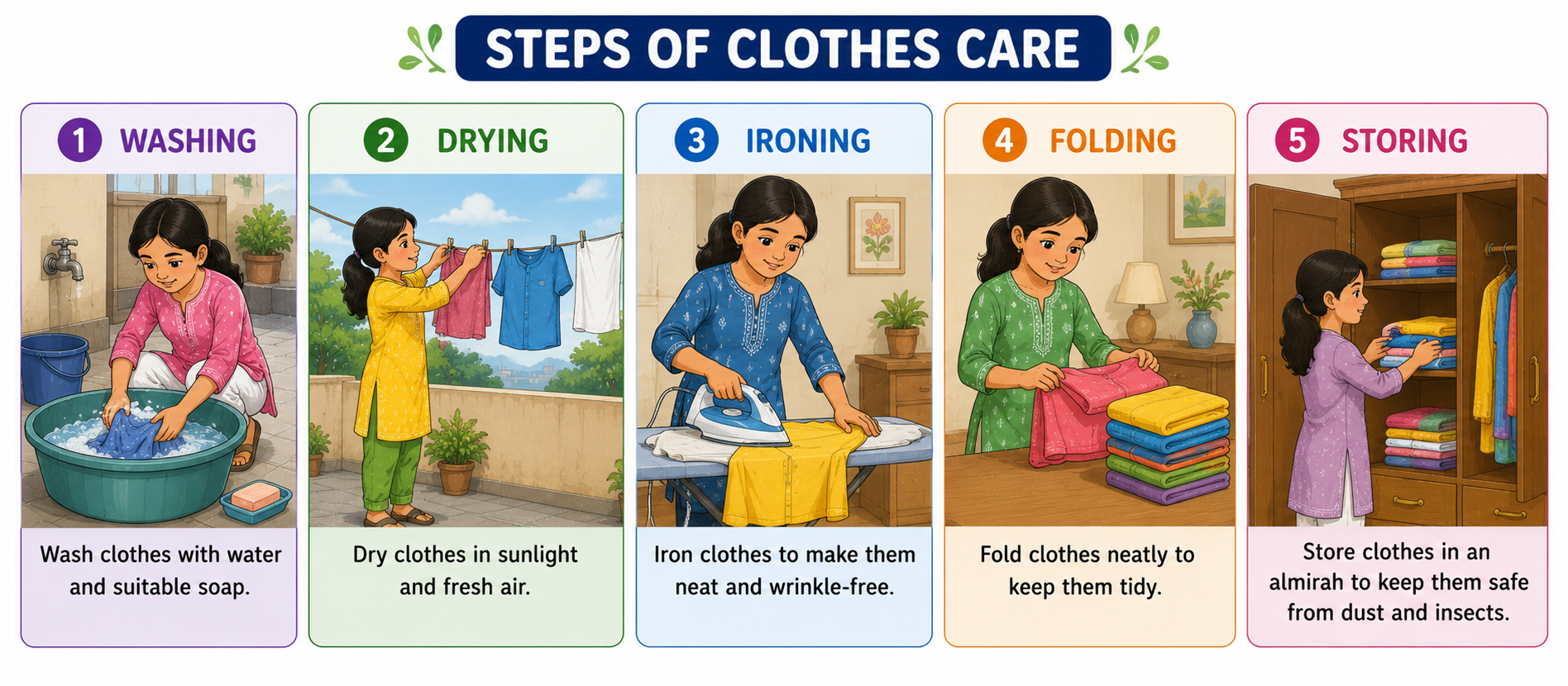
Clothes last longer if we take good care of them. Here are some ways to care for our clothes:
| Step | What to Do | Why |
|---|---|---|
| Washing | Wash dirty clothes with soap and water regularly | Removes dirt, sweat, and germs |
| Drying | Dry clothes in sunlight on a clothesline | Sunlight kills germs; air dries clothes |
| Ironing | Iron clothes to remove wrinkles | Makes clothes look neat and tidy |
| Folding | Fold clothes neatly after ironing | Prevents wrinkles; saves space |
| Storing | Keep clothes in a clean cupboard or almirah | Protects from dust, insects, and moisture |
| Mending | Stitch torn clothes; replace missing buttons | Makes clothes last longer |
Tips for Taking Care of Clothes:
- Change your clothes daily — do not wear the same clothes for many days.
- Hang your school uniform properly after coming home.
- Do not wipe your hands on your clothes — use a handkerchief or towel.
- Put naphthalene balls (mothballs) in the cupboard to keep insects away.
- Separate white clothes from coloured clothes while washing.
How Clothes Are Made
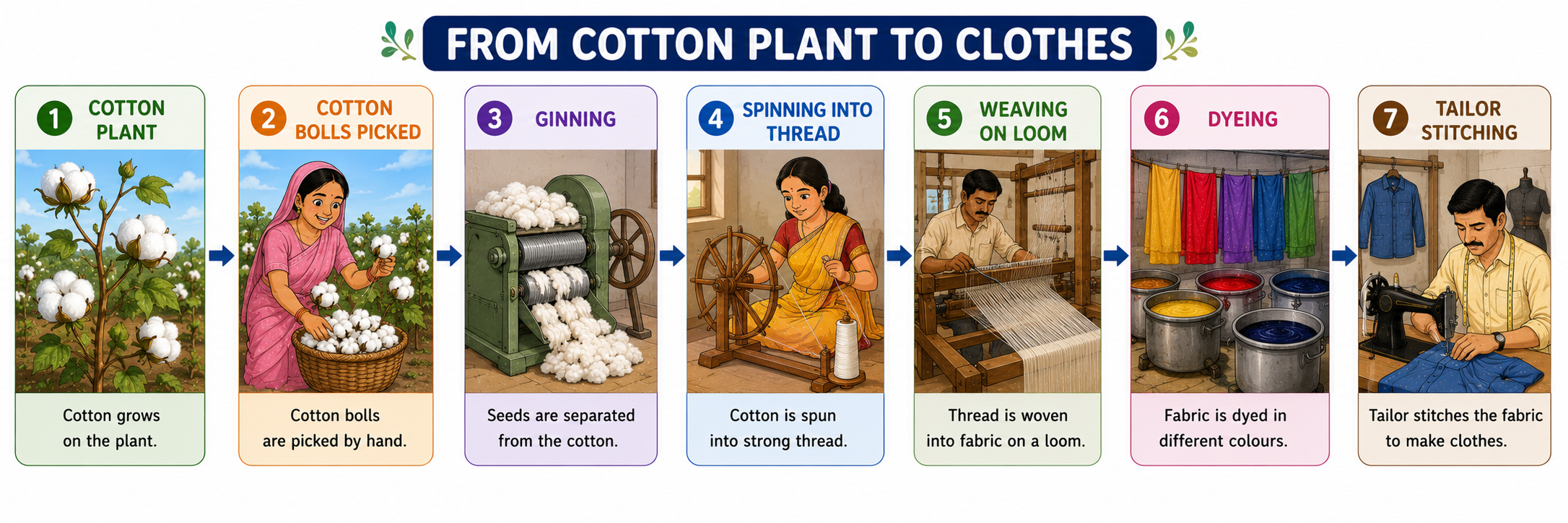
Have you ever wondered how a cotton plant becomes the shirt you wear? Here is the journey of cotton clothes:
Step 1: Farmers grow cotton plants in fields. White fluffy cotton bolls grow on the plant.
Step 2: Cotton bolls are picked (harvested) from the plants.
Step 3: Cotton is cleaned and seeds are removed. This is called ginning.
Step 4: Clean cotton is spun into thread (yarn) using a spinning machine or charkha.
Step 5: Thread is woven on a loom to make cloth (fabric).
Step 6: Cloth is dyed (coloured) and printed with designs.
Step 7: A tailor cuts and stitches the cloth into clothes (shirt, dress, etc.).
Interesting Facts About Clothing
- 🇮🇳 India is the second largest producer of cotton in the world.
- 🐛 One silkworm cocoon can give a silk thread up to 900 metres long!
- 🐑 One sheep gives enough wool to make 2-3 sweaters.
- 🧵 Khadi cloth was promoted by Mahatma Gandhi during India's freedom movement.
- 🎨 Bandhani (tie-dye) from Rajasthan and Gujarat is one of the oldest fabric arts in India.
- 👗 The saree is one of the oldest garments in the world — over 5,000 years old!
Key Words
| Word | Meaning |
|---|---|
| Fabric | The material from which clothes are made (cloth) |
| Cotton | A soft, light natural fabric from the cotton plant |
| Wool | A thick, warm fabric from the hair of sheep |
| Silk | A smooth, shiny fabric made from silkworm cocoons |
| Nylon | A strong man-made fabric used for raincoats and bags |
| Ginning | The process of removing seeds from cotton |
| Spinning | Twisting cotton fibres into thread (yarn) |
| Weaving | Interlacing threads on a loom to make cloth |
| Tailor | A person who stitches cloth into clothes |
| Uniform | Same type of clothes worn by a group (school, police) |
- We wear clothes for protection, modesty, safety, and for different occasions.
- In summer we wear light cotton clothes; in winter we wear thick woollen clothes; in rainy season we wear waterproof clothes.
- Clothes are made from natural materials (cotton, wool, silk, jute) and man-made materials (nylon, polyester).
- India has many traditional clothes — saree, dhoti, kurta-pyjama, salwar-kameez, lungi, lehenga.
- We wear different clothes for school, sports, festivals, and sleeping.
- We should take care of clothes by washing, drying, ironing, folding, and storing them properly.
- Cotton clothes are made through: Cotton plant → Ginning → Spinning → Weaving → Stitching.
Practice Questions
| Column A | Column B |
|---|---|
| 1. Cotton | a. Comes from sheep |
| 2. Wool | b. Made from silkworm cocoon |
| 3. Silk | c. Worn in rainy season |
| 4. Raincoat | d. Traditional dress of men in South India |
| 5. Lungi | e. Comes from a plant |
Activity 1: Fabric Detective
Collect small pieces of 4 different fabrics (cotton, wool, silk, nylon). Touch each one and write how it feels:
Cotton: _______________ | Wool: _______________ | Silk: _______________ | Nylon: _______________
Activity 2: Dress Me Up!
Draw a child and dress them for: (a) A hot summer day (b) A cold winter morning (c) A rainy day. Label the clothes you draw.
Activity 3: My Clothes Survey
Look at 5 of your clothes. Write what material each one is made of (check the label inside):
1. _______________ 2. _______________ 3. _______________ 4. _______________ 5. _______________
Want a printable worksheet? Switch to the Worksheet View, then print.