Good Habits and Hygiene
Learning Objectives
- I can explain why personal hygiene is important for good health.
- I can list the steps of proper handwashing and daily hygiene routines.
- I can describe what makes a balanced and healthy diet.
- I can explain why exercise and proper sleep are important for children.
- I can demonstrate good manners at home, school, and public places.
- I can describe how to keep our surroundings clean (Swachh Bharat).
- I can identify bad habits and explain why we should avoid them.
Let Us Begin!
Have you ever noticed how fresh and happy you feel after a nice bath? Or how strong you feel after eating dal-roti and vegetables? That is because good habits keep our body and mind healthy!
Good habits are things we do every day that help us stay clean, healthy, and happy. When we follow good habits, we do not fall sick easily and we feel energetic all day long.
Let us learn about the good habits that every child should follow — from brushing teeth to keeping our neighbourhood clean!
1. Personal Hygiene
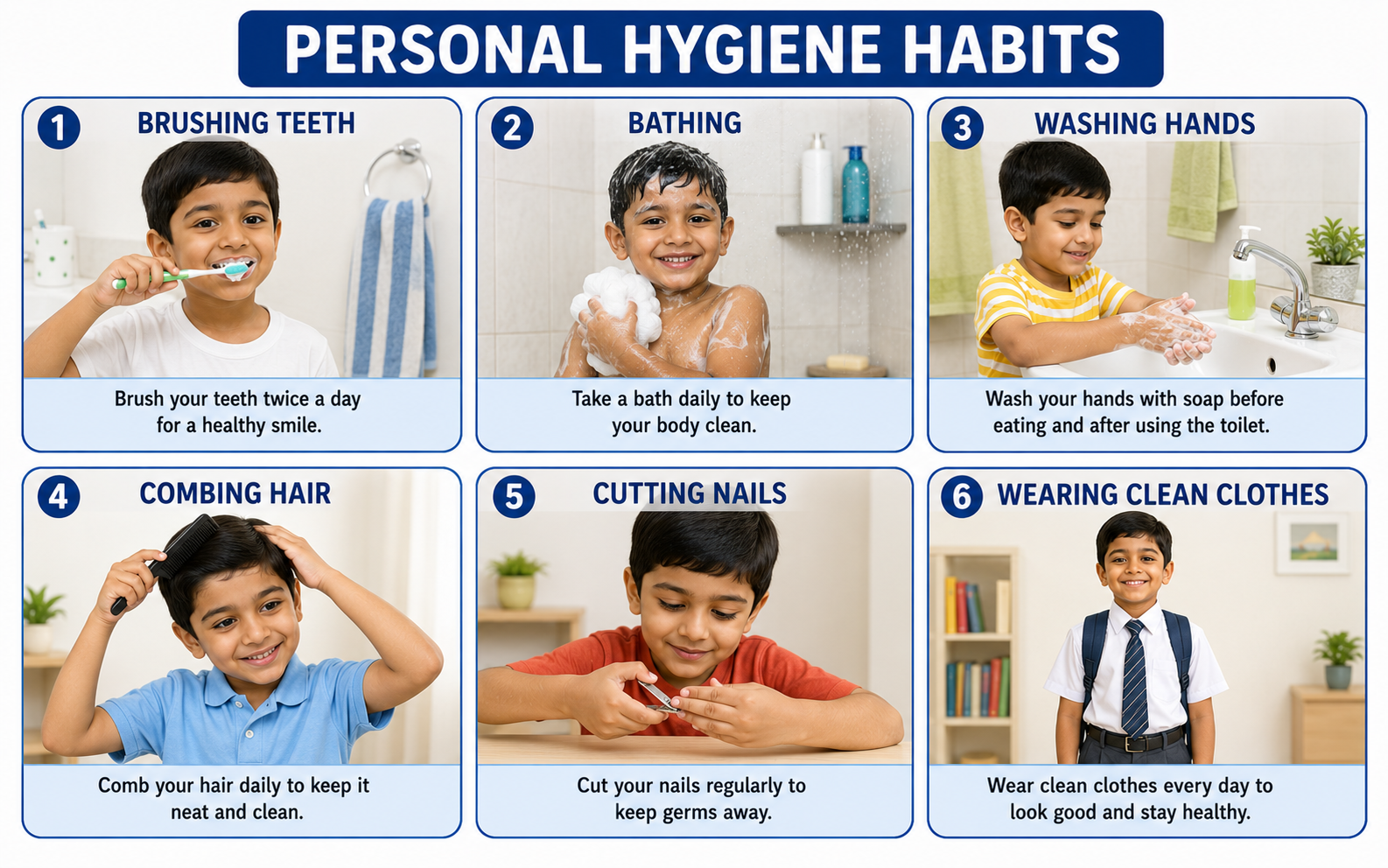
Hygiene means keeping our body clean and free from germs. Personal hygiene habits protect us from diseases.
| Habit | How Often | Why It Is Important |
|---|---|---|
| Brushing teeth | Twice a day (morning & night) | Prevents cavities, bad breath, and gum disease |
| Bathing | Every day | Removes dirt, sweat, and germs from skin |
| Washing hands | Before eating, after toilet, after playing | Kills germs that cause stomach infections |
| Combing hair | Every day | Removes tangles, keeps hair neat and lice-free |
| Cutting nails | Once a week | Dirt under nails carries germs |
| Wearing clean clothes | Every day | Dirty clothes have germs and cause skin problems |
| Washing feet before bed | Every night | Removes dust and germs collected during the day |
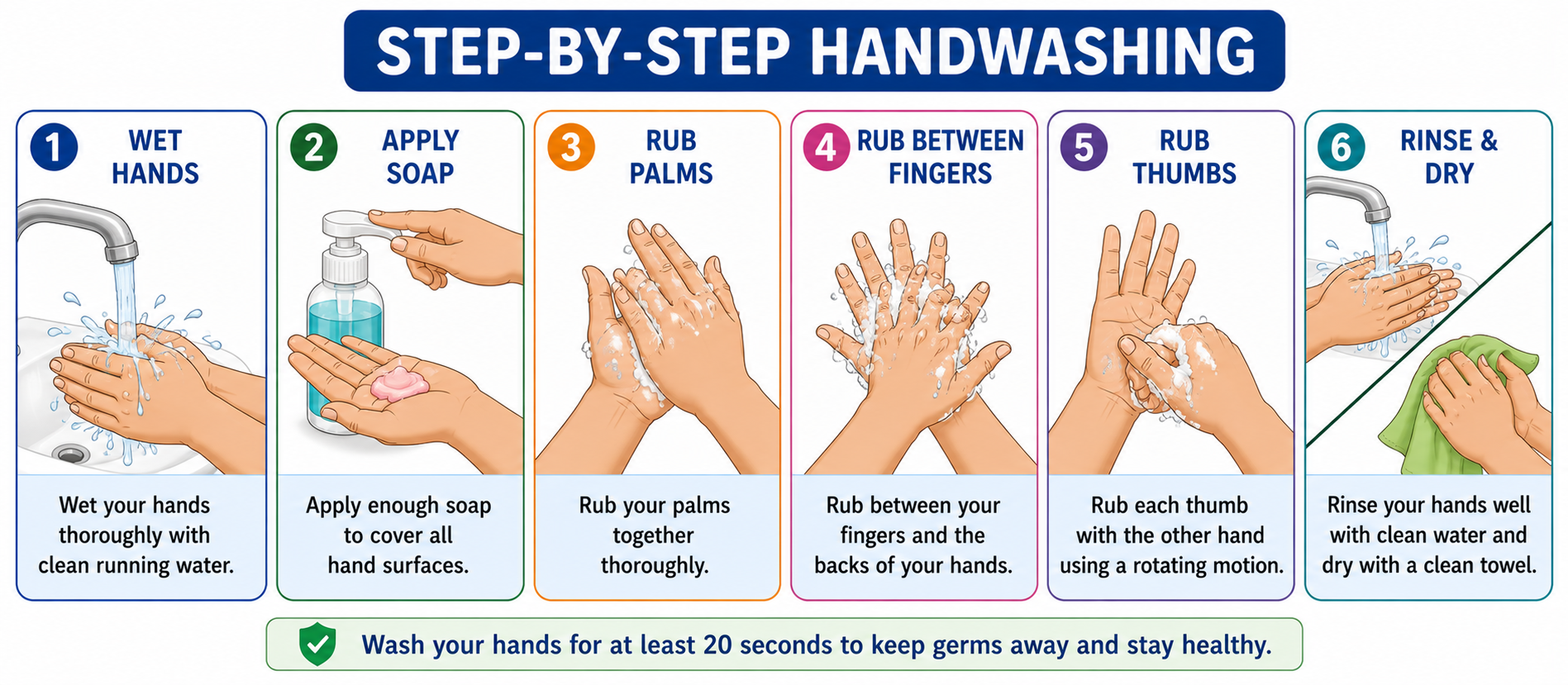
How to Wash Hands Properly
Doctors say we must wash hands with soap for at least 20 seconds. Follow these steps:
- Wet your hands with clean water.
- Apply soap and rub your palms together.
- Rub the back of each hand.
- Clean between your fingers.
- Rub your thumbs and fingertips.
- Rinse with clean water and dry with a clean towel.
2. Healthy Eating Habits
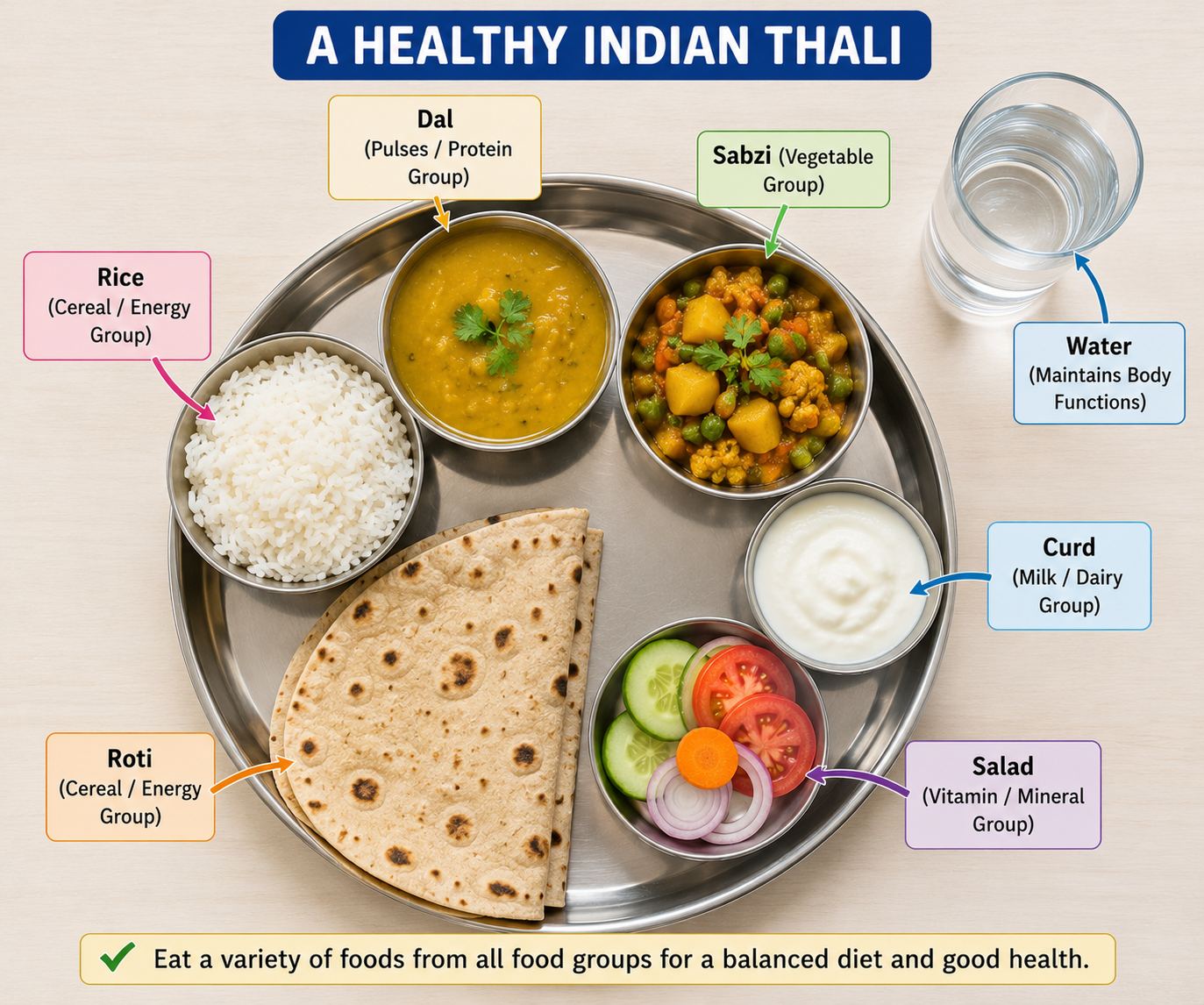
Our body needs different types of food to grow strong and stay healthy. A balanced diet includes all food groups:
| Food Group | What It Gives Us | Indian Examples |
|---|---|---|
| Energy-giving foods (Carbohydrates) | Energy to play and study | Rice, roti, chapati, paratha, idli, dosa |
| Body-building foods (Proteins) | Strong muscles and growth | Dal, paneer, eggs, milk, rajma, chole |
| Protective foods (Vitamins & Minerals) | Fight diseases, strong bones | Fruits, vegetables, amla, spinach, carrots |
| Fats (in small amounts) | Extra energy, warm body | Ghee, butter, nuts, cooking oil |
| Water | Keeps body cool, removes waste | 8–10 glasses of water daily |
Good Eating Habits to Follow
- Always wash hands before and after eating.
- Eat at regular times — do not skip meals, especially breakfast.
- Chew food slowly and properly.
- Eat more fruits and vegetables every day.
- Drink clean, boiled or filtered water.
- Do not eat too many sweets, chips, or junk food.
- Always eat freshly cooked food — avoid stale food.
- Cover food to keep flies and dust away.
3. Exercise and Sleep
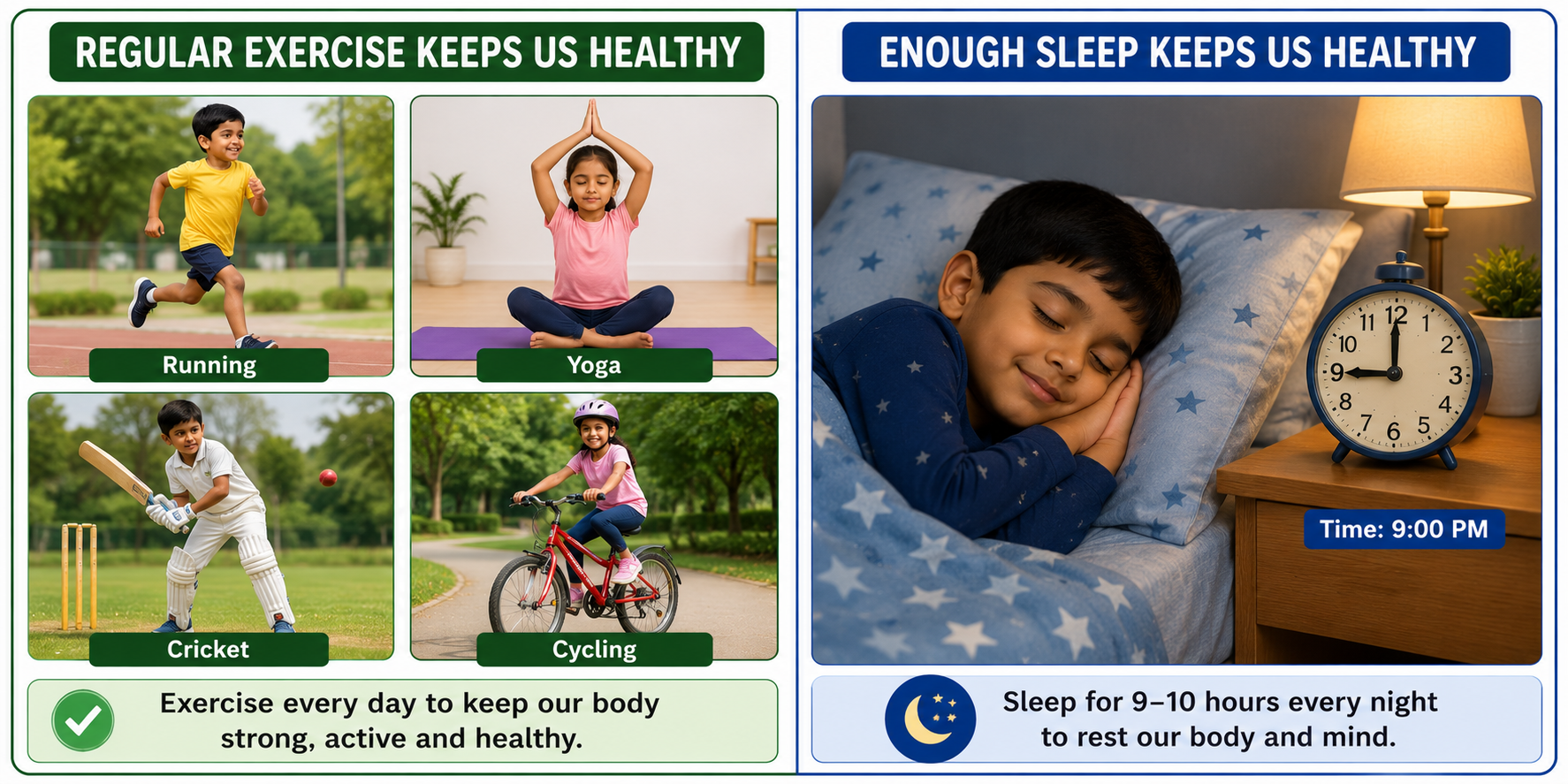
Our body needs both exercise (to stay fit) and sleep (to rest and grow).
Why Exercise Is Important
- Makes our muscles and bones strong.
- Keeps our heart healthy.
- Helps us stay at a healthy weight.
- Makes us feel happy and energetic.
- Helps us concentrate better in class.
Types of Exercise for Children
| Activity | Benefits |
|---|---|
| Running, cycling, skipping | Strong heart and lungs |
| Yoga and stretching | Flexibility, calm mind |
| Swimming | Full body exercise |
| Playing cricket, football, kho-kho, kabaddi | Teamwork, fitness, fun |
| Walking to school | Daily exercise without extra effort |
Why Sleep Is Important
- Our body grows and repairs itself during sleep.
- Our brain stores what we learned during the day.
- Children aged 8–9 need 9–11 hours of sleep every night.
- Sleep early (by 9 PM) and wake up early (by 6 AM).
- Do not use mobile phones or watch TV before sleeping.
4. Good Manners
Good manners show that we respect others. A well-mannered child is loved by everyone.
Magic Words
| Word | When to Use |
|---|---|
| Please (कृपया) | When asking for something |
| Thank you (धन्यवाद) | When someone helps you or gives you something |
| Sorry (क्षमा कीजिए) | When you make a mistake or hurt someone |
| Excuse me | When you need to pass or interrupt politely |
| Good morning / Namaste | When greeting elders and teachers |
Good Manners at Different Places
| Place | Good Manners |
|---|---|
| At Home | Help parents with small tasks, respect elders, share with siblings, keep room tidy |
| At School | Listen to teacher, raise hand before speaking, do not bully, complete homework on time |
| At the Dining Table | Do not talk with mouth full, do not waste food, say thank you after meals |
| In Public Places | Stand in queue, do not push, give seat to elderly, do not litter |
| With Friends | Share, take turns, do not fight, say sorry when wrong |
5. Clean Surroundings (Swachh Bharat)
Keeping our surroundings clean is as important as keeping our body clean. A clean environment means fewer germs and diseases.
Swachh Bharat Abhiyan
The Swachh Bharat Abhiyan (Clean India Mission) was started by our government on 2nd October 2014 (Gandhi Jayanti). Its goal is to make India clean and free from open defecation.
How to Keep Our Surroundings Clean
- Always throw garbage in the dustbin — never on the road.
- Separate wet waste (food scraps, vegetable peels) from dry waste (paper, plastic, glass).
- Do not spit on roads or walls.
- Use toilets — never go in the open.
- Keep drains clean — do not throw garbage in drains.
- Plant trees and take care of plants around your home.
- Reduce, Reuse, Recycle — use less plastic.
- Participate in cleanliness drives in your school and colony.
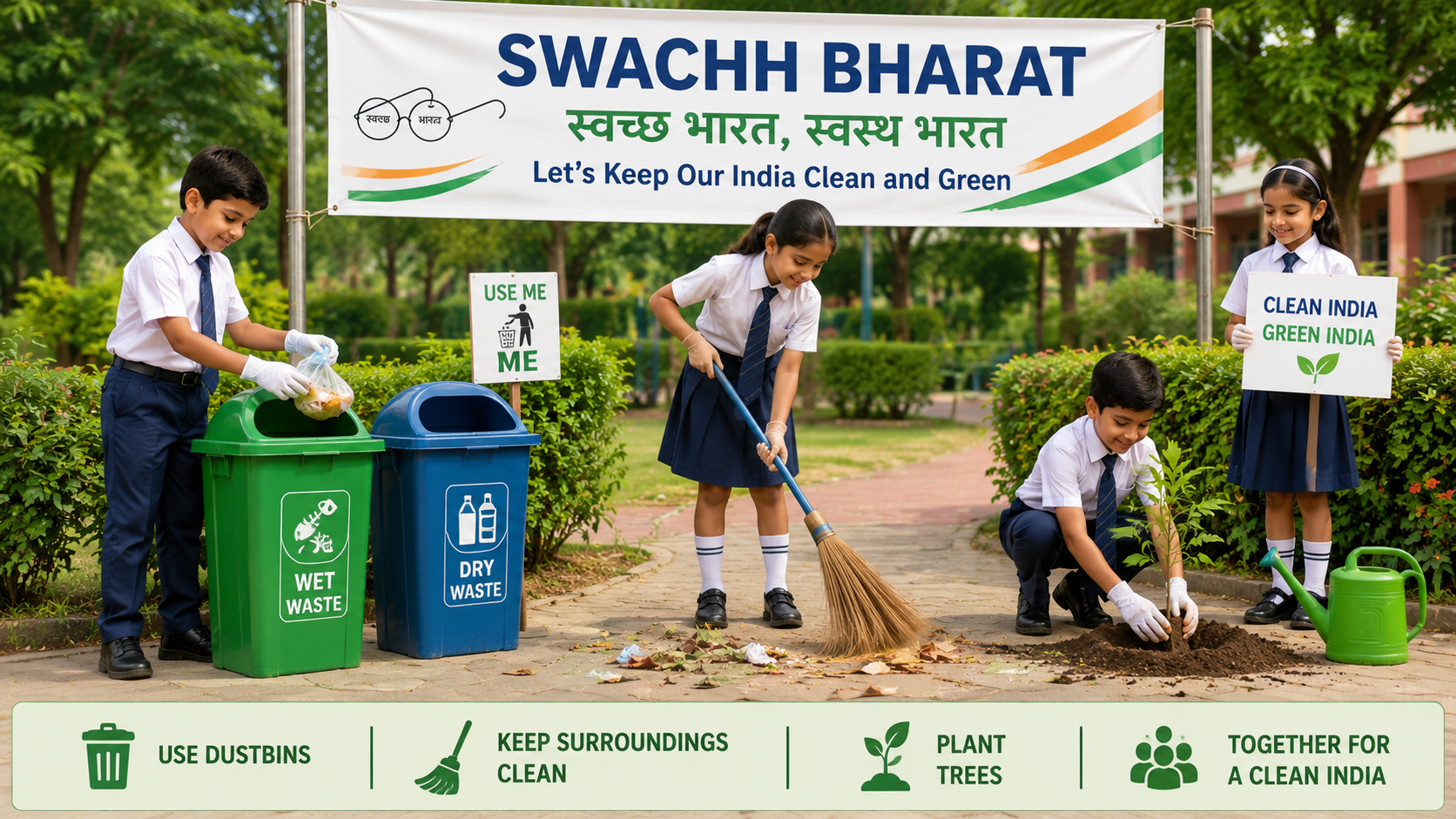
Waste Segregation
| Type | Dustbin Colour | Examples |
|---|---|---|
| Wet Waste (Biodegradable) | Green | Vegetable peels, leftover food, tea leaves, flowers |
| Dry Waste (Non-biodegradable) | Blue | Paper, plastic bottles, glass, metal cans |
| Hazardous Waste | Red | Batteries, medicines, broken glass, chemicals |
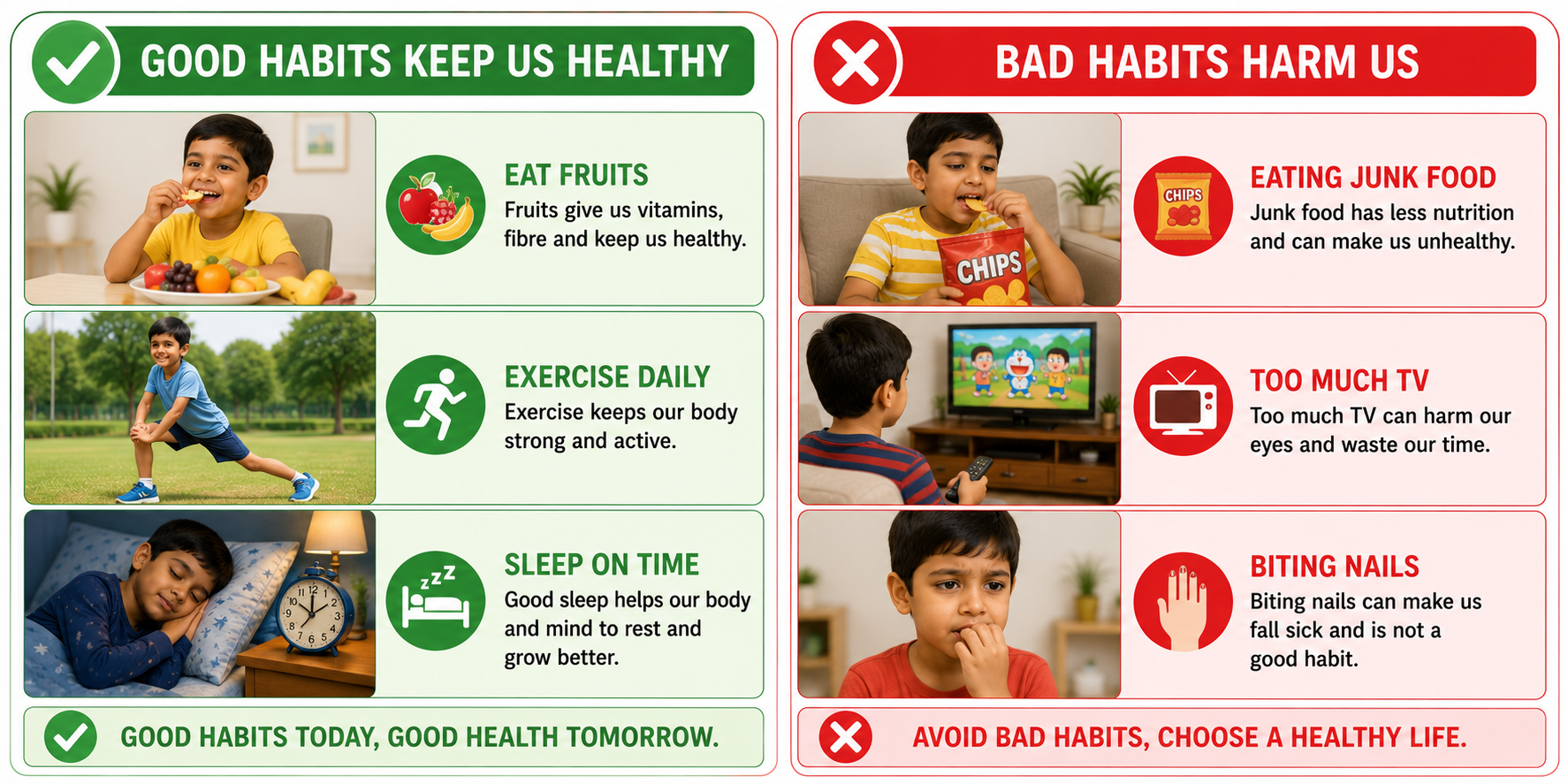
6. Bad Habits to Avoid
Some habits are harmful to our health and make others uncomfortable. We must try to avoid these:
| Bad Habit | Why It Is Harmful |
|---|---|
| Biting nails | Germs from nails go into stomach; nails become ugly |
| Eating too much junk food | Makes us fat, weak teeth, stomach problems |
| Not brushing teeth | Cavities, bad breath, toothache |
| Watching too much TV / mobile | Weak eyesight, headache, less physical activity |
| Sleeping late at night | Feeling tired, cannot concentrate in school |
| Littering / throwing garbage on road | Spreads diseases, makes surroundings dirty and smelly |
| Not drinking enough water | Dehydration, kidney problems, tiredness |
| Skipping breakfast | Low energy, poor concentration, weakness |
Key Words
| Word | Meaning |
|---|---|
| Hygiene | Keeping our body and surroundings clean to stay healthy |
| Germs | Tiny living things (bacteria, viruses) that cause diseases |
| Balanced diet | Food that has all nutrients — carbohydrates, proteins, vitamins, fats, water |
| Nutrients | Useful substances in food that help our body grow and work |
| Exercise | Physical activity that keeps our body fit and strong |
| Manners | Polite behaviour that shows respect for others |
| Swachh Bharat | Clean India Mission started in 2014 to make India clean |
| Waste segregation | Separating wet waste and dry waste into different bins |
| Biodegradable | Waste that rots naturally (food scraps, leaves) |
| Junk food | Unhealthy food with too much oil, sugar, or salt (chips, samosa, cold drinks) |
- Personal hygiene means keeping our body clean — brush twice, bathe daily, wash hands often.
- Wash hands with soap for 20 seconds before eating and after using the toilet.
- A balanced diet includes energy foods (roti, rice), body-building foods (dal, milk), and protective foods (fruits, vegetables).
- Children need 9–11 hours of sleep and at least 1 hour of exercise daily.
- Good manners include saying please, thank you, sorry, and respecting elders.
- Swachh Bharat Abhiyan teaches us to keep India clean — use dustbins, separate waste, plant trees.
- Avoid bad habits like nail biting, junk food, too much screen time, and littering.
Practice Questions
| Column A | Column B |
|---|---|
| 1. Green dustbin | a. Body-building food |
| 2. Dal and milk | b. Wet waste |
| 3. Swachh Bharat | c. 20 seconds |
| 4. Handwashing time | d. Good manners |
| 5. Saying "please" | e. Clean India Mission |
Activity 1: My Daily Routine Chart
Fill in what time you do each activity. Try to follow this routine every day!
| Activity | Time I Do It | ✓ / ✗ |
|---|---|---|
| Wake up | ||
| Brush teeth (morning) | ||
| Bath | ||
| Breakfast | ||
| Exercise / Play | ||
| Brush teeth (night) | ||
| Sleep |
Activity 2: Cleanliness Pledge
Write a pledge (promise) about how you will keep your school and neighbourhood clean. Start with: "I promise to..."
Want a printable worksheet? Switch to the Worksheet View, then print.