Historical Monuments of India
Learning Objectives
- I can explain what a monument is and why we preserve them.
- I can name famous historical monuments of India and their locations.
- I can describe the Taj Mahal, Red Fort, Qutub Minar, and other important monuments.
- I can explain what UNESCO World Heritage Sites are.
- I can describe ways to protect and care for our monuments.
- I can connect monuments to the history and culture of India.
What is a Monument?
A monument is an old building or structure that was built many years ago. Monuments tell us about the history, culture, and art of our country.
India is a land of rich history. Our ancestors built beautiful palaces, forts, temples, mosques, and tombs hundreds of years ago. These buildings are called historical monuments.
Monuments are like history books made of stone! They tell us stories about kings, queens, battles, and the way people lived long ago.
Why Do We Preserve Monuments?
We take care of old monuments because:
- They teach us history — We learn about our past, our kings, and our culture.
- They show amazing art — The carvings, paintings, and designs are beautiful works of art.
- They attract tourists — People from all over the world come to see them, which helps our economy.
- They are our heritage — They belong to all Indians and make us proud of our country.
- They connect us to our roots — They remind us where we came from and who built our nation.
Famous Monuments of India
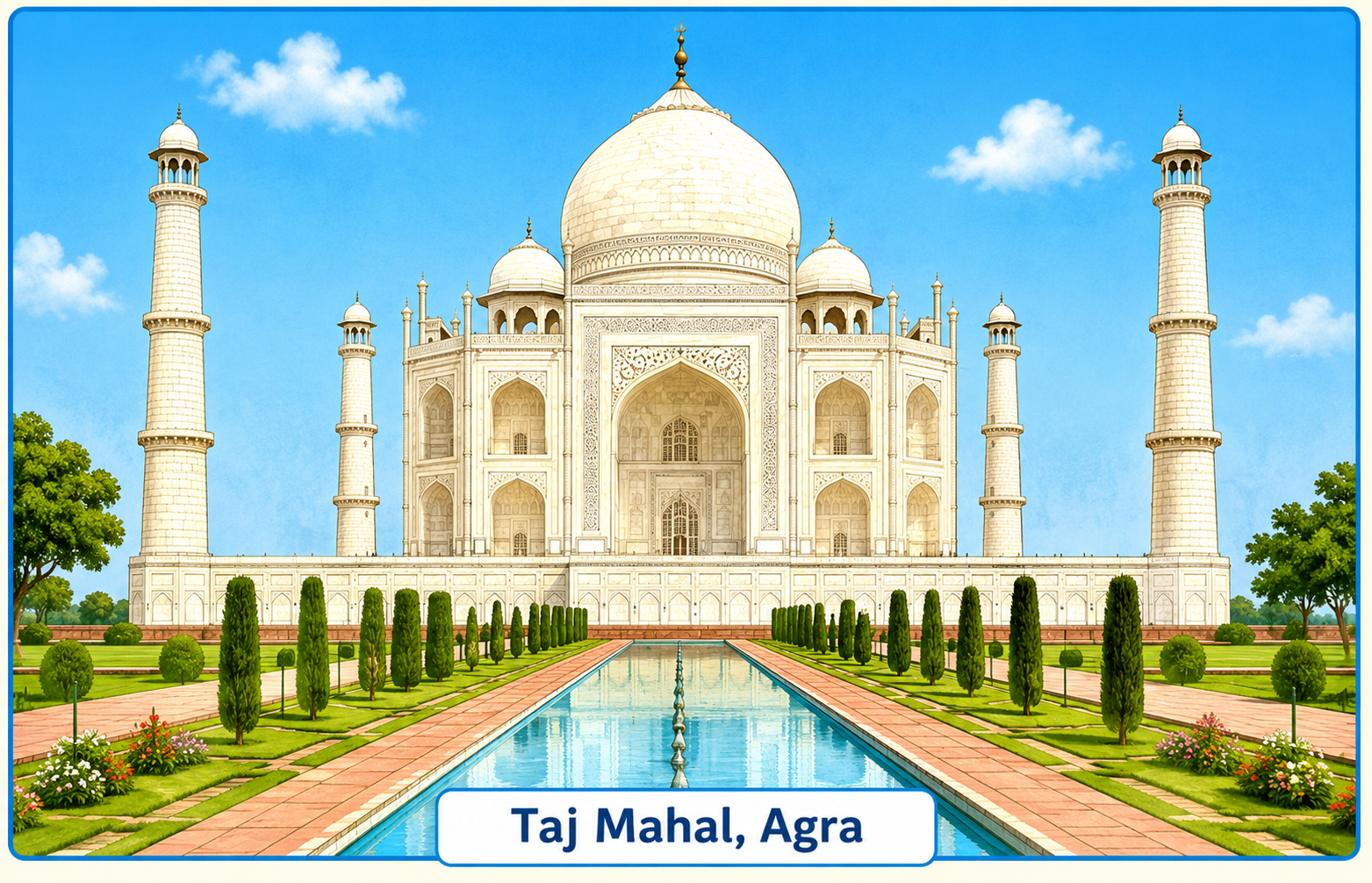
1. Taj Mahal — Agra, Uttar Pradesh
The Taj Mahal is one of the most beautiful buildings in the world. It was built by Mughal Emperor Shah Jahan in memory of his wife Mumtaz Mahal. It is made of pure white marble and took about 22 years to build (1632–1653). Around 20,000 workers helped build it!
The Taj Mahal is called the "Symbol of Love" and is one of the Seven Wonders of the World.
2. Red Fort (Lal Qila) — Delhi
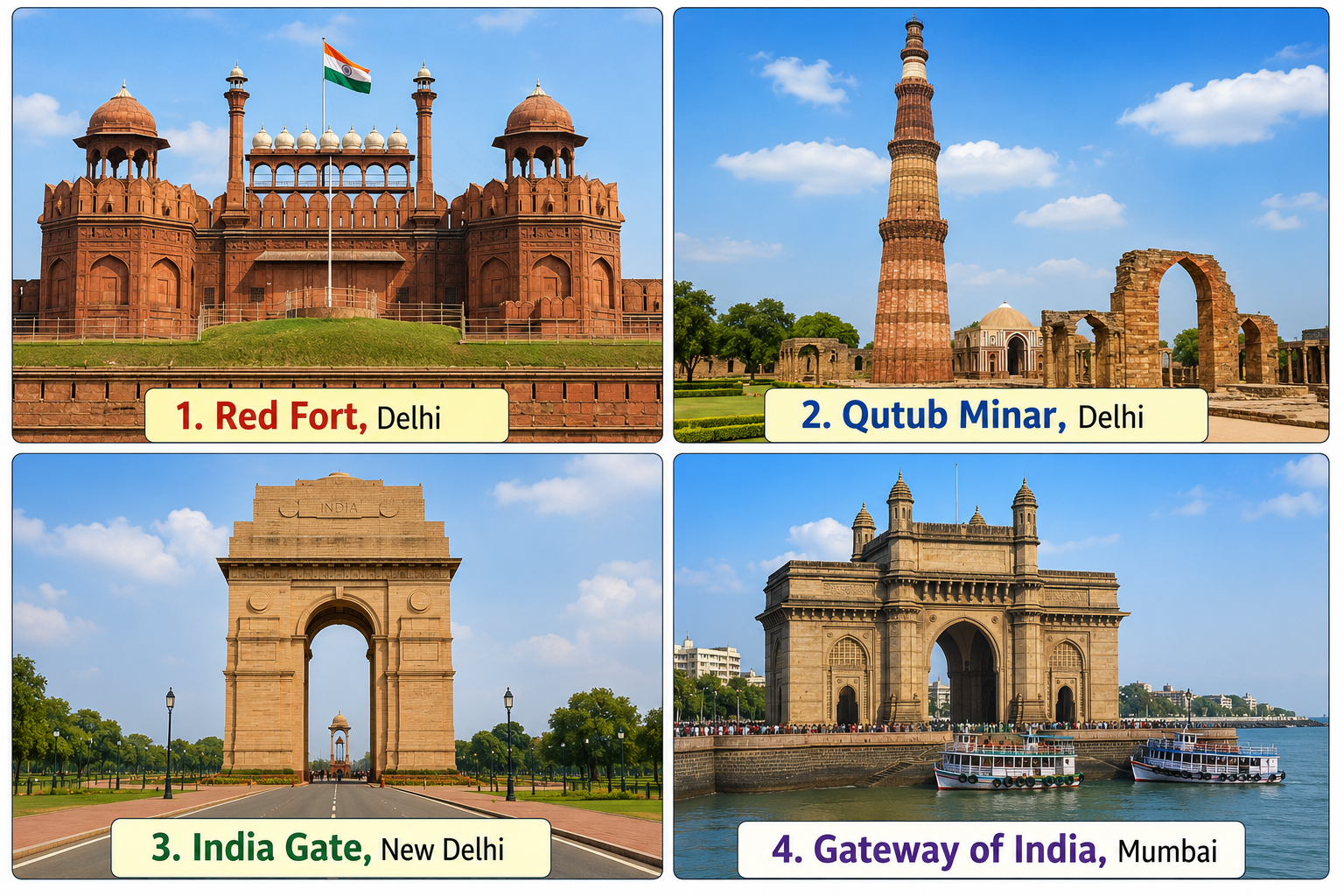
The Red Fort is a massive fort made of red sandstone. It was built by Mughal Emperor Shah Jahan in 1639. The Prime Minister of India hoists the national flag here every year on 15th August (Independence Day).
The fort has beautiful gardens, halls, and the famous Diwan-i-Aam (Hall of Public Audience) and Diwan-i-Khas (Hall of Private Audience).
3. Qutub Minar — Delhi
The Qutub Minar is the tallest brick minaret (tower) in the world at 72.5 metres high! It was started by Qutub-ud-din Aibak in 1193 and completed by his successor Iltutmish. It has 5 storeys and 379 steps inside.
4. India Gate — Delhi
India Gate is a war memorial built in memory of 70,000 Indian soldiers who died fighting in World War I. It was designed by Sir Edwin Lutyens and completed in 1931. It is 42 metres tall and has an eternal flame called the Amar Jawan Jyoti.
5. Gateway of India — Mumbai, Maharashtra
The Gateway of India is a grand arch built on the waterfront of Mumbai. It was built in 1924 to welcome King George V and Queen Mary when they visited India. It overlooks the Arabian Sea and is made of yellow basalt and concrete.
6. Hawa Mahal (Palace of Winds) — Jaipur, Rajasthan
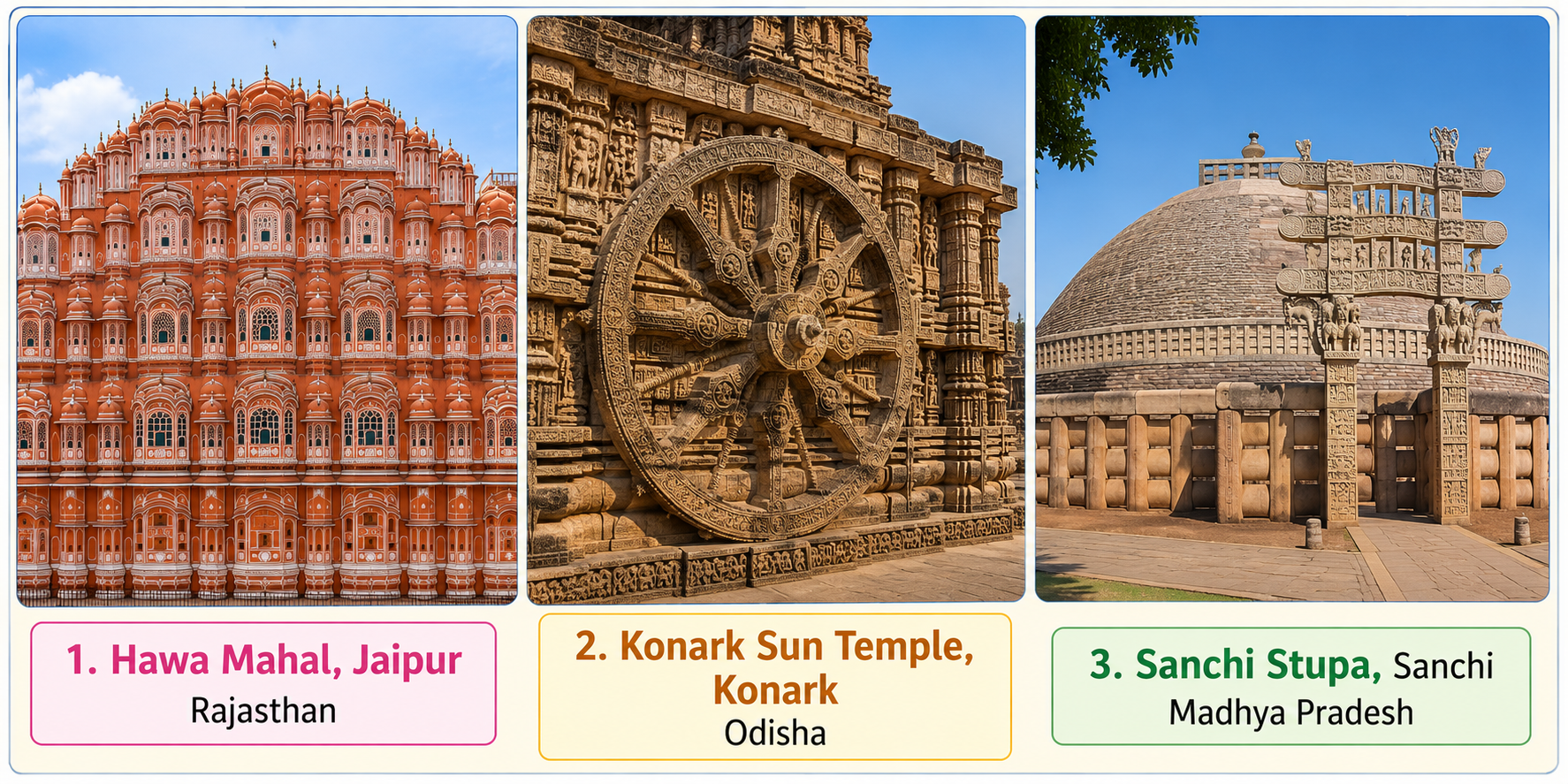
Hawa Mahal has 953 small windows (jharokhas)! It was built in 1799 by Maharaja Sawai Pratap Singh. The windows allowed royal women to watch street festivals without being seen. It is made of pink sandstone and looks like a honeycomb.
7. Konark Sun Temple — Odisha
The Konark Sun Temple is shaped like a giant chariot with 24 wheels, pulled by 7 horses. It was built by King Narasimhadeva I in the 13th century. It is dedicated to the Sun God (Surya). The wheels also work as sundials!
8. Sanchi Stupa — Madhya Pradesh
The Sanchi Stupa is one of the oldest Buddhist monuments in India. It was built by Emperor Ashoka in the 3rd century BCE to preserve the relics of Lord Buddha. It is a large dome-shaped structure with beautiful carved gateways (toranas).
9. Ajanta and Ellora Caves — Maharashtra
The Ajanta Caves have 30 rock-cut caves with beautiful paintings and sculptures of Lord Buddha. The Ellora Caves have 34 caves with Hindu, Buddhist, and Jain temples carved out of rock! The famous Kailasa Temple at Ellora was carved from a single rock — top to bottom!
Monuments at a Glance
| Monument | Location | Built By | Special Feature |
|---|---|---|---|
| Taj Mahal | Agra, UP | Shah Jahan | White marble, symbol of love |
| Red Fort | Delhi | Shah Jahan | Red sandstone, Independence Day flag |
| Qutub Minar | Delhi | Qutub-ud-din Aibak | Tallest brick minaret (72.5 m) |
| India Gate | Delhi | Sir Edwin Lutyens | War memorial, Amar Jawan Jyoti |
| Gateway of India | Mumbai | British Government | Waterfront arch, Arabian Sea |
| Hawa Mahal | Jaipur | Sawai Pratap Singh | 953 windows, pink sandstone |
| Konark Sun Temple | Odisha | Narasimhadeva I | Chariot shape, 24 wheels |
| Sanchi Stupa | MP | Emperor Ashoka | Buddhist dome, carved gateways |
| Ajanta & Ellora | Maharashtra | Various dynasties | Rock-cut caves, paintings |
UNESCO World Heritage Sites
UNESCO (United Nations Educational, Scientific and Cultural Organization) identifies special places around the world that must be protected for future generations. These are called World Heritage Sites.
India has 42 UNESCO World Heritage Sites — making it one of the countries with the most heritage sites in the world!
Some Indian UNESCO World Heritage Sites:
- Taj Mahal, Agra
- Red Fort, Delhi
- Qutub Minar, Delhi
- Konark Sun Temple, Odisha
- Ajanta Caves, Maharashtra
- Ellora Caves, Maharashtra
- Sanchi Stupa, Madhya Pradesh
- Hampi Ruins, Karnataka
- Khajuraho Temples, Madhya Pradesh
- Mahabodhi Temple, Bihar
How to Protect Our Monuments
Our monuments are very old and delicate. We must take care of them:
- Do not write or scratch on walls — graffiti damages the stone.
- Do not throw litter — keep the monument area clean.
- Do not touch carvings — oils from our hands can damage old stone.
- Follow rules — obey signs and guides at heritage sites.
- Reduce pollution — air pollution turns white marble yellow (like the Taj Mahal).
- Spread awareness — tell others about the importance of monuments.
- Support ASI — the Archaeological Survey of India works to restore and protect monuments.
Key Words
| Word | Meaning |
|---|---|
| Monument | An old building or structure of historical importance |
| Heritage | Things passed down from our ancestors (buildings, traditions, culture) |
| Preserve | To protect and keep safe for the future |
| UNESCO | United Nations body that identifies World Heritage Sites |
| Minaret | A tall tower, usually part of a mosque |
| Tomb | A building where a dead person is buried |
| Stupa | A dome-shaped Buddhist monument |
| Archaeological | Related to the study of old buildings and objects |
- A monument is an old building of historical importance.
- We preserve monuments to learn history, appreciate art, and protect our heritage.
- The Taj Mahal (Agra) was built by Shah Jahan in white marble — a symbol of love.
- Red Fort (Delhi) — Independence Day flag hoisting happens here every year.
- Qutub Minar (Delhi) is the tallest brick minaret in the world (72.5 m).
- India Gate (Delhi) is a war memorial for soldiers of World War I.
- India has 42 UNESCO World Heritage Sites.
- ASI (Archaeological Survey of India) protects our monuments.
- We should not write on walls, litter, or touch carvings at monuments.
Practice Questions
| Column A | Column B |
|---|---|
| 1. Taj Mahal | a. Tallest brick minaret |
| 2. Qutub Minar | b. 953 windows |
| 3. Hawa Mahal | c. War memorial |
| 4. India Gate | d. White marble, Agra |
| 5. Konark Temple | e. Chariot with 24 wheels |
Activity 1: Monument Passport
Imagine you are visiting these monuments. Fill in your "Monument Passport":
| Monument | City | One Interesting Fact |
|---|---|---|
| Taj Mahal | ||
| Red Fort | ||
| Qutub Minar |
Activity 2: Draw your favourite Indian monument and write 3 sentences about it.
Want a printable worksheet? Switch to the Worksheet View, then print.