Life in the Past and Present
Learning Objectives
- I can describe how life was different long ago compared to today.
- I can compare houses, food, clothes, and transport of the past and present.
- I can explain how communication and entertainment have changed over time.
- I can describe how education and money systems have changed.
- I can name important inventions that changed people's lives.
- I can identify things that have stayed the same across time (love, family, festivals).
Let Us Begin!
Have you ever wondered how your grandparents lived when they were children? Did they have phones, cars, or TV? Life was very different long ago!
Over hundreds of years, people have invented new things that made life easier and more comfortable. From living in caves to living in tall buildings — humans have come a long way!
Let us travel back in time and see how life has changed from the past to the present.
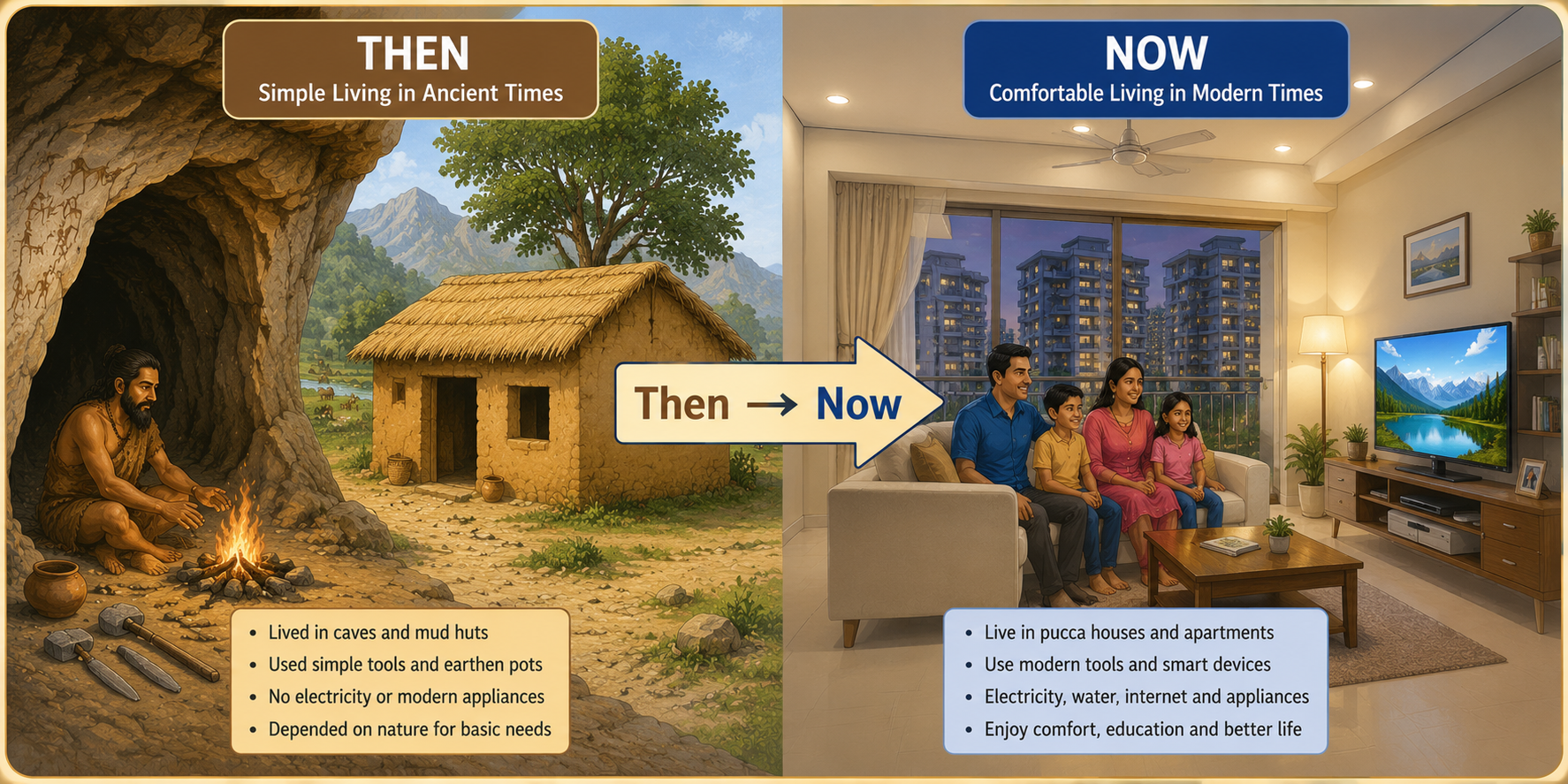
Houses — Then and Now
The way people live and the homes they build have changed greatly over time:
| Long Ago (Past) | Today (Present) |
|---|---|
| People lived in caves to stay safe from wild animals and rain | We live in pucca houses, flats, and apartments |
| Later, they built huts from mud, straw, and leaves | Houses are made of bricks, cement, and steel |
| No electricity — used fire for light | Electric lights, fans, and air conditioners |
| Cooked on open fire or chulha | Gas stoves, microwave ovens, induction cookers |
| Water from rivers and wells | Taps, water purifiers, pipelines |
Food — Then and Now
How people got their food has changed a lot:
| Long Ago (Past) | Today (Present) |
|---|---|
| People hunted animals and gathered fruits from forests | We buy food from shops and markets |
| Later, they learned farming — grew wheat, rice, vegetables | Modern farming with tractors and machines |
| Ate raw food or cooked on open fire | Cooked food on gas stoves; packaged and frozen food available |
| No refrigerators — food spoiled quickly | Refrigerators keep food fresh for days |
| Ate only local, seasonal food | Food from all over the world available (mangoes in winter!) |
Clothes — Then and Now
| Long Ago (Past) | Today (Present) |
|---|---|
| Wore leaves, bark of trees, and animal skins | Wear clothes made of cotton, silk, wool, and synthetic fabrics |
| No stitched clothes — wrapped cloth around body | Stitched clothes — shirts, pants, dresses, sarees |
| Made by hand — spinning and weaving at home | Made in factories using machines |
| Very few clothes; same for all seasons | Different clothes for summer, winter, rain, parties, school |
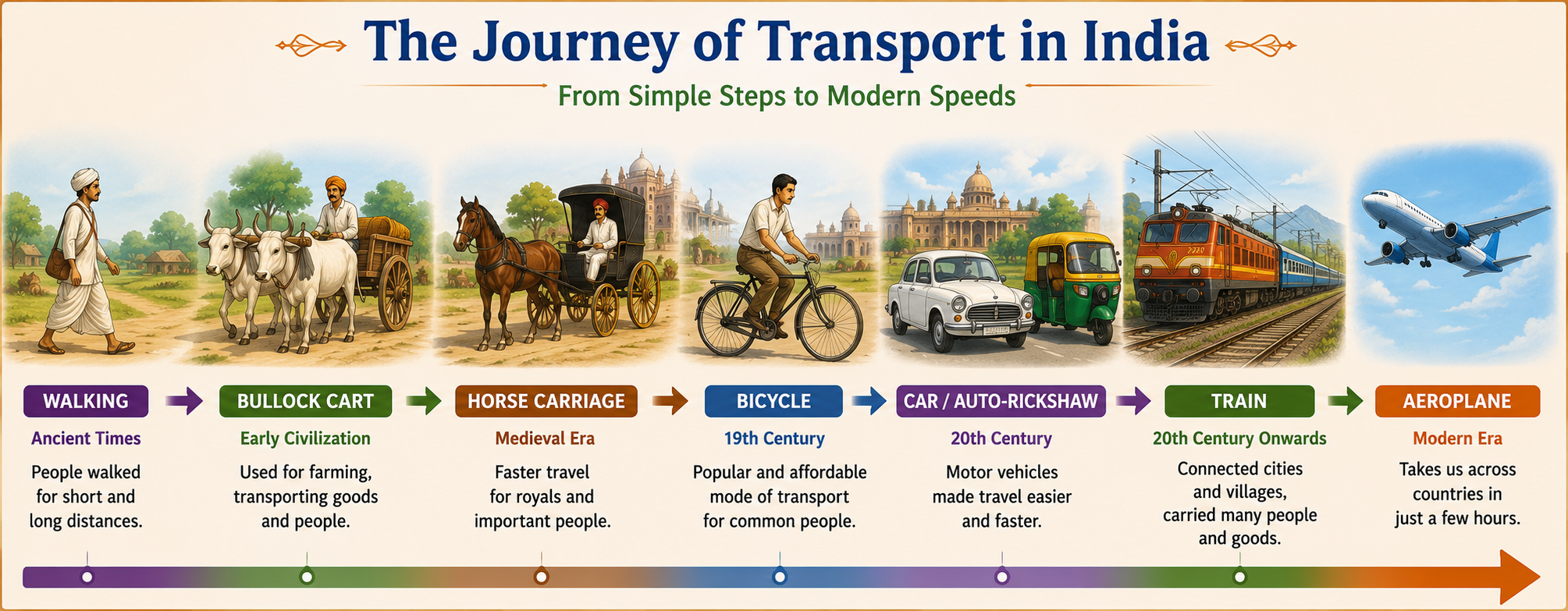
Transport — Then and Now
How people travel from one place to another has changed dramatically:
| Long Ago (Past) | Today (Present) |
|---|---|
| People walked everywhere on foot | Cars, buses, auto-rickshaws, metro trains |
| Used animals — horses, camels, elephants, donkeys | Motorcycles, bicycles, electric scooters |
| Bullock carts carried goods and people | Trucks and trains carry heavy goods |
| Boats and rafts on rivers | Big ships and submarines cross oceans |
| No air travel — could not fly | Aeroplanes and helicopters fly across the world |
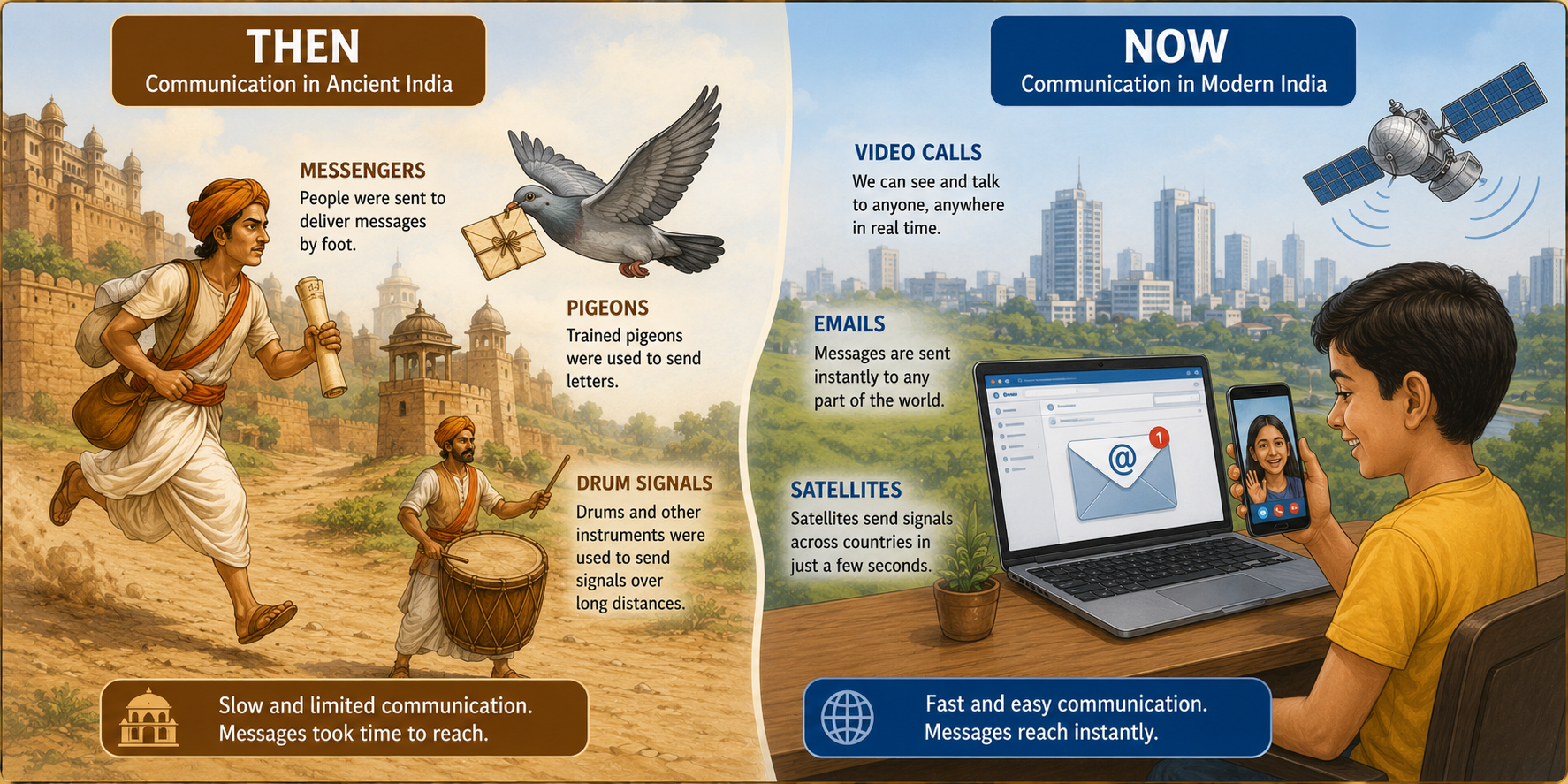
Communication — Then and Now
How people send messages and talk to each other has changed the most:
| Long Ago (Past) | Today (Present) |
|---|---|
| Sent messages through messengers (runners) | Instant messages on mobile phones |
| Used pigeons to carry letters | Email and WhatsApp — messages reach in seconds |
| Beat drums or lit fires to signal danger | Sirens, alarms, news channels alert people |
| Wrote on palm leaves and stone tablets | Write on paper, type on computers |
| Letters took days or weeks to reach | Video calls — see and talk to anyone instantly |
Entertainment — Then and Now
| Long Ago (Past) | Today (Present) |
|---|---|
| Grandparents told stories at night | Watch TV shows, movies, and cartoons |
| Sang folk songs and played traditional games (kabaddi, gilli-danda) | Listen to music on phones; play video games |
| Watched puppet shows and street plays (nautanki) | Go to cinemas, malls, and amusement parks |
| Played outdoors — climbing trees, swimming in ponds | Indoor games, tablets, online games |
| Festivals and fairs were the main entertainment | Festivals + internet + social media + travel |
Education — Then and Now
| Long Ago (Past) | Today (Present) |
|---|---|
| Children studied in gurukuls (teacher's home) | Children go to modern schools with classrooms |
| Lived with the guru (teacher) for many years | Come home every day after school |
| Learned by listening and memorising (oral tradition) | Learn from books, computers, and the internet |
| Wrote on palm leaves or the ground with sticks | Write in notebooks; type on computers |
| Only some children (mostly boys) could study | All children — boys and girls — go to school (Right to Education) |
Money — Then and Now
| Long Ago (Past) | Today (Present) |
|---|---|
| Barter system — exchanged goods (gave rice, got cloth) | Use money (coins and notes) to buy things |
| No fixed prices — depended on need | Fixed prices in shops (MRP) |
| Later, used gold and silver coins | Paper notes, coins (₹1, ₹2, ₹5, ₹10, ₹500) |
| Had to carry heavy coins everywhere | Digital payments — UPI, Google Pay, Paytm |
A farmer gives 5 kg of rice to a weaver. The weaver gives one piece of cloth to the farmer. No money is used — they just exchange what they have!
Important Inventions That Changed Life
Some inventions made life much easier for everyone:
| Invention | How It Changed Life |
|---|---|
| 🔥 Fire | Cooking food, staying warm, keeping animals away |
| ☸️ Wheel | Made transport and carrying heavy things easy |
| 💡 Electricity | Lights, fans, machines — changed everything! |
| 📞 Telephone | Talk to people far away instantly |
| 🚂 Steam Engine | Trains and factories — faster travel and production |
| 💻 Computer | Store information, solve problems, connect the world |
| 🌐 Internet | Access knowledge, talk to anyone, work from anywhere |
Things That Have NOT Changed
Even though many things have changed, some beautiful things remain the same:
- Love — Parents loved their children in the past, and they love them today too.
- Family — People lived together as families then, and they still do now.
- Festivals — We still celebrate Diwali, Eid, Christmas, Holi, Pongal just like our ancestors did.
- Respect for elders — Touching feet and listening to grandparents is still important.
- Helping others — Kindness and sharing have always been valued.
- Nature — The sun, moon, rivers, and mountains are the same as thousands of years ago.
- Stories and songs — We still tell stories from the Panchatantra and Ramayana.
Key Words
| Word | Meaning |
|---|---|
| Past | The time that has already gone by (long ago) |
| Present | The time we are living in now (today) |
| Invention | Something new that is created for the first time |
| Barter | Exchanging goods without using money |
| Gurukul | Ancient Indian school at the teacher's home |
| Communication | Sending and receiving messages or information |
| Transport | Moving people or things from one place to another |
| Digital | Using computers and the internet (not physical) |
- Life was very different long ago — no electricity, no cars, no phones.
- Houses changed from caves and huts to modern apartments.
- People went from hunting/gathering to farming and buying from shops.
- Clothes changed from leaves and animal skins to cotton, silk, and synthetic fabrics.
- Transport evolved from walking and bullock carts to cars, trains, and aeroplanes.
- Communication changed from messengers and pigeons to phones and internet.
- Education moved from gurukuls to modern schools open to all children.
- Money changed from barter to coins to digital payments (UPI).
- Inventions like fire, wheel, electricity, and computers changed life greatly.
- Love, family, festivals, and respect for elders have NOT changed.
Practice Questions
| Column A (Past) | Column B (Present) |
|---|---|
| 1. Caves and huts | a. Cars and aeroplanes |
| 2. Pigeons and messengers | b. Mobile phones and internet |
| 3. Bullock carts | c. Apartments and buildings |
| 4. Gurukul | d. UPI and digital payments |
| 5. Barter system | e. Modern schools |
Activity 1: Ask Your Grandparents!
Talk to your grandparents or an elderly person. Ask them how life was different when they were young. Fill in:
| Topic | When They Were Young | Today |
|---|---|---|
| How they went to school | ||
| What games they played | ||
| How they sent messages |
Activity 2: Draw and Compare
Draw a picture showing life in the past on one side and life today on the other side. Include houses, transport, and clothes.
Want a printable worksheet? Switch to the Worksheet View, then print.