I can tell the difference between living and non-living things.
I can list the characteristics of living things (breathe, eat, grow, move, reproduce, respond, die).
I can give examples of living and non-living things around me.
I can classify non-living things as natural or man-made.
I can identify things that were once living but are now non-living.
I can observe and classify things in my surroundings correctly.
📖 Introduction
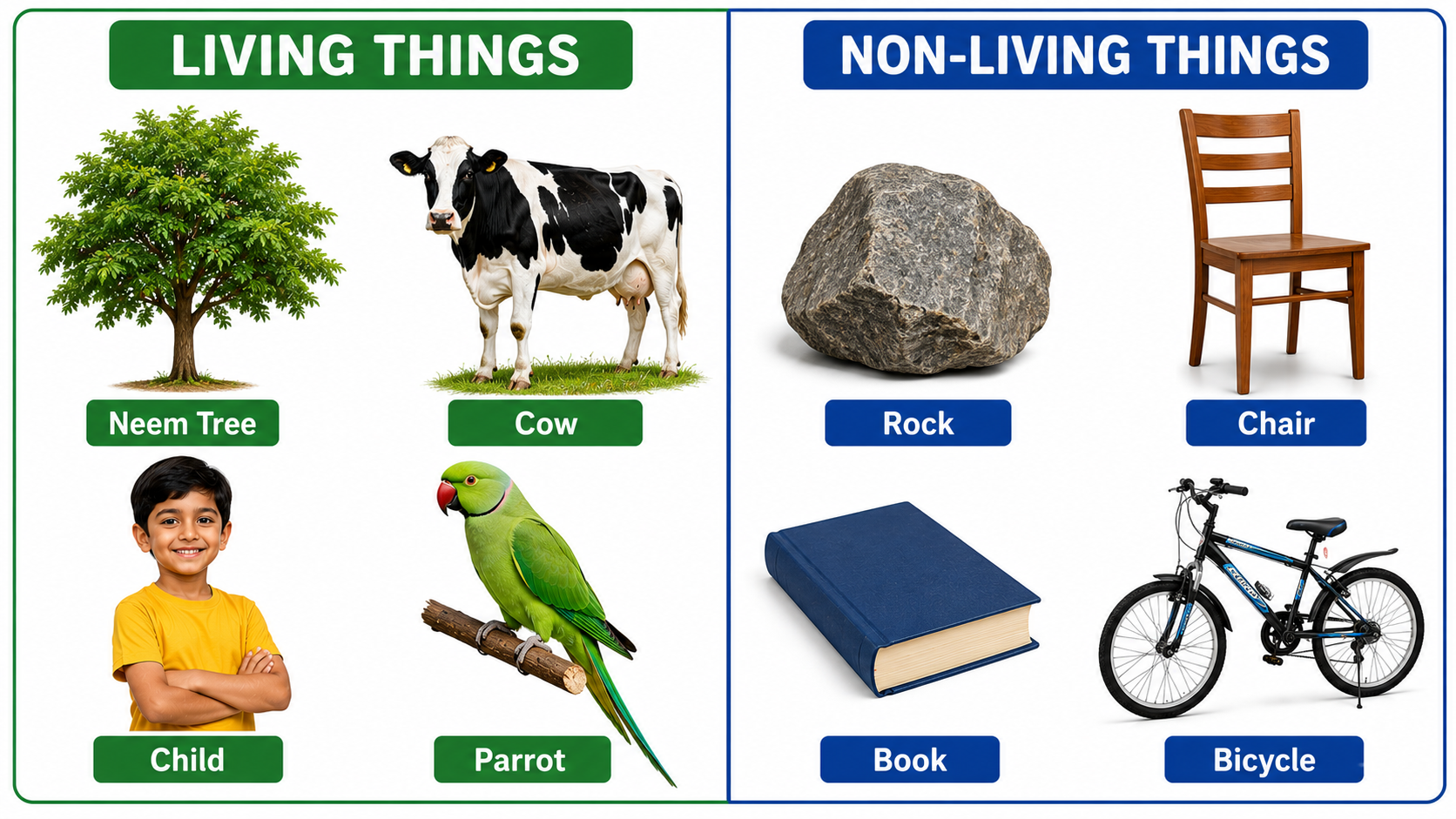
Look around you! You can see many things — a neem tree in the garden, a cow on the road, a stone on the ground, and a book on your desk. Are all these things the same? No!
Some things are alive — they breathe, eat, grow, and move. These are called living things. Other things do not breathe, eat, or grow on their own. These are called non-living things.
Let us learn how to tell the difference between living and non-living things!
What are Living Things?
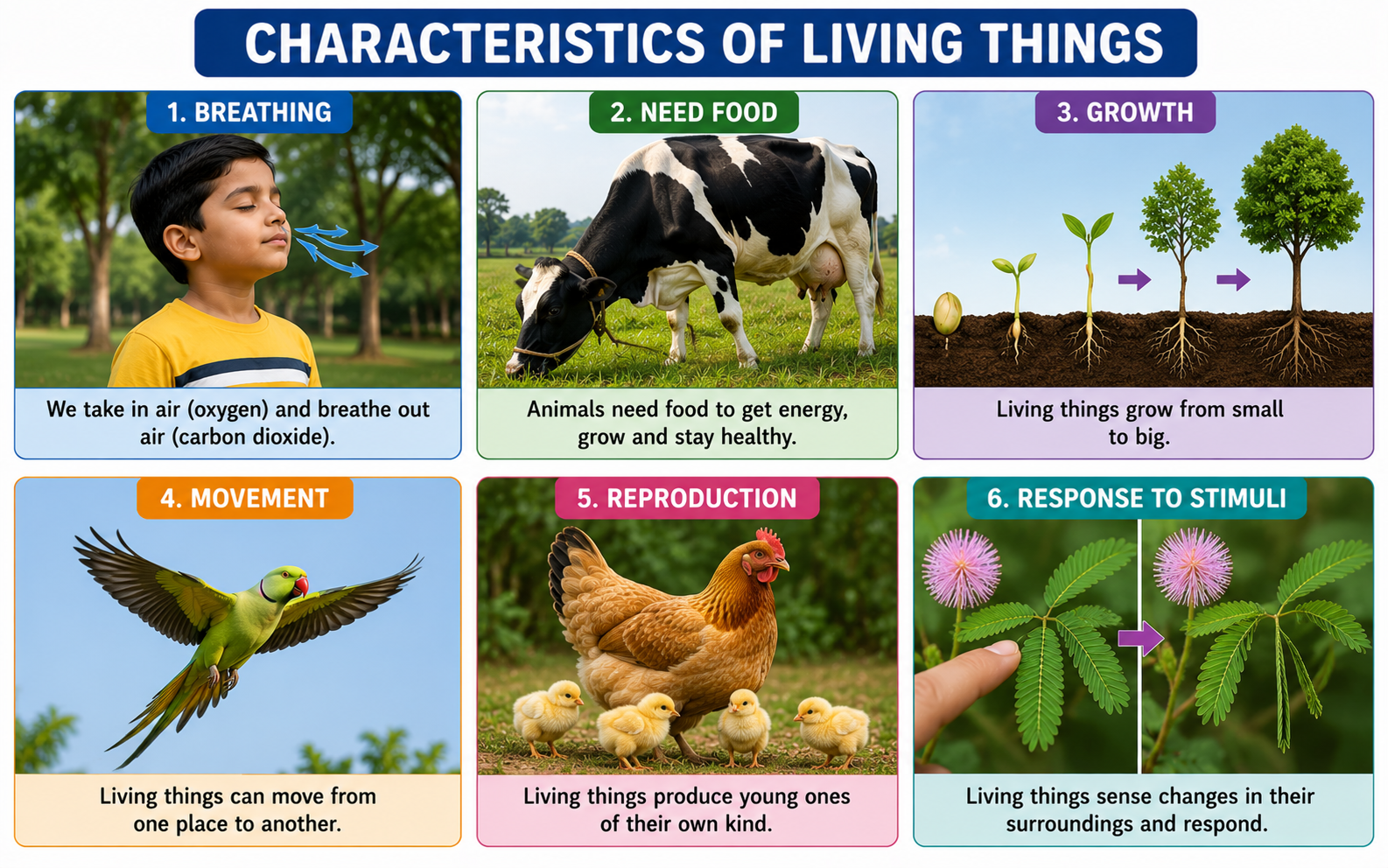
Living things are all around us. Plants, animals, birds, insects, fish, and humans are all living things. They share some special characteristics:
Characteristic
What It Means
Example
Breathe
All living things need air to stay alive
We breathe in oxygen; plants take in carbon dioxide
Eat (Need food)
Living things need food for energy
A cow eats grass; a neem tree makes food from sunlight
Grow
Living things increase in size over time
A baby grows into an adult; a seed grows into a tree
Move
Living things can move on their own
A dog runs; a sunflower turns towards the sun
Reproduce
Living things produce young ones like themselves
A hen lays eggs; a mango tree produces seeds
Respond
Living things react to changes around them
We feel hot/cold; a touch-me-not plant closes its leaves
Die
All living things have a lifespan and eventually die
Leaves dry and fall; animals grow old and die
Did you know? Even plants are living things! They breathe, eat (make food using sunlight), grow, and respond to light and water — but they cannot move from place to place like animals.
What are Non-Living Things?
Non-living things do not have life. They do not breathe, eat, grow, move on their own, or reproduce. Here are their characteristics:
Do not breathe — A stone does not need air.
Do not eat — A chair does not need food.
Do not grow — A book stays the same size forever.
Do not move on their own — A car needs a driver; a ball needs someone to kick it.
Do not reproduce — A table cannot make baby tables!
Do not respond — A rock does not feel hot or cold.
Do not die — They can break or wear out, but they do not die like living things.
Examples: Rocks, water, air, soil, chair, book, car, phone, Taj Mahal, Ganga river (the water is non-living, but fish in it are living!)
Differences Between Living and Non-Living Things
Feature
Living Things
Non-Living Things
Breathing
Need air to breathe
Do not breathe
Food
Need food for energy
Do not need food
Growth
Grow in size
Do not grow
Movement
Move on their own
Cannot move on their own
Reproduction
Produce young ones
Cannot reproduce
Response
React to surroundings
Do not respond
Lifespan
Born, grow, and die
Do not have a lifespan
Examples of Living Things
Living things can be grouped into different categories:
Category
Examples
Plants
Neem tree, Mango tree, Tulsi, Rose, Banyan tree, Grass
Animals
Cow, Dog, Cat, Elephant, Tiger, Monkey
Humans
You, your family, your teacher, your friends
Insects
Ant, Butterfly, Bee, Mosquito, Ladybird
Birds
Sparrow, Peacock, Parrot, Crow, Pigeon
Fish & Water Animals
Rohu fish, Frog, Turtle, Dolphin, Whale
Even tiny things you cannot see — like bacteria — are living things! They breathe, eat, grow, and reproduce, just like us.
Examples of Non-Living Things
Non-living things can be divided into two groups:
1. Natural Non-Living Things
These are found in nature. No one made them.
Thing
Where Found
Rocks and Stones
Mountains, rivers, ground
Water
Rivers (Ganga, Yamuna), lakes, oceans, rain
Air
All around us
Soil and Sand
Ground, deserts (Thar desert), farms
Sunlight
From the Sun
Mountains
Himalayas, Western Ghats
2. Man-Made Non-Living Things
These are made by humans from different materials.
Thing
Made From
Chair, Table
Wood or plastic
Book, Notebook
Paper (from trees)
Car, Bus, Train
Metal, rubber, glass
Phone, Computer
Metal, plastic, glass
Clothes
Cotton, silk, wool, synthetic
Buildings (Taj Mahal)
Stone, marble, cement
Natural vs Man-Made Non-Living Things
Feature
Natural Non-Living Things
Man-Made Non-Living Things
Made by
Nature (no human help)
Humans
Examples
Rocks, water, air, soil, sunlight
Chair, book, car, phone, buildings
Can be destroyed?
Very hard to destroy completely
Can break, tear, or wear out
Found where?
Everywhere in nature
In homes, schools, markets
The Taj Mahal is a non-living thing. It is man-made (built by Shah Jahan). But the marble stone it is made from is a natural non-living thing!
Things That Were Once Living
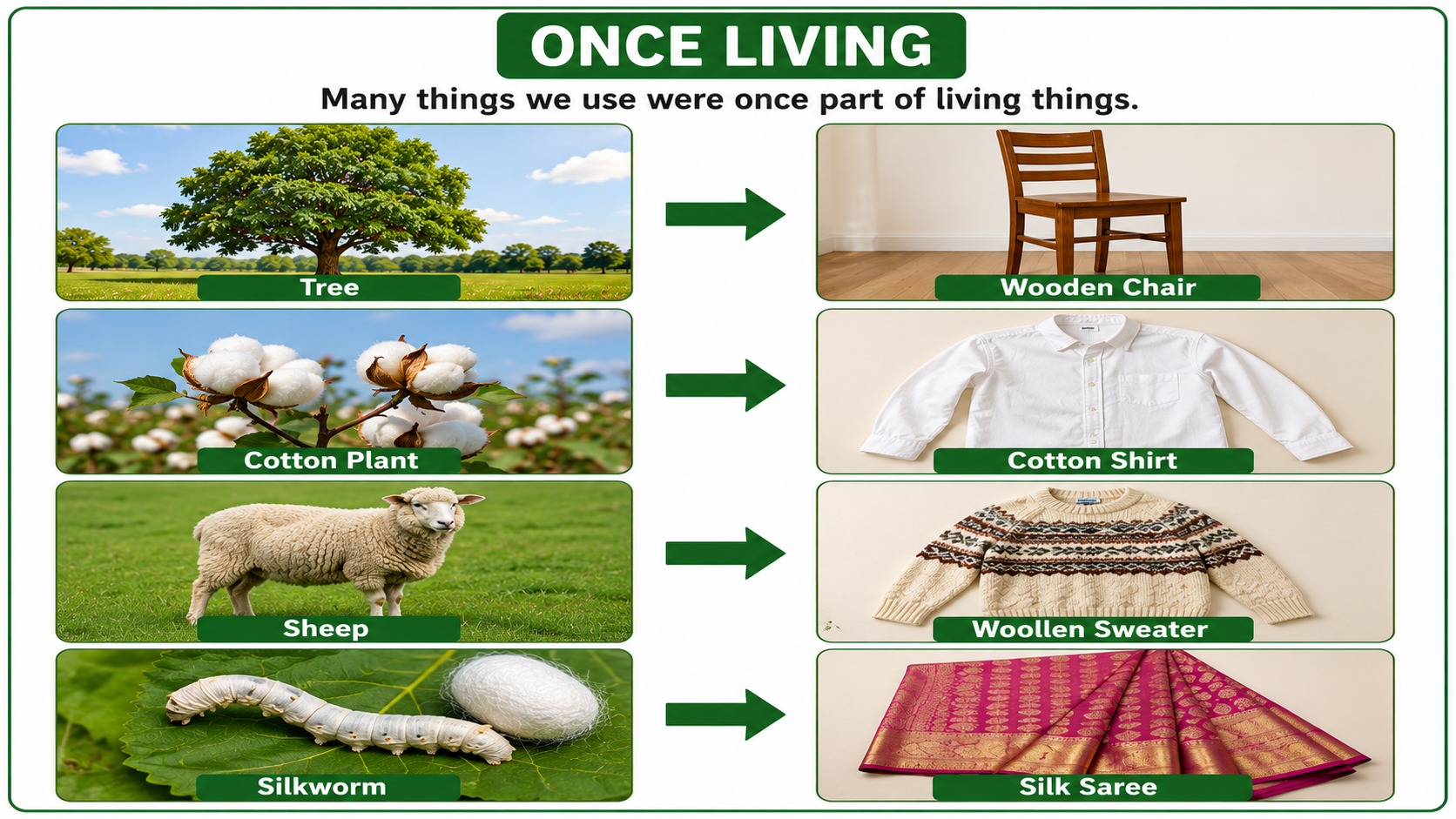
Some non-living things were once part of a living thing! They come from plants or animals that were alive:
Non-Living Thing
Came From (Living Thing)
Wood (furniture, doors)
Trees (cut down)
Paper
Trees (wood pulp)
Leather (bags, shoes, belts)
Animal skin (cow, buffalo)
Cotton (clothes)
Cotton plant
Wool (sweaters, shawls)
Sheep
Silk
Silkworm
Food (cooked rice, roti)
Plants (rice, wheat were living)
Dry leaves
Were once green and alive on a tree
Your wooden desk was once part of a living tree! The paper in your notebook also came from trees. That is why we should save paper and plant more trees.
📝 Key Words
Word
Meaning
Living things
Things that have life — they breathe, eat, grow, move, reproduce, and die
Non-living things
Things that do not have life — they cannot breathe, eat, or grow
Breathe
Taking in air (oxygen) to stay alive
Reproduce
To produce young ones of the same kind
Respond
To react to changes in the surroundings (heat, light, touch)
Natural
Found in nature, not made by humans
Man-made
Created or built by humans
Lifespan
The length of time a living thing stays alive
Characteristics
Special features or qualities of something
Organism
Any living thing (plant, animal, or human)
⭐ Key Points to Remember
Living things breathe, eat, grow, move, reproduce, respond to surroundings, and die.
Non-living things do not breathe, eat, grow, move on their own, or reproduce.
Plants are living things even though they cannot move from place to place.
Non-living things can be natural (rocks, water, air) or man-made (chair, book, car).
Some non-living things were once living — wood, paper, leather, cotton, wool, silk.
Living things have a lifespan — they are born, grow, and eventually die.
Non-living things can break or wear out, but they do not die.
✏️ Practice Questions
A. Fill in the Blanks
1. Things that breathe, eat, grow, and move are called things.
2. A stone is a thing.
3. Living things need and to stay alive.
4. Plants make their food using .
5. Non-living things that are found in nature are called non-living things.
6. Paper is made from which was once a living thing.
7. Living things produce young ones. This is called .
8. A plant closes its leaves when touched.
9. Wool comes from which is a living thing.
10. The Taj Mahal is a non-living thing.
B. Multiple Choice Questions
1. Which of the following is a living thing?
(a) Rock(b) Neem tree(c) Chair(d) Water
2. Which characteristic is NOT found in non-living things?
(a) Breaking(b) Growing(c) Rusting(d) Melting
3. Which of these was once a living thing?
(a) Stone(b) Water(c) Wooden table(d) Iron nail
4. Which is a natural non-living thing?
(a) Book(b) Car(c) River(d) Phone
5. Plants are living things because they:
(a) Cannot move(b) Grow and reproduce(c) Are green(d) Are big
C. Short Answer Questions
1. Write any four characteristics of living things.
2. Give three examples each of living and non-living things.
3. What is the difference between natural and man-made non-living things? Give examples.
4. Name three things that were once living. What living thing did they come from?
5. Why are plants called living things even though they cannot move from place to place?
D. True or False
1. A car is a living thing because it moves.
2. All living things need food and air.
3. Water is a living thing.
4. Wood was once part of a living tree.
5. Non-living things can reproduce.
E. Match the Following
Column A
Column B
1. Neem tree
a. Man-made non-living thing
2. River Ganga
b. Living thing (plant)
3. Wooden chair
c. Once living
4. Cow
d. Natural non-living thing
5. Leather bag
e. Living thing (animal)
🎨 Fun Activity: Classify Things Around You
Activity: Look around your classroom or home. Find 5 living things and 5 non-living things. Write them in the table below:
Living Things
Non-Living Things
Natural or Man-Made?
Bonus: Can you find something that was once living but is now non-living? Write it here:
Want a printable worksheet? Switch to the Worksheet View, then print.
EVS / Science
Living and Non-Living Things
Class 3 | CBSE / NCERT / ICSE
Name: Class: Date:
Things around us are either living (breathe, eat, grow, move, reproduce, respond, die) or non-living (do not breathe, eat, grow, move on their own, or reproduce).
Characteristics of Living Things
Characteristic
Meaning
Example
Breathe
Need air to stay alive
Humans breathe oxygen; plants take CO₂
Eat
Need food for energy
Cow eats grass; plants make food from sunlight
Grow
Increase in size
Baby → adult; seed → tree
Move
Move on their own
Dog runs; sunflower turns to sun
Reproduce
Produce young ones
Hen lays eggs; mango tree makes seeds
Respond
React to surroundings
Touch-me-not closes leaves
Die
Have a lifespan
Leaves fall; animals grow old
Non-Living Things
Do not breathe, eat, grow, move on their own, reproduce, or die. Examples: rocks, water, air, chair, book, car.
Differences: Living vs Non-Living
Feature
Living Things
Non-Living Things
Breathing
Need air
Do not breathe
Food
Need food
Do not need food
Growth
Grow in size
Do not grow
Movement
Move on their own
Cannot move on their own
Reproduction
Produce young ones
Cannot reproduce
Response
React to changes
Do not respond
Lifespan
Born, grow, die
No lifespan
Examples of Living Things
Category
Examples
Plants
Neem tree, Mango tree, Tulsi, Rose, Banyan
Animals
Cow, Dog, Cat, Elephant, Tiger
Humans
You, your family, teacher, friends
Insects
Ant, Butterfly, Bee, Mosquito
Birds
Sparrow, Peacock, Parrot, Crow
Fish
Rohu, Frog, Turtle, Dolphin
Examples of Non-Living Things
Type
Examples
Natural
Rocks, Water (Ganga), Air, Soil, Sunlight, Mountains (Himalayas)