National Symbols of India
Learning Objectives
- I can explain what national symbols are and why they are important.
- I can describe the Indian National Flag (Tiranga) — its colours, Ashoka Chakra, and rules.
- I can identify the National Emblem and its motto "Satyameva Jayate".
- I can name the National Anthem and National Song with their authors.
- I can identify India's national animal, bird, flower, fruit, tree, and river.
- I can tell the significance of each national symbol.
What Are National Symbols?
Every country has special symbols that represent it. These are called national symbols. They show the identity, culture, and pride of a nation.
India has many national symbols. Each one was chosen carefully because it represents something special about our country — our history, nature, strength, and values.
When we see our national flag or hear our national anthem, we feel proud to be Indian! Let us learn about all the national symbols of India.
🇮🇳 National Flag — Tiranga
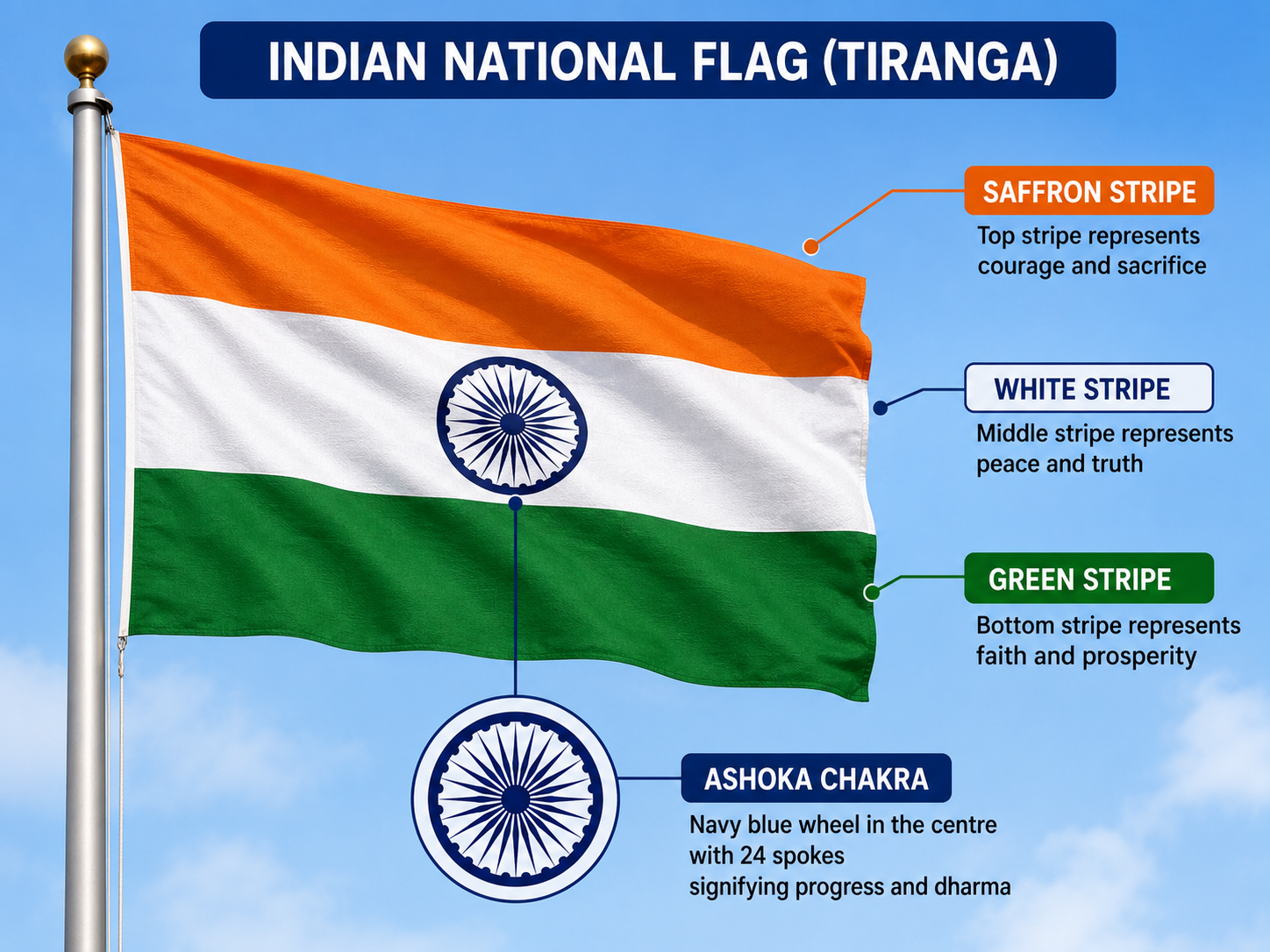
Our national flag is called the Tiranga (meaning "three colours"). It was adopted on 22 July 1947.
| Colour / Part | Position | Meaning |
|---|---|---|
| Saffron (Kesari) | Top stripe | Courage and sacrifice |
| White | Middle stripe | Peace and truth |
| Green | Bottom stripe | Growth, fertility, and prosperity |
| Ashoka Chakra (navy blue) | Centre of white stripe | Wheel of law; has 24 spokes representing 24 hours |
- The flag must always be made of khadi (hand-spun cloth).
- The saffron colour must always be on top.
- The flag must never touch the ground or water.
- A torn or dirty flag must not be displayed.
- No other flag can be placed higher than the Tiranga in India.
- The flag is hoisted on Republic Day (26 January) and Independence Day (15 August).
🦁 National Emblem — Lion Capital of Ashoka
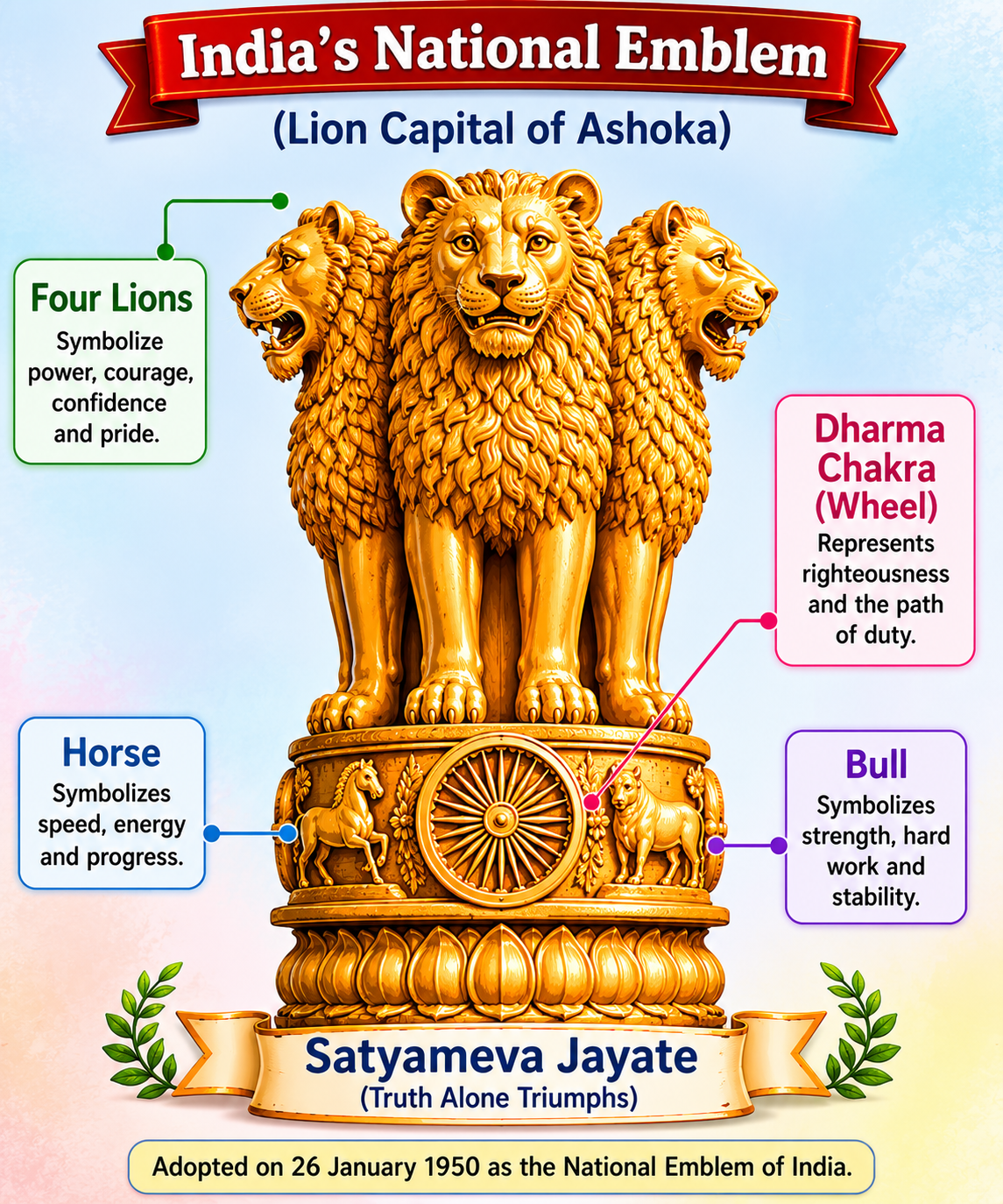
India's national emblem is adapted from the Lion Capital of Ashoka at Sarnath. It was adopted on 26 January 1950.
- It shows four lions standing back to back (only three are visible from the front).
- Below the lions is a circular base with a horse, a bull, an elephant, and a lion separated by wheels (Dharma Chakra).
- The motto written below is "Satyameva Jayate" (सत्यमेव जयते) — meaning "Truth Alone Triumphs".
- It is taken from the ancient text Mundaka Upanishad.
- The emblem is used on all government documents, currency notes, and passports.
🎵 National Anthem — Jana Gana Mana
Our national anthem is "Jana Gana Mana". It was written by Rabindranath Tagore in Bengali.
- It was first sung on 27 December 1911 at the Calcutta session of the Indian National Congress.
- It was adopted as the national anthem on 24 January 1950.
- It takes approximately 52 seconds to sing the full anthem.
- It mentions the names of different regions of India — Punjab, Sindh, Gujarat, Maratha, Dravida, Utkala, Banga.
- We must stand at attention when the national anthem is played.
🎶 National Song — Vande Mataram
Our national song is "Vande Mataram" (meaning "I bow to thee, Mother").
- It was written by Bankim Chandra Chattopadhyay (Chatterjee) in Sanskrit and Bengali.
- It is from his novel "Anandamath" (1882).
- It inspired freedom fighters during India's independence movement.
- The first two stanzas were adopted as the national song on 24 January 1950.
- It has equal status with the national anthem.
🐯 National Animal — Bengal Tiger
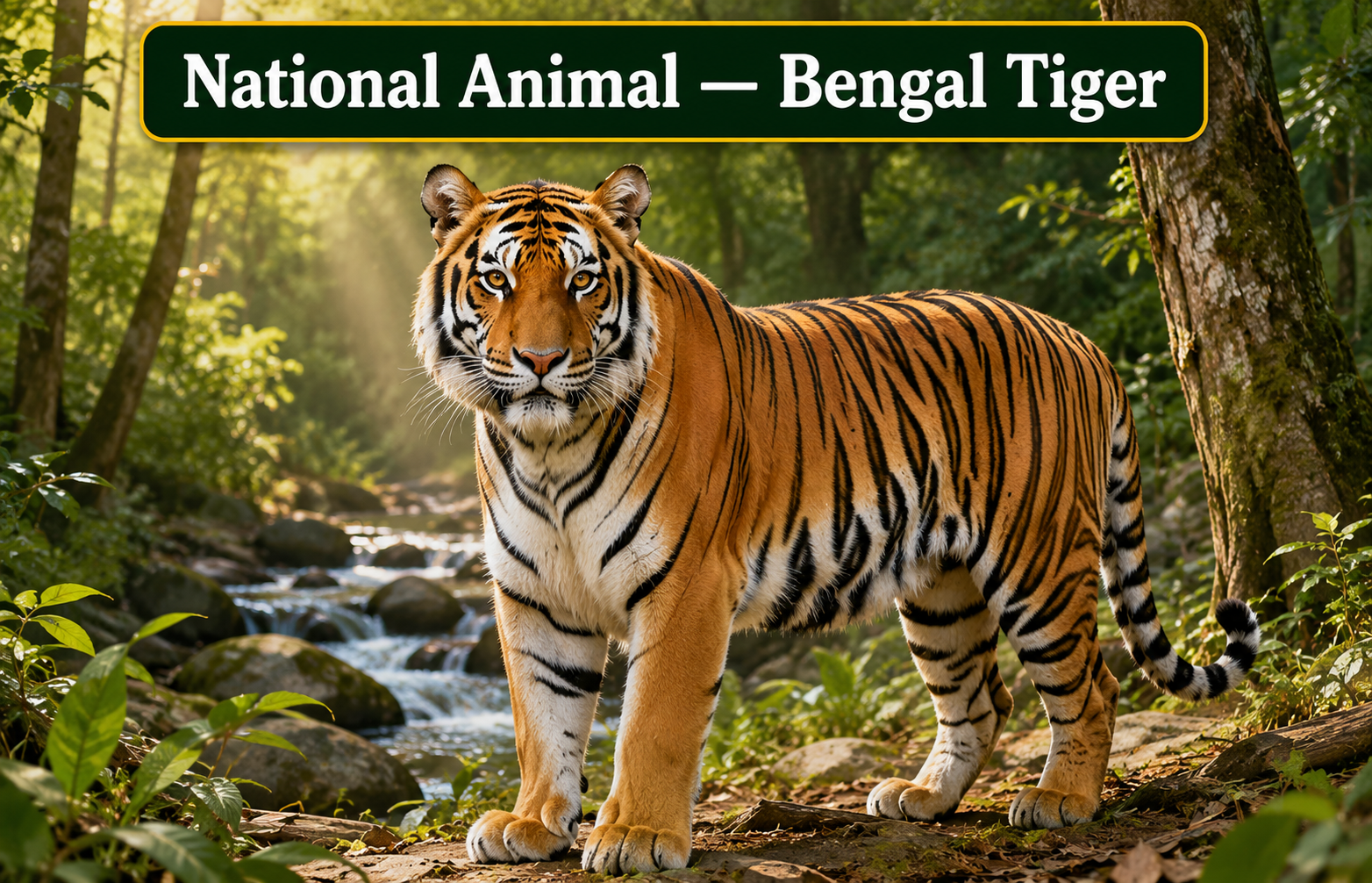
The Royal Bengal Tiger (Panthera tigris) is India's national animal. It was declared the national animal in 1973.
- It represents strength, grace, and power.
- Bengal Tigers are found in the Sundarbans (West Bengal), Jim Corbett National Park (Uttarakhand), Ranthambore (Rajasthan), and other forests.
- The government started Project Tiger in 1973 to protect tigers from extinction.
- India has about 3,000+ tigers (as per the latest census).
- Tigers have orange fur with black stripes — each tiger's stripes are unique (like fingerprints)!
🦚 National Bird — Peacock
The Indian Peacock (Pavo cristatus) is India's national bird. It was declared the national bird in 1963.
- It represents beauty, grace, and pride.
- The male peacock has beautiful, colourful tail feathers that it spreads like a fan.
- Peacocks dance when they see dark rain clouds — this is called the "peacock dance".
- The female is called a peahen and is brown in colour.
- Peacocks are found all over India, especially in Rajasthan, Gujarat, and Madhya Pradesh.
🪷 National Flower — Lotus
The Lotus (Nelumbo nucifera) is India's national flower.
- It represents purity, beauty, and spirituality.
- The lotus grows in muddy water but its flower is always clean and beautiful.
- It is sacred in Indian culture — Goddess Lakshmi sits on a lotus.
- Lotus flowers are pink or white in colour.
- It teaches us that we can rise above difficulties and shine (just like the lotus rises from mud).
🥭 National Fruit — Mango
The Mango (Mangifera indica) is India's national fruit. It is called the "King of Fruits".
- India is the largest producer of mangoes in the world.
- There are over 100 varieties of mangoes in India — Alphonso, Dasheri, Langra, Himsagar, Totapuri.
- Mangoes have been grown in India for over 5,000 years.
- The mango season is in summer (April to July).
- Mangoes are rich in Vitamin A and Vitamin C.
🌳 National Tree — Banyan Tree
The Banyan Tree (Ficus benghalensis) is India's national tree.
- It represents immortality and long life.
- The banyan tree has aerial roots that grow down from branches and become new trunks.
- A single banyan tree can spread over a very large area — like a small forest!
- The Great Banyan Tree in Kolkata's Botanical Garden is over 250 years old and covers about 14,500 square metres.
- Village meetings (panchayats) were traditionally held under banyan trees.
🌊 National River — Ganga
The Ganga (Ganges) is India's national river.
- It originates from the Gangotri Glacier in the Himalayas (Uttarakhand).
- It flows through many states — Uttarakhand, Uttar Pradesh, Bihar, Jharkhand, and West Bengal.
- It is about 2,525 km long and finally meets the Bay of Bengal.
- The Ganga is considered sacred (holy) by Hindus.
- The government started the "Namami Gange" project to clean and protect the river.
- Important cities on the Ganga: Haridwar, Varanasi, Allahabad (Prayagraj), Patna, Kolkata.
🏑 National Game — Hockey
Hockey is considered India's national game (though not officially declared by the government).
- India won 8 Olympic gold medals in hockey (1928–1980) — the most by any country!
- Major Dhyan Chand is the most famous Indian hockey player — called the "Wizard of Hockey".
- His birthday (29 August) is celebrated as National Sports Day.
- The Indian hockey team won gold at the 1948 Olympics — the first as an independent nation.
- Hockey is played with a stick and a ball on a field.
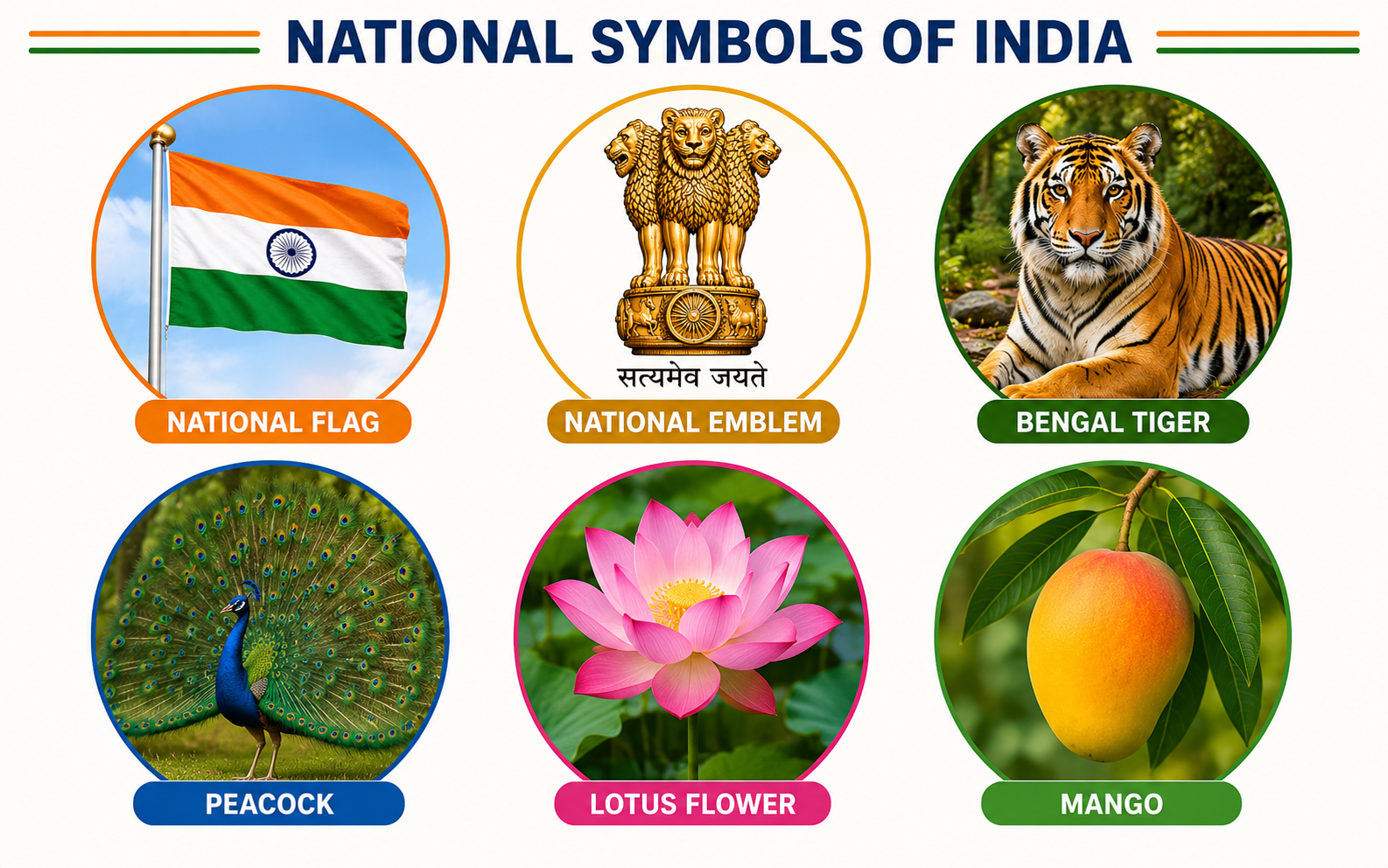
📋 Summary Table — All National Symbols
| Symbol | Name | Key Fact |
|---|---|---|
| National Flag | Tiranga | Saffron, White, Green + Ashoka Chakra (24 spokes) |
| National Emblem | Lion Capital of Ashoka | Four lions; motto: Satyameva Jayate |
| National Anthem | Jana Gana Mana | Written by Rabindranath Tagore; 52 seconds |
| National Song | Vande Mataram | Written by Bankim Chandra Chattopadhyay |
| National Animal | Bengal Tiger | Project Tiger (1973); strength and power |
| National Bird | Peacock | Beautiful tail feathers; dances in rain |
| National Flower | Lotus | Grows in mud, stays pure; purity |
| National Fruit | Mango | King of Fruits; 100+ varieties in India |
| National Tree | Banyan Tree | Aerial roots; long life; very large spread |
| National River | Ganga | 2,525 km; originates from Gangotri Glacier |
| National Game | Hockey | 8 Olympic golds; Major Dhyan Chand |
Key Words
| Word | Meaning |
|---|---|
| National Symbol | A sign or object that represents a country |
| Tiranga | Three-coloured; name of India's national flag |
| Ashoka Chakra | The 24-spoke wheel in the centre of our flag |
| Satyameva Jayate | "Truth Alone Triumphs" — motto on the national emblem |
| Anthem | A special song of a country, sung with respect |
| Emblem | An official symbol or badge of a country |
| Khadi | Hand-spun cloth; the flag must be made of khadi |
| Project Tiger | Government programme to protect tigers (started 1973) |
- National symbols represent the identity and pride of India.
- The Tiranga has saffron (courage), white (peace), green (growth) and the Ashoka Chakra (24 spokes).
- The National Emblem has four lions and the motto "Satyameva Jayate".
- National Anthem: Jana Gana Mana (Tagore). National Song: Vande Mataram (Bankim Chandra).
- National Animal: Bengal Tiger. National Bird: Peacock. National Flower: Lotus.
- National Fruit: Mango. National Tree: Banyan. National River: Ganga.
- Hockey is India's national game — 8 Olympic gold medals.
Practice Questions
| Column A | Column B |
|---|---|
| 1. National Animal | a. Lotus |
| 2. National Flower | b. Ganga |
| 3. National River | c. Mango |
| 4. National Fruit | d. Bengal Tiger |
| 5. National Tree | e. Banyan Tree |
Activity 1: Draw and Colour the National Flag
Draw the Indian national flag in the space below. Colour it correctly with saffron, white, and green. Draw the Ashoka Chakra with 24 spokes in the centre.
Activity 2: National Symbols Poster
Make a poster showing all 11 national symbols of India. Draw or paste pictures and write one fact about each symbol.
Want a printable worksheet? Switch to the Worksheet View, then print.