Our Body
Learning Objectives
- I can name the external parts of the human body.
- I can describe the five sense organs and their functions.
- I can name important internal organs and what they do.
- I can explain why bones and muscles are important.
- I can describe good habits to keep my body healthy.
- I can tell how our body grows and changes.
Let Us Begin!
Our body is like an amazing machine! It can run, jump, think, see, hear, and do so many things. Every part of our body has a special job to do.
From the brain that helps us think, to the heart that pumps blood, to the legs that help us walk — every part works together to keep us alive and active.
Let us explore the wonderful human body!
External Parts of the Body
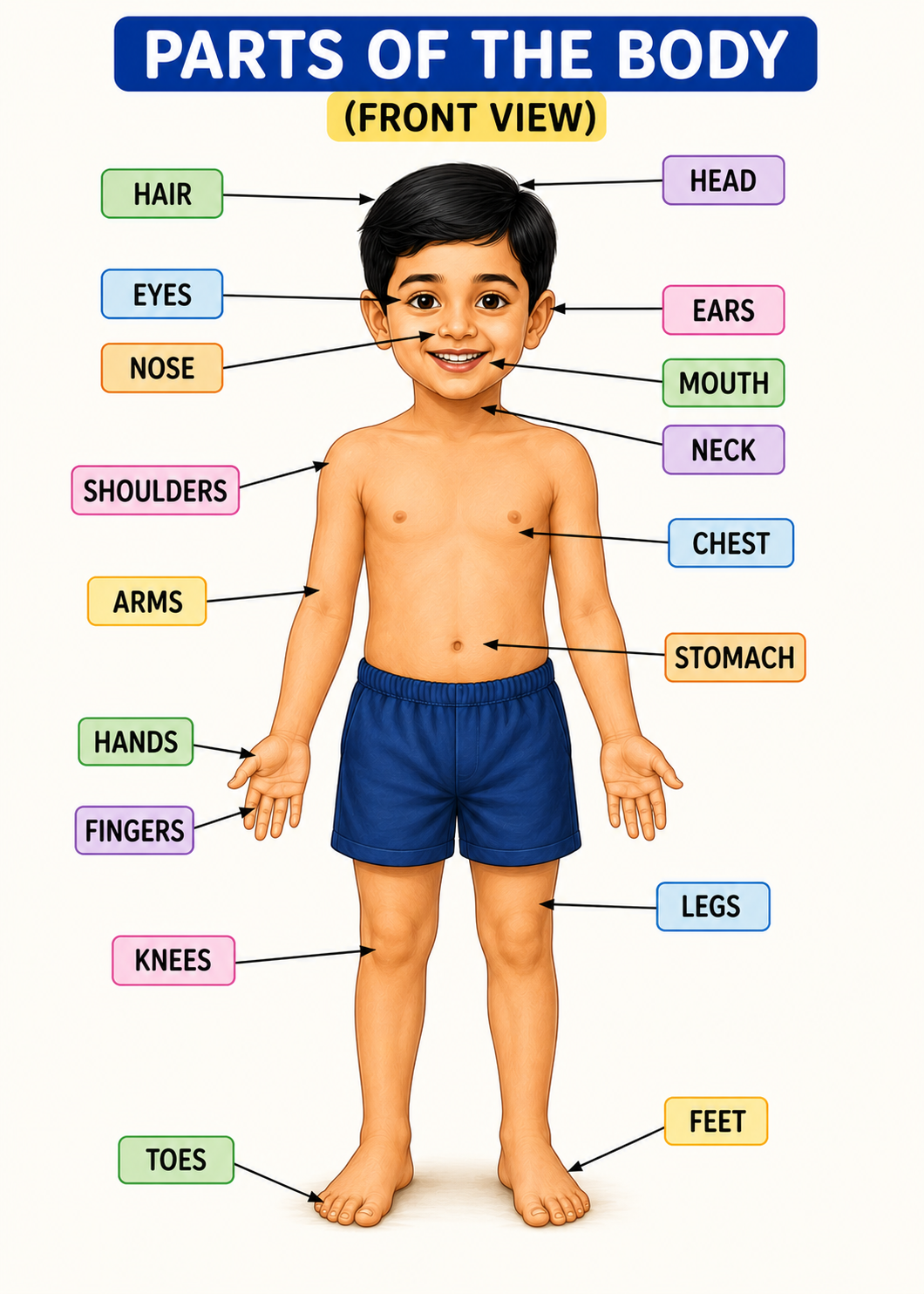
The parts we can see from outside are called external parts:
| Part | What It Does |
|---|---|
| Head | Contains the brain; has eyes, ears, nose, mouth |
| Eyes | Help us see |
| Ears | Help us hear sounds |
| Nose | Helps us smell and breathe |
| Mouth | Helps us eat, speak, and taste |
| Neck | Connects head to body; helps turn head |
| Arms and Hands | Help us hold, write, lift, and carry things |
| Legs and Feet | Help us walk, run, jump, and kick |
| Chest | Protects heart and lungs inside |
| Stomach area | Contains digestive organs |
The Five Sense Organs
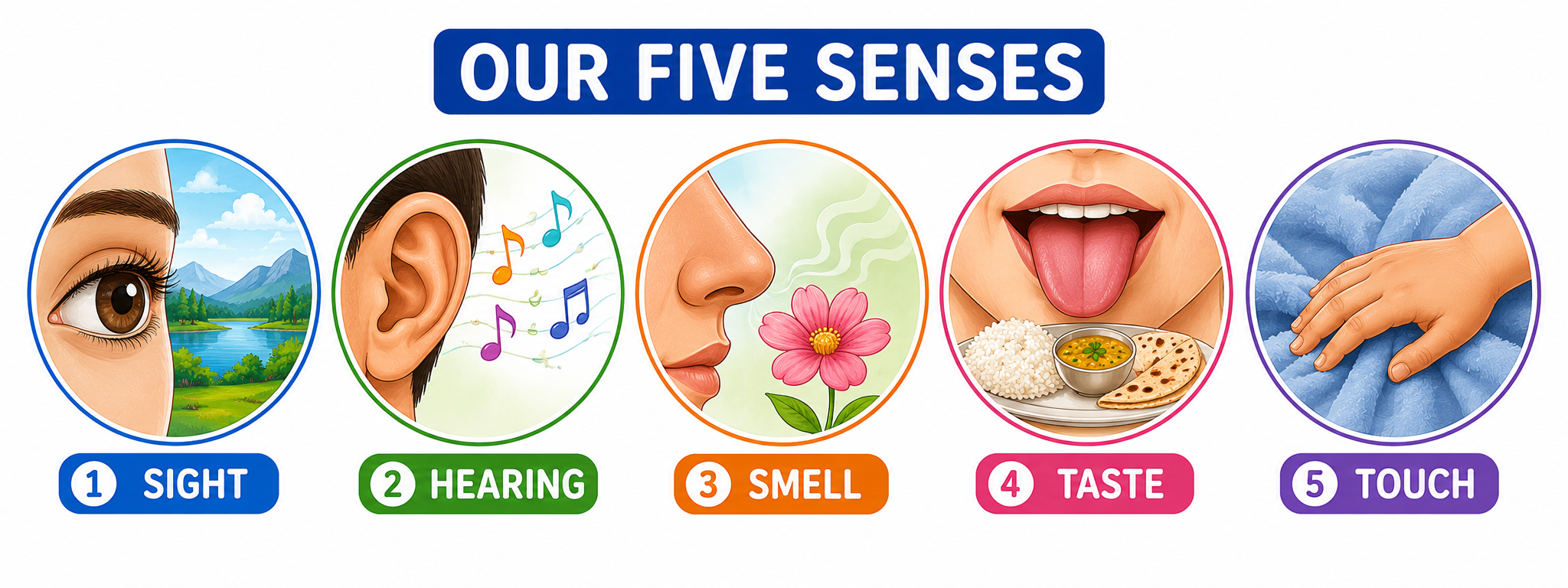
We have five special organs that help us understand the world around us:
| Sense Organ | Sense | What It Helps Us Do | Examples |
|---|---|---|---|
| 👁️ Eyes | Sight | See colours, shapes, people, things | Reading a book, watching birds |
| 👂 Ears | Hearing | Hear sounds, music, voices | Listening to teacher, hearing a bell |
| 👃 Nose | Smell | Smell flowers, food, smoke | Smelling a rose, detecting gas leak |
| 👅 Tongue | Taste | Taste sweet, sour, salty, bitter, spicy | Tasting mango (sweet), lemon (sour) |
| 🖐️ Skin | Touch | Feel hot, cold, soft, hard, rough, smooth | Feeling ice (cold), fire (hot) |
Internal Organs
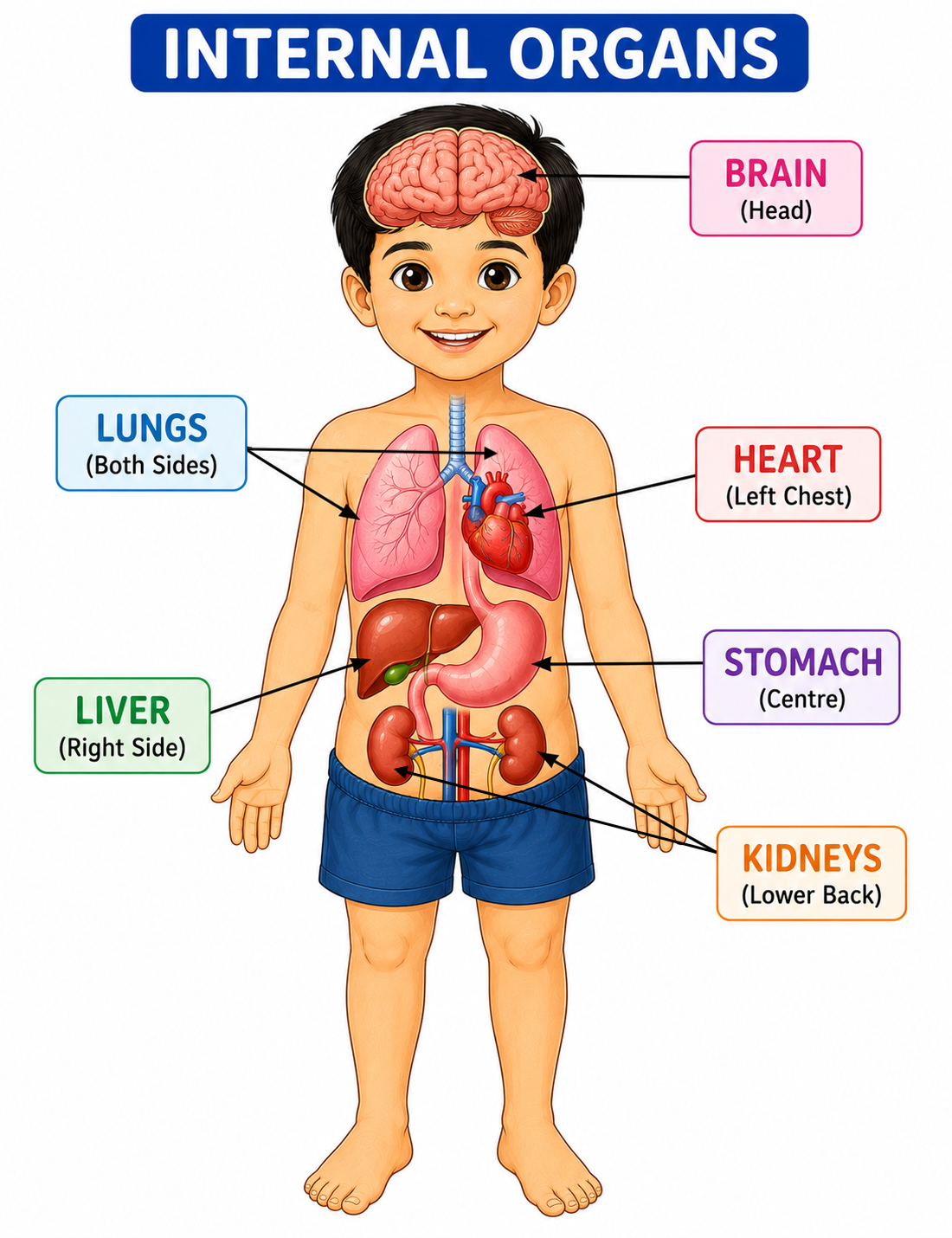
Inside our body, there are important organs we cannot see:
| Organ | Where It Is | What It Does |
|---|---|---|
| Brain | Inside the head (skull) | Controls everything — thinking, memory, movement, feelings |
| Heart | In the chest (left side) | Pumps blood to all parts of the body; beats 70-80 times per minute |
| Lungs | In the chest (both sides) | Help us breathe — take in oxygen, give out carbon dioxide |
| Stomach | Below the chest | Digests (breaks down) the food we eat |
| Kidneys | Lower back (two) | Clean the blood; remove waste as urine |
| Liver | Right side, below ribs | Cleans blood; helps digest fats |
Bones and Muscles
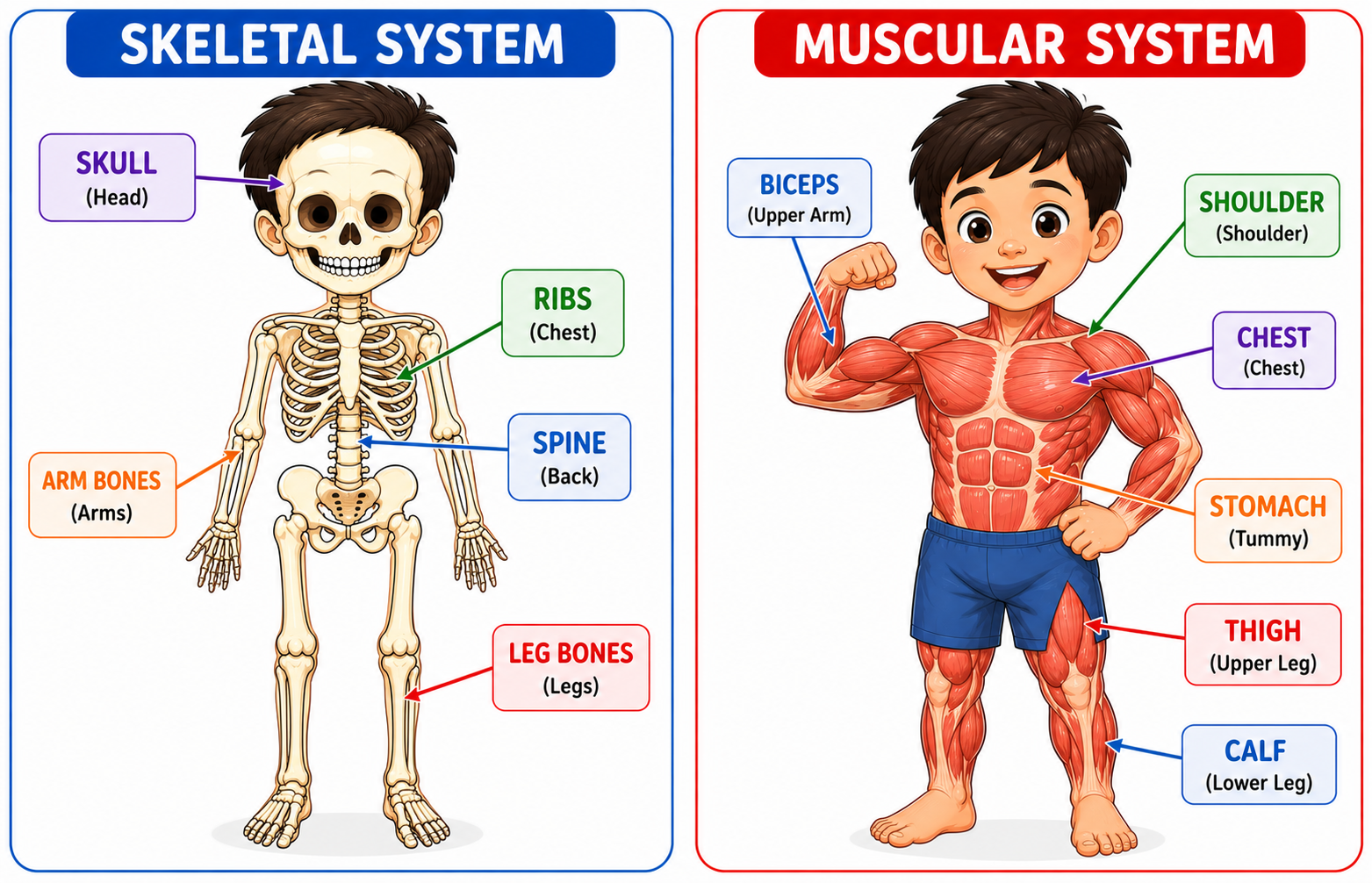
Bones (Skeleton):
- Our body has 206 bones that form the skeleton.
- Bones give our body its shape and support.
- Bones protect soft organs (skull protects brain, ribs protect heart and lungs).
- The place where two bones meet is called a joint (elbow, knee, shoulder).
- Joints help us bend and move.
Muscles:
- Our body has over 600 muscles.
- Muscles are attached to bones and help us move.
- When muscles pull on bones, we can walk, run, lift, and bend.
- The heart is also a muscle — it never stops working!
- Exercise makes muscles stronger.
Taking Care of Our Body
We must take good care of our body to stay healthy:
| Good Habit | Why It Helps |
|---|---|
| Eat healthy food (balanced diet) | Gives energy, helps grow, fights diseases |
| Drink plenty of water | Keeps body hydrated and cool |
| Exercise and play daily | Makes bones and muscles strong |
| Sleep 8-10 hours | Body rests and repairs itself |
| Bathe daily | Keeps skin clean, removes germs |
| Brush teeth twice a day | Prevents cavities and bad breath |
| Wash hands before eating | Removes germs, prevents diseases |
| Sit and stand straight (posture) | Keeps spine healthy |
| Protect eyes (don't watch too much TV) | Prevents weak eyesight |
| Cover mouth when coughing/sneezing | Stops germs from spreading |
Interesting Facts About Our Body
- 🧠 The brain has about 100 billion nerve cells!
- ❤️ Your heart beats about 1,00,000 times every day.
- 🦴 The smallest bone is in the ear (stirrup bone) — only 3mm!
- 🦴 The longest bone is the thigh bone (femur).
- 👃 Your nose can detect over 10,000 different smells.
- 💪 The tongue is the strongest muscle for its size.
- 🩸 Blood travels through your body in about 20 seconds.
Key Words
| Word | Meaning |
|---|---|
| Organ | A body part with a special job (heart, brain, lungs) |
| Skeleton | The framework of 206 bones that supports our body |
| Joint | Place where two bones meet (elbow, knee) |
| Muscle | Body tissue that helps us move by pulling on bones |
| Sense organ | Organ that helps us sense the world (eyes, ears, nose, tongue, skin) |
| Digestion | Breaking down food in the stomach so body can use it |
| Lungs | Organs that help us breathe |
| Hygiene | Keeping our body clean to stay healthy |
- External parts: head, eyes, ears, nose, mouth, arms, hands, legs, feet.
- Five senses: Sight (eyes), Hearing (ears), Smell (nose), Taste (tongue), Touch (skin).
- Internal organs: Brain (thinking), Heart (pumps blood), Lungs (breathing), Stomach (digestion).
- We have 206 bones (skeleton) and 600+ muscles.
- Joints help us bend and move (elbow, knee, shoulder).
- Stay healthy: eat well, exercise, sleep 8-10 hours, bathe daily, brush teeth.
Practice Questions
| Column A | Column B |
|---|---|
| 1. Eyes | a. Hearing |
| 2. Ears | b. Smell |
| 3. Nose | c. Taste |
| 4. Tongue | d. Sight |
| 5. Skin | e. Touch |
Activity 1: Sense Test
Close your eyes. Ask a friend to give you different things to smell (flower, lemon, soap). Can you guess what they are using only your nose?
Activity 2: Count Your Heartbeat
Place two fingers on your wrist. Count how many times your heart beats in one minute. Write: My heartbeat = _______ beats per minute.
Now jump 20 times and count again: After exercise = _______ beats per minute. What do you notice?
Want a printable worksheet? Switch to the Worksheet View, then print.