Plants Around Us
Learning Objectives
- I can name the different parts of a plant and their functions.
- I can classify plants into trees, shrubs, herbs, creepers, and climbers.
- I can explain how plants make their food (photosynthesis).
- I can describe how plants grow from seeds.
- I can list the uses of plants in our daily life.
- I can explain why we should protect plants and trees.
Let Us Begin!
Look around you — can you see any plants? Maybe a big tree in your garden, a small plant on your balcony, or grass in the park?
Plants are everywhere! They give us food, oxygen, shade, and beauty. Without plants, there would be no life on Earth because they make the oxygen we breathe.
Let us learn about the wonderful world of plants!
Parts of a Plant
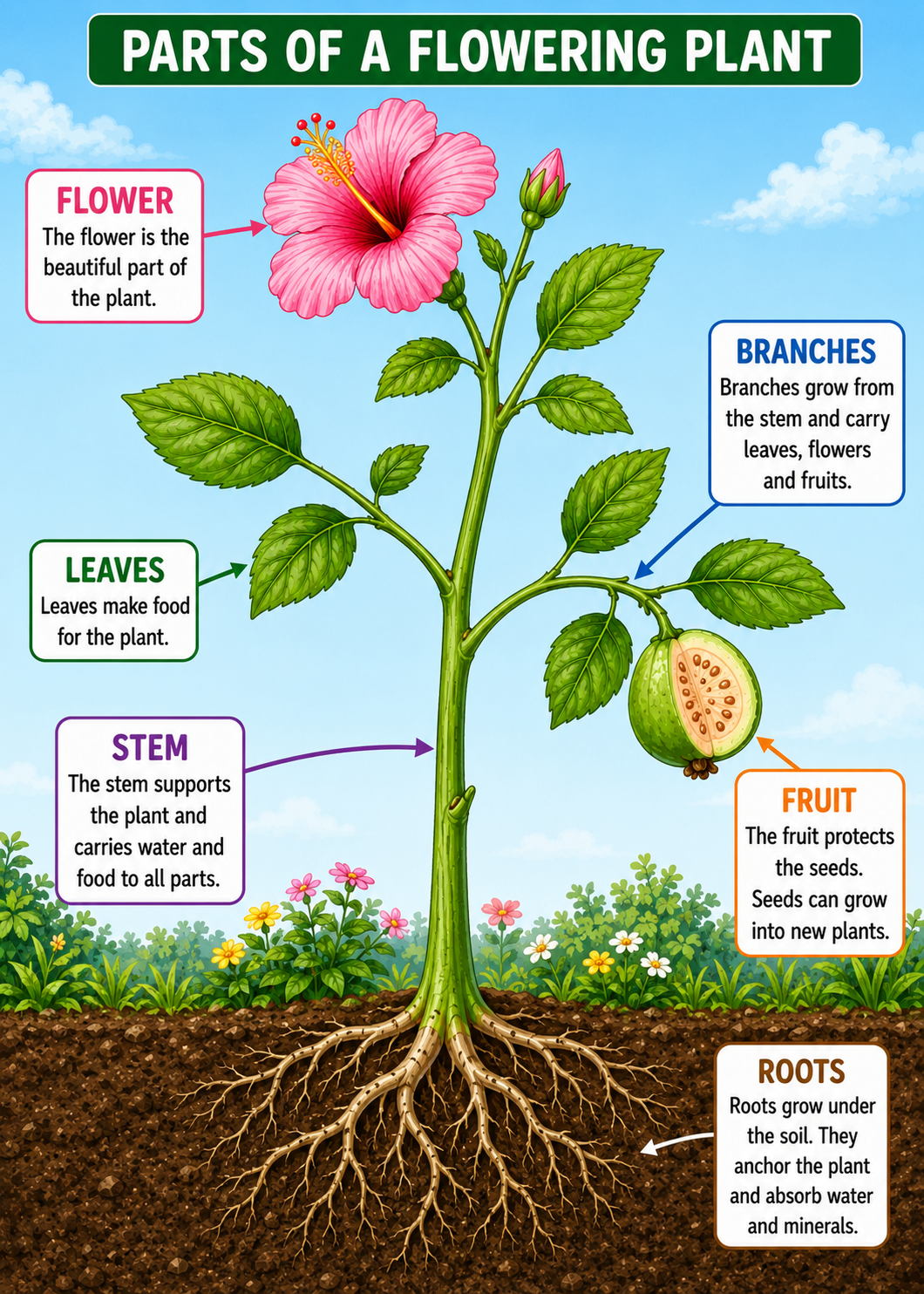
Every plant has different parts, and each part has a special job:
| Part | Where It Is | What It Does (Function) |
|---|---|---|
| Root | Underground (in soil) | Holds the plant firmly; absorbs water and minerals from soil |
| Stem | Above ground, holds the plant up | Carries water from roots to leaves; supports branches and leaves |
| Leaf | On branches/stem | Makes food for the plant using sunlight (photosynthesis); breathes |
| Flower | On branches | Helps the plant reproduce (make seeds); attracts insects |
| Fruit | Grows from flower | Protects the seeds inside; we eat many fruits |
| Seed | Inside the fruit | Grows into a new plant |
Types of Plants
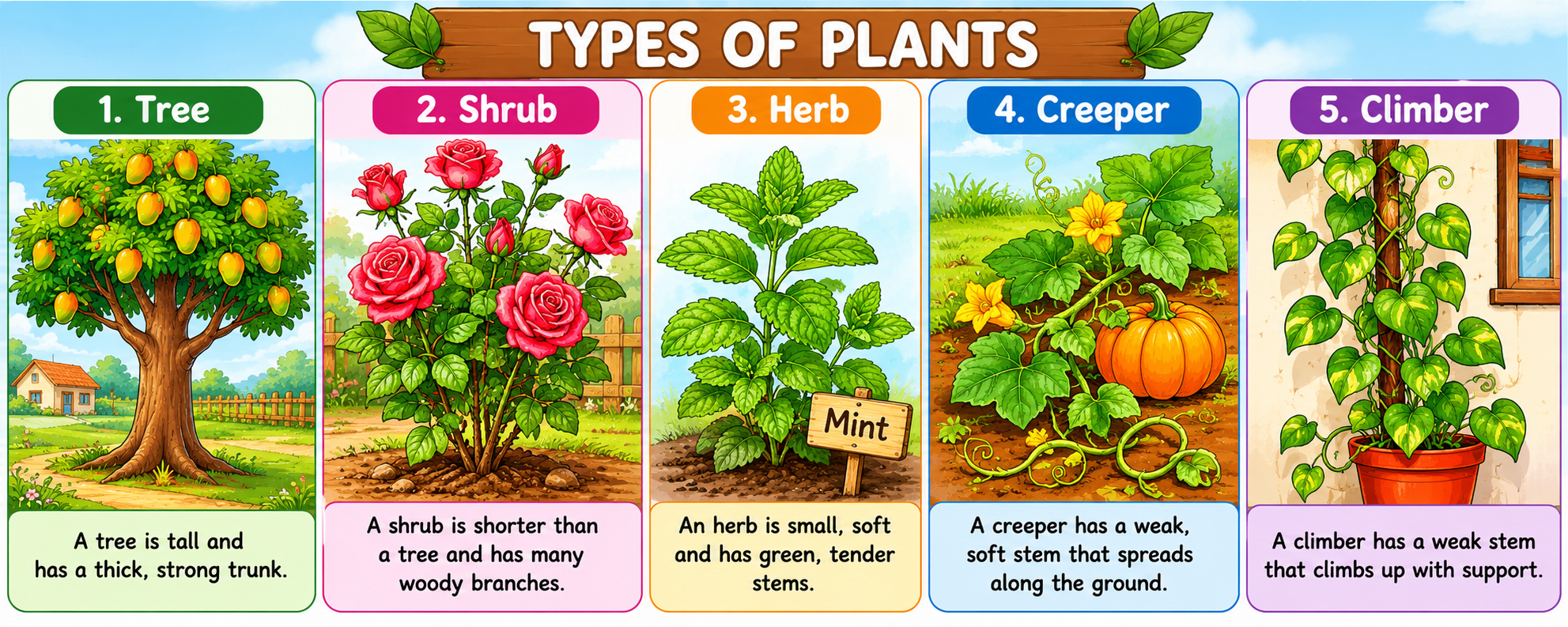
Plants come in many sizes and shapes. We group them based on their size and stem:
| Type | Size | Stem | Examples |
|---|---|---|---|
| Tree | Very tall (many metres) | Thick, hard, woody trunk | Neem, Banyan, Mango, Peepal, Coconut |
| Shrub | Medium (shorter than trees) | Hard, woody, branches near ground | Rose, Hibiscus, Tulsi, Lemon |
| Herb | Small (short) | Soft, green, thin stem | Mint, Coriander, Wheat, Rice, Tomato |
| Creeper | Grows along the ground | Weak, cannot stand alone | Pumpkin, Watermelon, Strawberry |
| Climber | Grows upward on support | Weak, needs support to climb | Money plant, Grapevine, Pea, Jasmine |
How Plants Make Food (Photosynthesis)
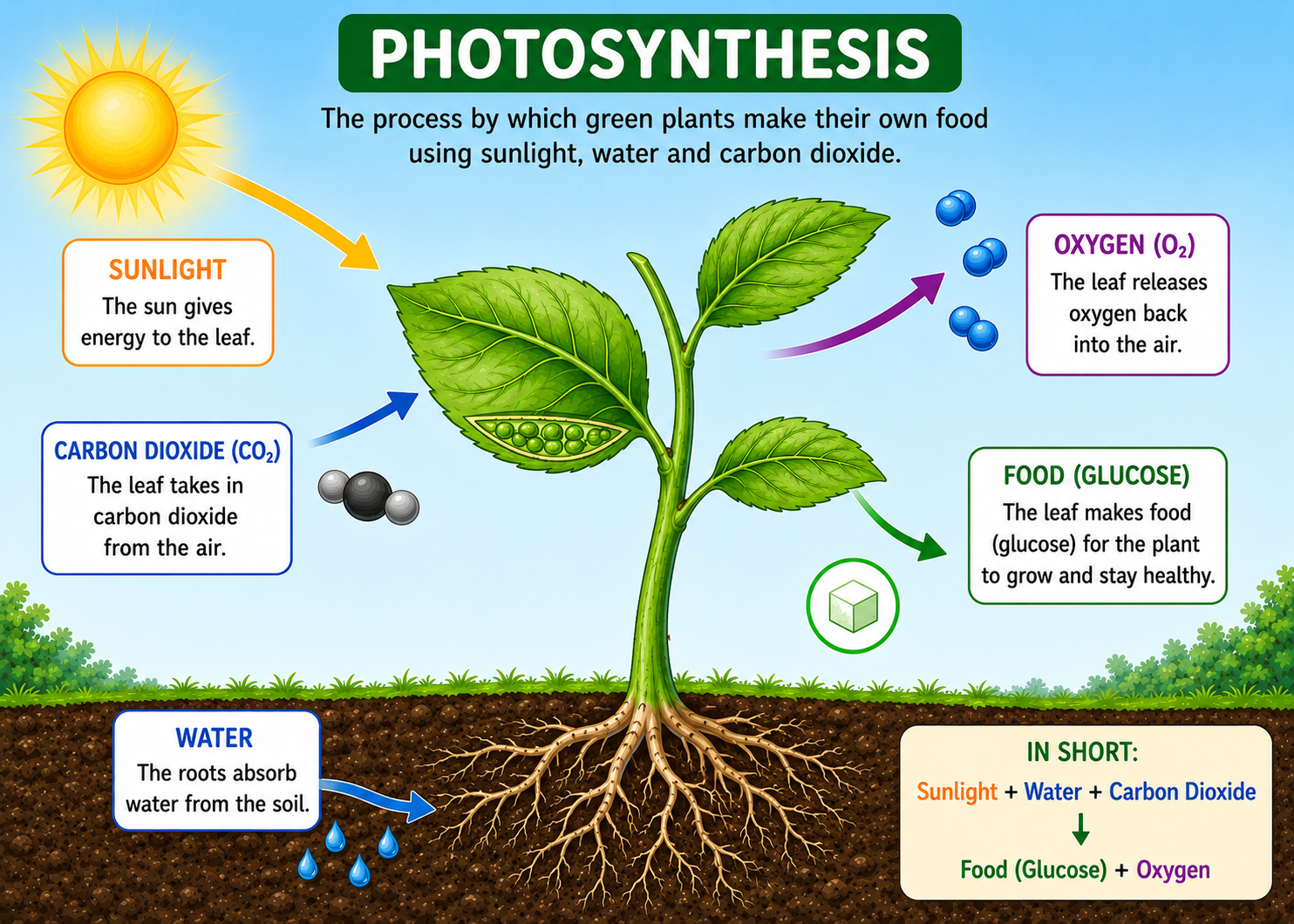
Plants are amazing — they make their own food! This process is called photosynthesis.
What plants need to make food:
- ☀️ Sunlight — energy from the Sun
- 💧 Water — absorbed by roots from soil
- 💨 Carbon dioxide — taken from air through tiny holes in leaves (stomata)
- 🍃 Chlorophyll — green colour in leaves that captures sunlight
What plants give out:
- 🍽️ Food (glucose/sugar) — for the plant to grow
- 🌬️ Oxygen — released into the air (we breathe this!)
How Plants Grow (From Seed to Plant)
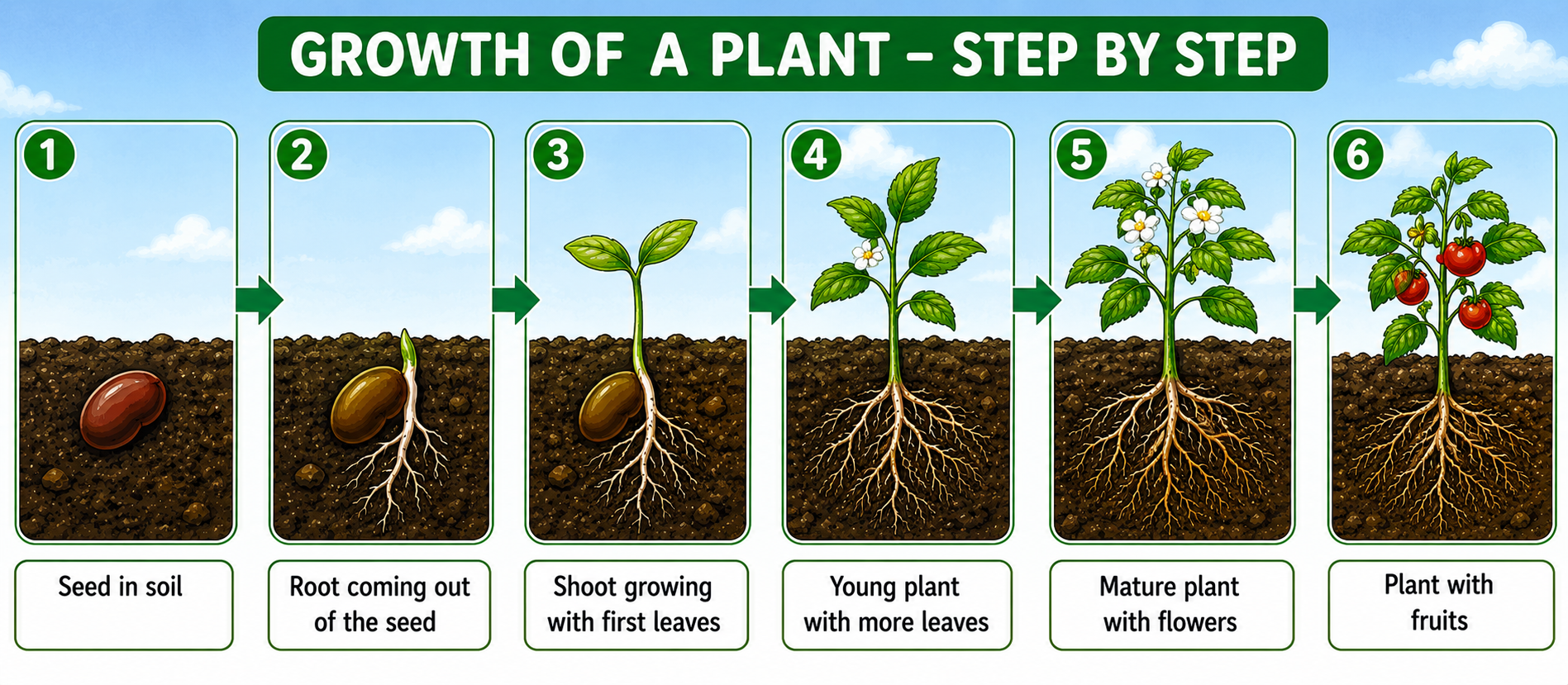
Most plants grow from seeds. Here is how a seed becomes a plant:
- Seed: A seed is planted in soil and watered.
- Germination: The seed absorbs water, swells up, and a tiny root comes out.
- Seedling: A small shoot grows upward. The first leaves appear.
- Young plant: More leaves grow. The stem gets stronger.
- Mature plant: The plant grows fully. Flowers appear.
- Fruit and seeds: Flowers turn into fruits with seeds inside. Seeds fall and grow into new plants!
What do seeds need to grow?
- Water (to soften the seed coat)
- Air (for breathing)
- Warmth (right temperature)
- Soil (for nutrients and support)
- Sunlight (once leaves appear)
Uses of Plants
Plants are extremely useful to us:
| Use | What We Get | Examples |
|---|---|---|
| Food | Fruits, vegetables, grains, pulses | Mango, potato, rice, wheat, dal |
| Oxygen | Clean air to breathe | All green plants release oxygen |
| Medicine | Cures for diseases | Neem (skin), Tulsi (cold), Aloe vera (burns) |
| Wood | Furniture, houses, paper | Teak, Sal, Bamboo |
| Clothing | Cotton, Jute | Cotton plant → cloth; Jute → bags |
| Shade | Cool shade on hot days | Banyan, Neem, Peepal trees |
| Rubber | Tyres, erasers, gloves | Rubber tree (Kerala) |
| Spices | Flavour for food | Turmeric, Pepper, Cardamom, Clove |
| Oil | Cooking oil | Mustard, Coconut, Groundnut, Sunflower |
| Beauty | Gardens, parks, decoration | Rose, Marigold, Lotus |
Protect Our Plants and Trees!
Trees and plants are being cut down for buildings, roads, and farms. This is called deforestation. We must protect them:
- 🌳 Plant more trees — celebrate Van Mahotsav (Tree Planting Week in July)
- 🚫 Do not cut trees unnecessarily
- 💧 Water plants regularly
- 🌿 Grow plants at home — on balconies, terraces, and gardens
- 📢 Spread awareness — tell others why trees are important
- ♻️ Use less paper — save trees!
Interesting Facts About Plants
- 🌳 The Banyan tree is India's national tree. The largest one is in Kolkata (Great Banyan Tree).
- 🌸 The Lotus is India's national flower.
- 🎋 Bamboo is the fastest growing plant — it can grow up to 91 cm in one day!
- 🌵 Cactus stores water in its thick stem and can survive in deserts.
- 🍃 Leaves of the Touch-Me-Not plant (Mimosa) close when you touch them!
- 🌻 Sunflowers always face the Sun as it moves across the sky.
- 🇮🇳 India is the largest producer of spices in the world.
Key Words
| Word | Meaning |
|---|---|
| Photosynthesis | Process by which plants make food using sunlight, water, and CO₂ |
| Chlorophyll | Green pigment in leaves that captures sunlight |
| Germination | When a seed starts to grow into a new plant |
| Root | Part of plant underground that absorbs water |
| Stem | Part that supports the plant and carries water |
| Stomata | Tiny holes in leaves for gas exchange |
| Deforestation | Cutting down trees on a large scale |
| Herb | Small plant with soft, green stem |
| Shrub | Medium plant with hard, woody branches near ground |
| Creeper | Plant that grows along the ground |
- Parts of a plant: Root, Stem, Leaf, Flower, Fruit, Seed — each has a function.
- Types: Trees (tall, woody), Shrubs (medium), Herbs (small, soft), Creepers (ground), Climbers (need support).
- Photosynthesis: Sunlight + Water + CO₂ → Food + Oxygen (happens in leaves).
- Seeds grow into plants through germination (need water, air, warmth, soil).
- Plants give us food, oxygen, medicine, wood, cotton, rubber, spices, and shade.
- Protect trees: plant more, don't cut, water regularly, use less paper.
Practice Questions
| Column A | Column B |
|---|---|
| 1. Root | a. Makes food using sunlight |
| 2. Leaf | b. Absorbs water from soil |
| 3. Flower | c. Carries water to leaves |
| 4. Stem | d. Grows into a new plant |
| 5. Seed | e. Helps plant reproduce |
Activity 1: Grow a Seed
Take a few moong dal (green gram) seeds. Place them on wet cotton in a bowl. Keep in a warm place. Water daily. Observe for 5 days and draw what you see each day.
Activity 2: Leaf Collection
Collect 5 different leaves from your garden or park. Paste them in your notebook. Write the plant name, shape, and colour of each leaf.
Want a printable worksheet? Switch to the Worksheet View, then print.