Safety Rules
Learning Objectives
- I can explain the importance of following safety rules in daily life.
- I can describe road safety rules including traffic signals and zebra crossings.
- I can list safety rules to follow at home, school, and during natural disasters.
- I can recall important emergency numbers in India (100, 101, 108, 112).
- I can explain basic first aid for cuts, burns, and insect bites.
- I can understand the concept of good touch and bad touch and know how to stay safe from strangers.
Introduction
Safety means protecting ourselves from danger and harm. Every day, we go to school, play with friends, and do many activities. If we are not careful, we can get hurt.
Safety rules are simple guidelines that help us stay safe at home, on the road, at school, and everywhere we go. When we follow safety rules, we protect ourselves and others around us.
Let us learn about different safety rules that every child must know!
Road Safety
Roads can be dangerous if we do not follow rules. Every year, many people get hurt in road accidents. Let us learn how to stay safe on the road.
Traffic Lights
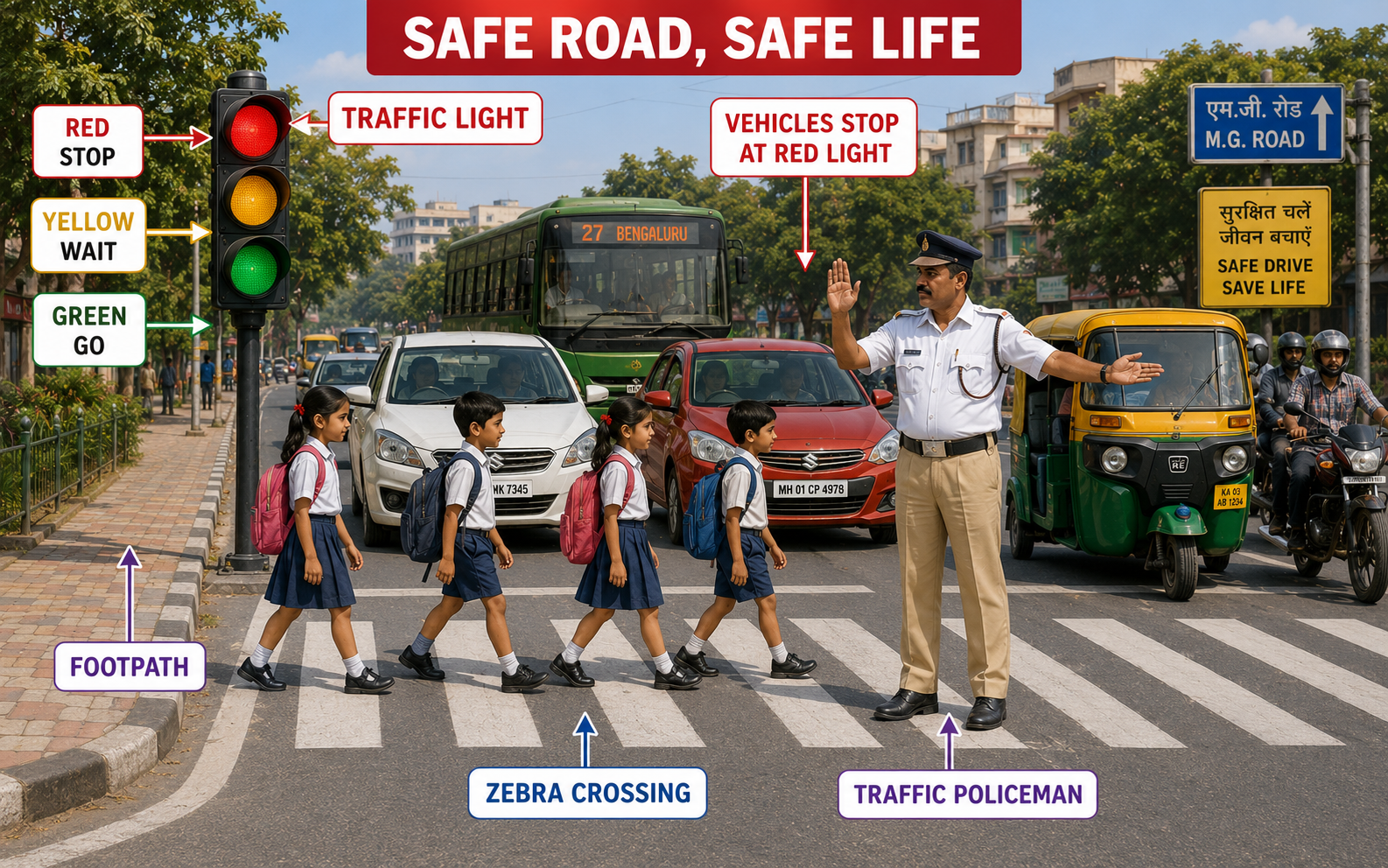
Traffic lights (also called traffic signals) control the movement of vehicles and people on the road:
| Light | Meaning | What to Do |
|---|---|---|
| 🔴 Red | STOP | All vehicles must stop. Pedestrians can cross. |
| 🟡 Yellow | GET READY | Be alert. The signal is about to change. |
| 🟢 Green | GO | Vehicles can move. Pedestrians must wait. |
Zebra Crossing
A zebra crossing is a set of black and white stripes painted on the road. It is the safest place for pedestrians to cross the road. Vehicles must stop when people are on the zebra crossing.
Rules for Pedestrians (People Walking)
- Always walk on the footpath (pavement). If there is no footpath, walk on the left side of the road facing traffic.
- Cross the road only at the zebra crossing or when the pedestrian signal is green.
- Look right, then left, then right again before crossing.
- Never run across the road. Walk quickly but carefully.
- Do not play on or near the road.
- Hold an adult's hand while crossing busy roads.
- Wear bright or light-coloured clothes at night so drivers can see you.
Rules for Cyclists
- Always ride on the left side of the road.
- Wear a helmet while cycling.
- Use hand signals before turning left or right.
- Never ride with both hands off the handlebar.
- Do not carry another person on a bicycle meant for one.
- Make sure your bicycle has a bell, reflector, and working brakes.
Safety at Home
Home is where we feel safest, but accidents can happen here too. Let us learn how to stay safe at home.
Electrical Safety
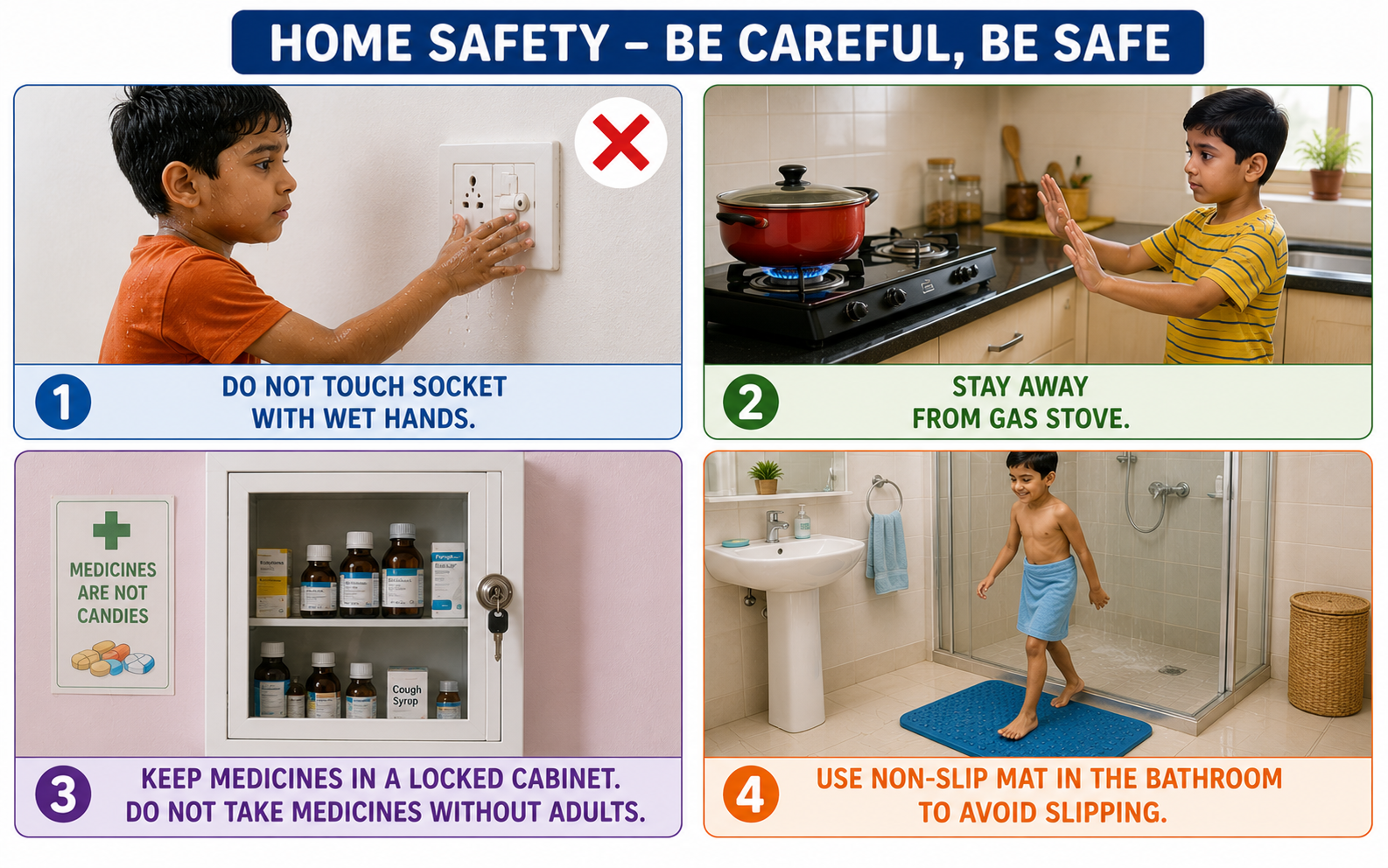
- Never touch electrical switches, plugs, or wires with wet hands.
- Do not put fingers or objects (pins, pencils) into electrical sockets.
- Do not pull electrical cords to unplug — hold the plug and pull gently.
- Stay away from broken wires or fallen electric poles.
- Switch off appliances (fan, TV, iron) when not in use.
Fire Safety
- Never play with matchsticks, lighters, or candles.
- Keep curtains, clothes, and paper away from the gas stove.
- If clothes catch fire: STOP, DROP, and ROLL on the ground.
- Know where the fire extinguisher is kept at home.
- Never leave a burning candle or diya unattended.
Kitchen Safety
- Do not go near the gas stove when it is on.
- Never touch hot vessels, pans, or boiling water.
- Do not use sharp knives or scissors without an adult's help.
- Keep the kitchen floor dry to avoid slipping.
- Turn off the gas knob after cooking.
Bathroom Safety
- Do not run in the bathroom — the floor may be wet and slippery.
- Always use a non-slip mat near the bathtub or bucket area.
- Do not lock the bathroom door from inside (in case you need help).
- Keep soap and shampoo bottles away from the floor.
Medicine Safety
- Never take any medicine without an adult's permission.
- Medicines are not candy — never eat them on your own.
- Keep medicines in a locked cabinet away from children.
- Always tell an adult if you feel sick.
Safety at School
School is a place to learn and play. But we must follow safety rules here too!
Playground Safety
- Wait for your turn on swings, slides, and see-saws.
- Do not push or pull other children while playing.
- Do not climb on top of the slide — use the ladder.
- Play only in the designated playground area.
- Tell a teacher immediately if someone gets hurt.
Lab Safety
- Never touch chemicals, glass equipment, or sharp tools without the teacher's permission.
- Do not taste or smell anything in the lab unless told to.
- Wear an apron if the teacher asks you to.
- Report any spill or breakage to the teacher immediately.
Staircase Rules
- Always hold the railing while going up or down.
- Walk — do not run on the stairs.
- Keep to the left side of the staircase.
- Do not push others on the stairs.
- Do not sit or play on the staircase.
Fire Drill
- When the fire alarm rings, stop all work immediately.
- Form a line and walk quickly (do not run) to the assembly point.
- Do not use the lift — always use the stairs.
- Do not go back to collect bags or belongings.
- Follow the teacher's instructions calmly.
- Cover your nose with a wet cloth if there is smoke.
Safety During Natural Disasters
Natural disasters like earthquakes, floods, and fires can happen suddenly. Knowing what to do can save lives.
During an Earthquake
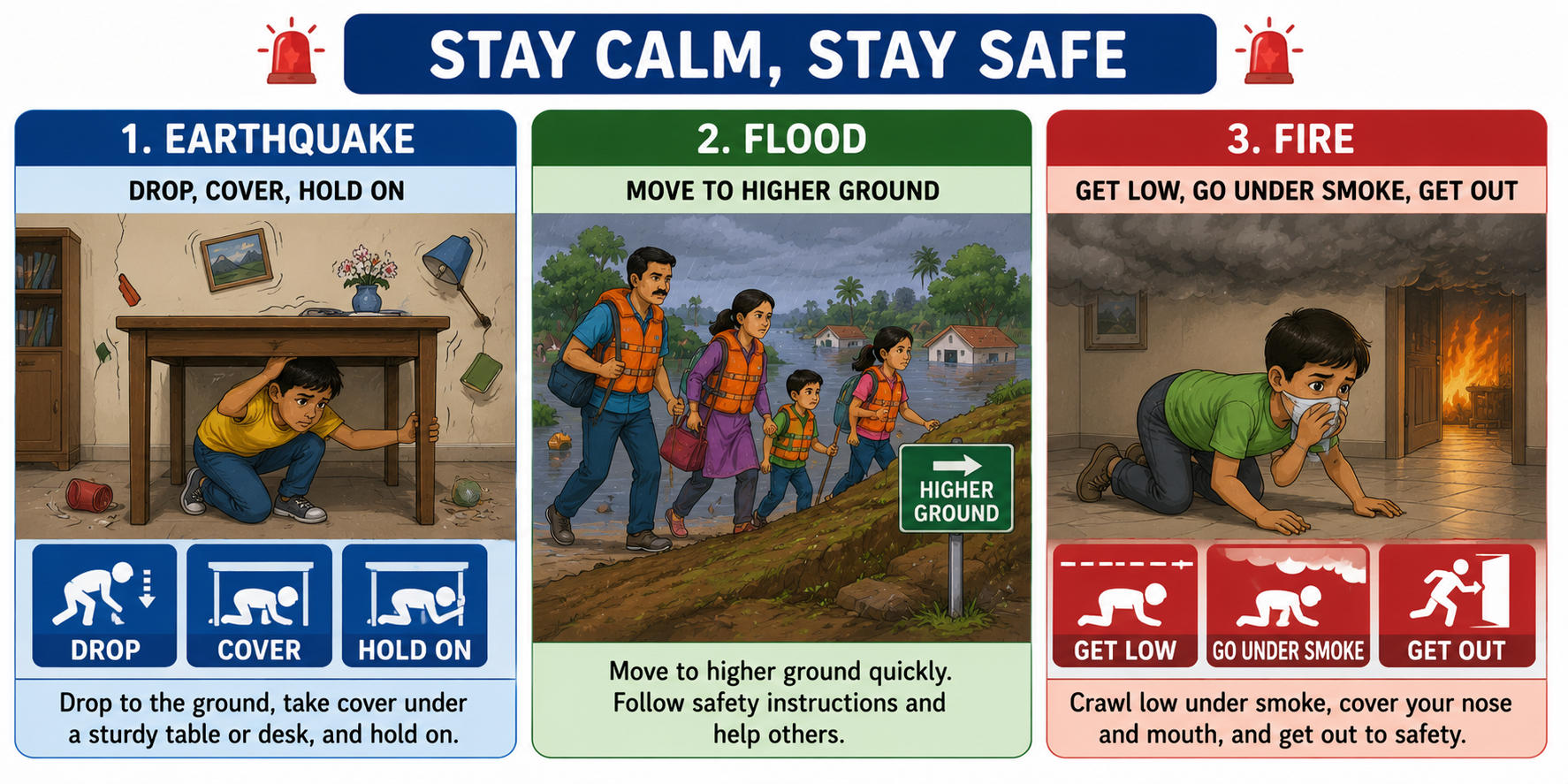
- DROP, COVER, and HOLD ON — get under a strong table or desk.
- Stay away from windows, mirrors, and heavy shelves.
- If outdoors, move to an open area away from buildings and trees.
- Do not use the lift. Use stairs to go out after shaking stops.
- Do not panic — stay calm and follow instructions.
During a Flood
- Move to higher ground immediately.
- Do not walk or play in flood water — it may have germs or hidden dangers.
- Do not touch electrical poles or wires in water.
- Keep important documents and medicines in a waterproof bag.
- Listen to radio or TV for warnings and instructions.
During a Fire
- Shout "FIRE! FIRE!" to alert everyone.
- Crawl low on the floor if there is smoke (clean air is near the floor).
- Cover your nose and mouth with a wet cloth.
- Use stairs, never the lift.
- Call 101 (Fire Brigade) immediately.
- If your clothes catch fire: STOP, DROP, and ROLL.
First Aid Basics
First aid is the immediate help given to a person who is hurt or sick, before a doctor arrives. Every child should know basic first aid.
| Injury | What to Do |
|---|---|
| Small Cut or Wound | Wash with clean water → Apply antiseptic (Dettol/Savlon) → Cover with a clean bandage or band-aid |
| Burn (minor) | Hold the burnt area under cool running water for 10 minutes → Do NOT apply ice, butter, or toothpaste → Cover loosely with a clean cloth |
| Insect Bite | Wash the area with soap and water → Apply a cold cloth to reduce swelling → Do not scratch the bite |
| Nosebleed | Sit up straight, lean slightly forward → Pinch the soft part of the nose for 10 minutes → Do NOT tilt head back |
| Sprain (twisted ankle) | Rest the injured part → Apply ice wrapped in cloth → Tell an adult immediately |
Emergency Numbers in India
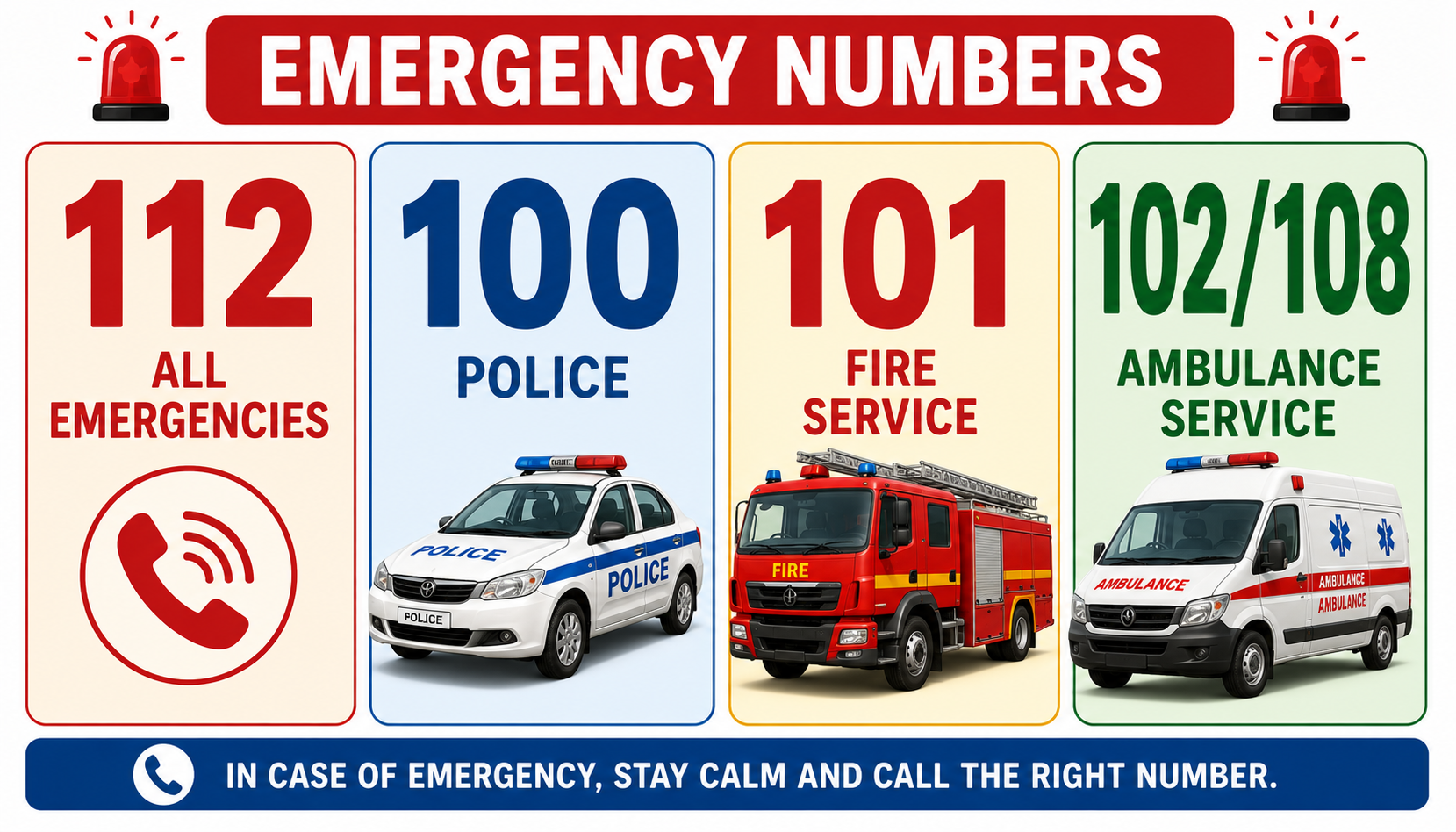
These are important phone numbers that every child must remember. In an emergency, call these numbers for help:
| Number | Service | When to Call |
|---|---|---|
| 112 | All-in-One Emergency | Any emergency — police, fire, or ambulance |
| 100 | Police | Theft, crime, stranger danger, accident |
| 101 | Fire Brigade | Fire in building, forest fire, gas leak |
| 102 | Ambulance (free) | Pregnant women, medical emergency |
| 108 | Ambulance (emergency) | Accident, heart attack, serious injury |
Good Touch and Bad Touch
Our body belongs to us. It is important to know the difference between a good touch and a bad touch.
| Good Touch | Bad Touch |
|---|---|
| A hug from parents or grandparents | Any touch that makes you feel scared or uncomfortable |
| A pat on the back from your teacher | Someone touching your private body parts |
| A handshake with a friend | Someone asking you to keep a touch "secret" |
| A doctor examining you (with parent present) | Any touch that hurts you |
Stranger Safety — How to Stay Safe
- Never go anywhere with a stranger, even if they offer sweets, toys, or a ride.
- Do not share your name, address, phone number, or school name with strangers.
- If someone makes you uncomfortable, say "NO!" loudly and run away.
- Always tell a trusted adult (parent, teacher, grandparent) if someone touches you badly or makes you feel unsafe.
- Remember: It is never your fault. You will not get in trouble for telling.
- Your body is yours. No one has the right to touch you without your permission.
Key Words
| Word | Meaning |
|---|---|
| Pedestrian | A person walking on the road |
| Zebra Crossing | Black and white stripes on the road for safe crossing |
| Traffic Signal | Lights (red, yellow, green) that control traffic |
| First Aid | Immediate help given to an injured person before a doctor comes |
| Emergency | A sudden dangerous situation that needs quick action |
| Fire Drill | Practice exercise to prepare for a real fire |
| Earthquake | Sudden shaking of the ground |
| Flood | Overflow of water onto land that is usually dry |
| Stranger | A person you do not know |
| Trusted Adult | A grown-up you know well and feel safe with (parent, teacher) |
- Always follow traffic rules — Red means STOP, Green means GO.
- Cross the road at the zebra crossing. Look right, left, then right again.
- Never touch electrical switches with wet hands or play with fire.
- Follow staircase rules at school — hold the railing, walk on the left.
- During an earthquake: DROP, COVER, and HOLD ON.
- For fire: crawl low, cover nose, use stairs, call 101.
- For small cuts: wash, apply antiseptic, cover with bandage.
- Emergency number 112 works for all emergencies in India.
- Say NO to bad touch, get away, and tell a trusted adult.
- Never go with strangers or share personal information with them.
Practice Questions
| Column A | Column B |
|---|---|
| 1. Red light | a. Fire Brigade |
| 2. 101 | b. Get under a table |
| 3. Earthquake | c. Stop |
| 4. Zebra crossing | d. Cool running water |
| 5. Minor burn | e. Safe place to cross road |
Activity 1: Safety Poster
Make a colourful poster on "Road Safety Rules" with drawings of traffic lights, zebra crossing, and children following rules. Display it in your classroom!
Activity 2: Emergency Number Card
Make a small card with all emergency numbers (112, 100, 101, 102, 108) and stick it near the telephone or on the fridge at home. Ask your family members to memorise them too!
Activity 3: Fire Drill Practice
With your family, practise a fire drill at home. Decide an escape route and a meeting point outside. Time how quickly everyone can get out safely!
Want a printable worksheet? Switch to the Worksheet View, then print.