Transport
Learning Objectives
- I can explain what transport means and why we need it.
- I can name and classify the three types of transport — land, water, and air.
- I can tell the difference between public and private transport.
- I can describe how transport has changed from old times to modern times.
- I can explain basic traffic rules and road safety measures.
- I can name different fuels used by vehicles and understand eco-friendly transport.
Let Us Begin!
Every day, we travel from one place to another — to school, to the market, to our grandparents' house. Have you ever thought about how people and goods move from one place to another?
The means by which people and goods move from one place to another is called transport. Without transport, we would have to walk everywhere!
India is a large country with many types of transport — from bullock carts in villages to metro trains in big cities. Let us learn about the wonderful world of transport!
What is Transport? Why Do We Need It?
Transport means carrying people or goods from one place to another. The vehicles we use for this are called means of transport.
We need transport to:
- Go to school, office, market, hospital, and other places.
- Carry goods like food, clothes, and medicines from one city to another.
- Visit relatives and friends who live far away.
- Send letters, parcels, and packages to different places.
- Travel to other states and countries.
Types of Transport
Transport is divided into three types based on where the vehicles move:
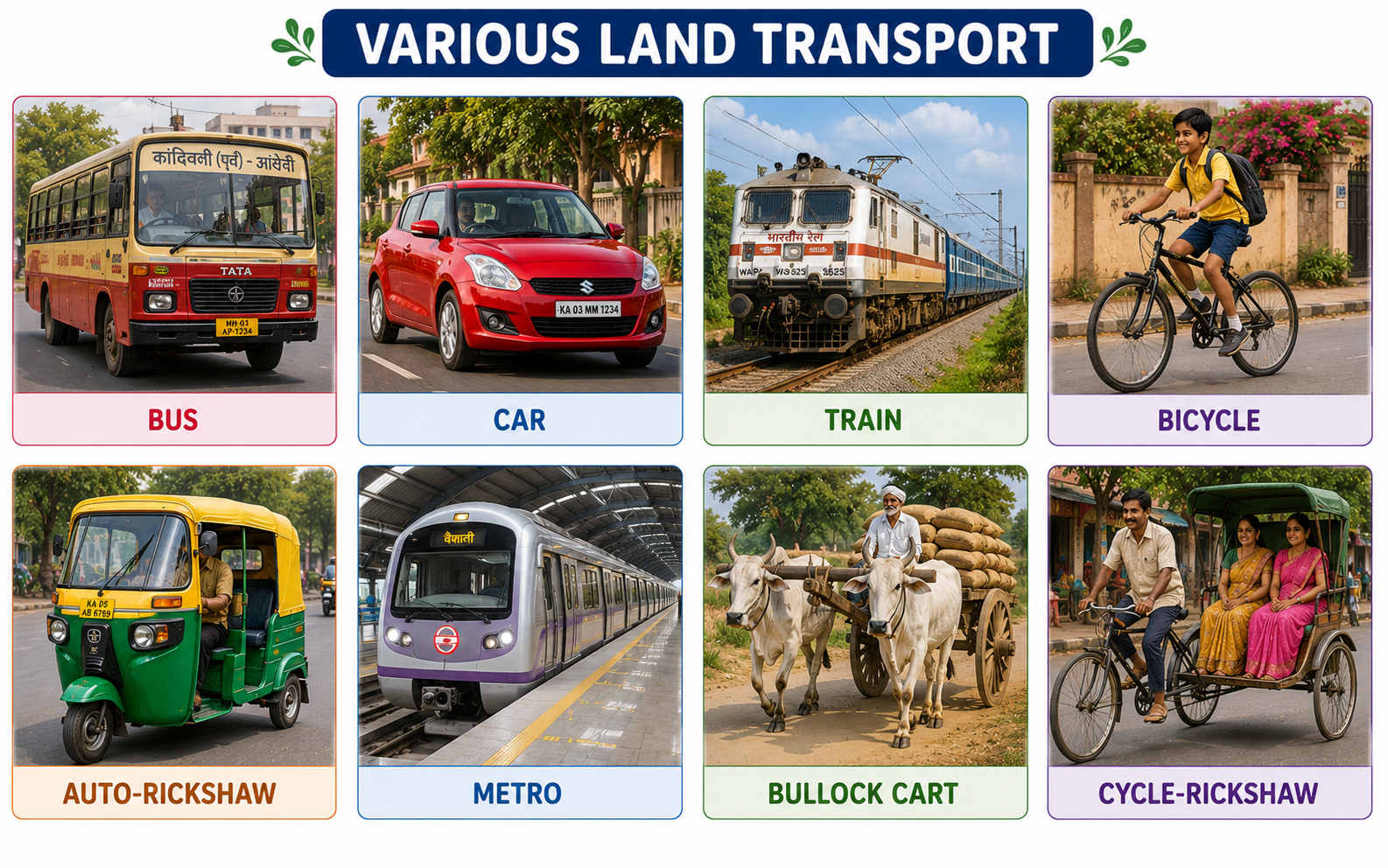
1. Land Transport (Road and Rail)
Vehicles that move on land — on roads or railway tracks.
| Vehicle | Used For | Runs On |
|---|---|---|
| Bus | Carrying many people in cities and between cities | Road (diesel/CNG) |
| Car | Family travel, personal use | Road (petrol/diesel/electric) |
| Train | Long-distance travel, carrying heavy goods | Railway tracks (diesel/electric) |
| Bicycle | Short distances, exercise, eco-friendly | Road (no fuel needed!) |
| Auto-rickshaw | Short trips in cities and towns | Road (CNG/petrol) |
| Metro | Fast travel within big cities (Delhi, Kolkata, Bengaluru) | Elevated/underground tracks (electric) |
| Bullock cart | Carrying goods in villages | Mud roads (pulled by bullocks) |
| Cycle-rickshaw | Short trips, no pollution | Road (human-powered) |
| Truck | Carrying heavy goods between cities | Road (diesel) |
| Motorcycle/Scooter | Personal travel for 1–2 people | Road (petrol/electric) |
2. Water Transport
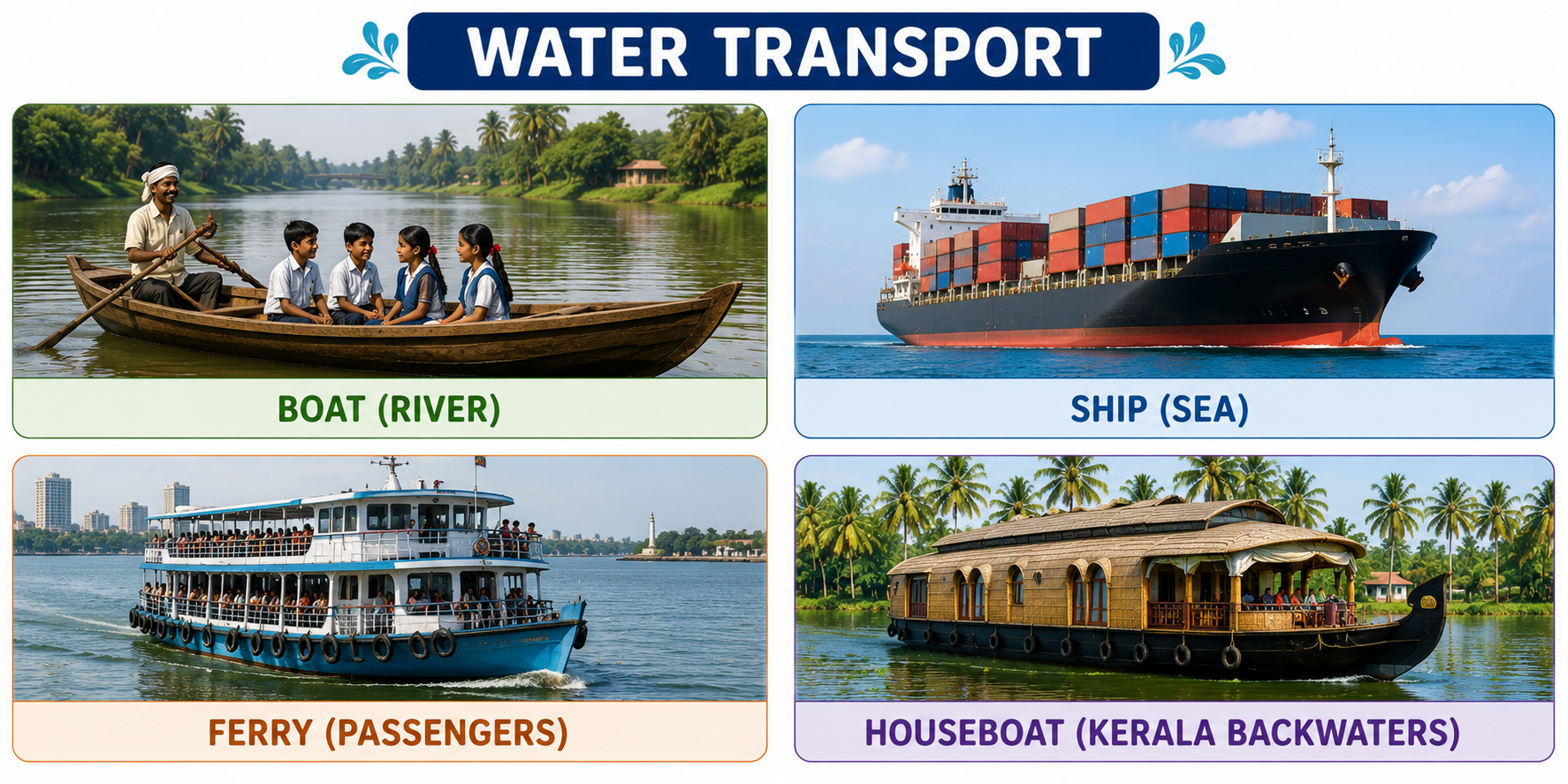
Vehicles that move on water — rivers, seas, and oceans.
| Vehicle | Used For | Where Used |
|---|---|---|
| Boat | Fishing, crossing rivers, short trips | Rivers, lakes (Kerala backwaters, Varanasi Ganga) |
| Ship | Carrying goods and people across oceans | Seas and oceans (Mumbai port, Chennai port) |
| Ferry | Carrying people across rivers/harbours | Rivers, harbours (Kolkata, Kochi, Goa) |
| Steamer | Passenger travel on large rivers | Rivers (Brahmaputra in Assam, Sundarbans) |
| Houseboat | Living and travelling on water | Kerala backwaters (Alleppey, Kumarakom) |
3. Air Transport
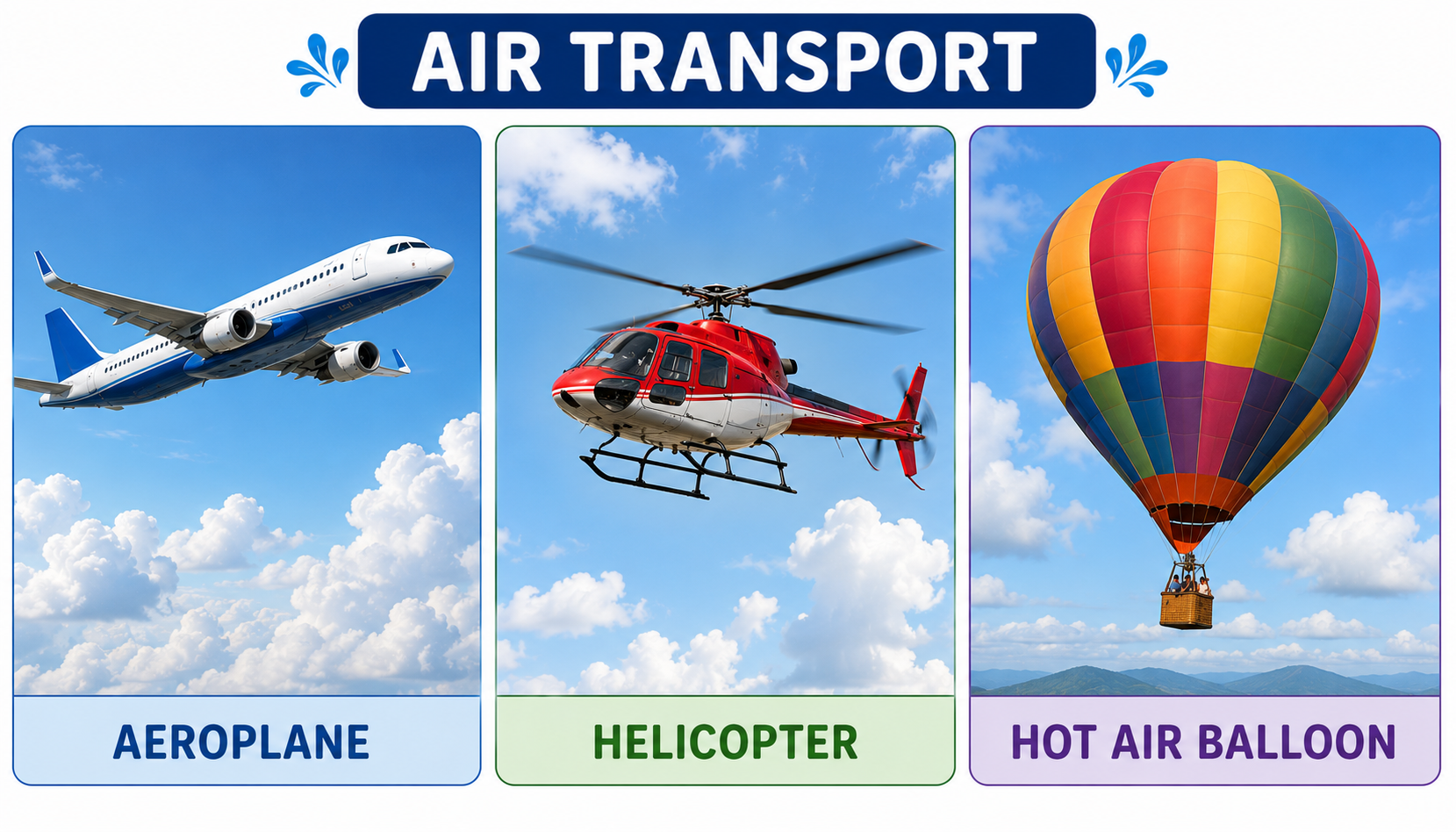
Vehicles that fly in the air — the fastest means of transport!
| Vehicle | Used For | Special Feature |
|---|---|---|
| Aeroplane | Travelling long distances very fast | Fastest transport; flies above clouds |
| Helicopter | Rescue, reaching difficult places, VIP travel | Can take off and land without a runway |
| Hot air balloon | Sightseeing, fun rides | Uses hot air to rise up |
Air transport is the fastest but also the most expensive. It is used when we need to travel very long distances quickly — like going from Delhi to Chennai or to another country.
Public Transport vs Private Transport
| Public Transport | Private Transport |
|---|---|
| Used by many people together | Used by one person or family |
| Bus, train, metro, auto-rickshaw, ferry | Car, bicycle, motorcycle, scooter |
| Cheaper — we pay a fare/ticket | More expensive — we buy and maintain the vehicle |
| Follows a fixed route and timetable | Goes wherever we want, anytime |
| Less pollution (carries many people at once) | More pollution (one car = one family) |
| Examples: DTC bus (Delhi), BEST bus (Mumbai), Mumbai local train | Examples: family car, papa's scooter |
Old Transport vs Modern Transport
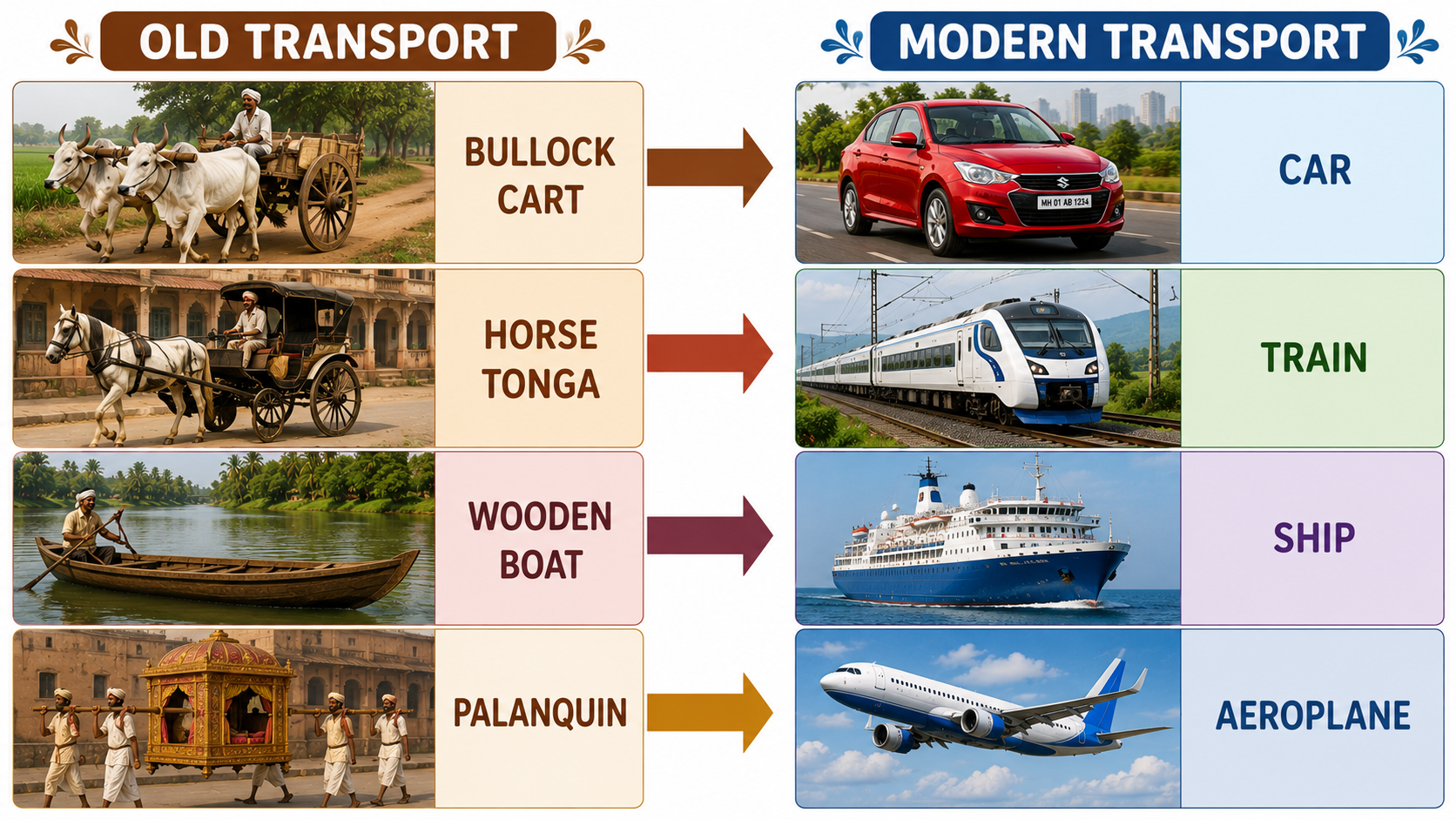
Transport has changed a lot over time! Long ago, people used animals and simple vehicles. Today, we have fast machines.
| Old Times | Modern Times | What Changed |
|---|---|---|
| Bullock cart | Car, Bus, Truck | Animals replaced by engines |
| Horse / Horse carriage (Tonga) | Train, Metro | Faster, carries more people |
| Wooden boat / Raft | Ship, Steamer | Bigger, safer, engine-powered |
| Walking long distances | Aeroplane | Travel in hours instead of months! |
| Palanquin (Palki/Doli) | Car, Auto-rickshaw | No need for human carriers |
| Camel (in deserts) | Jeep, Bus | Faster in sand, air-conditioned |
Traffic Rules and Road Safety
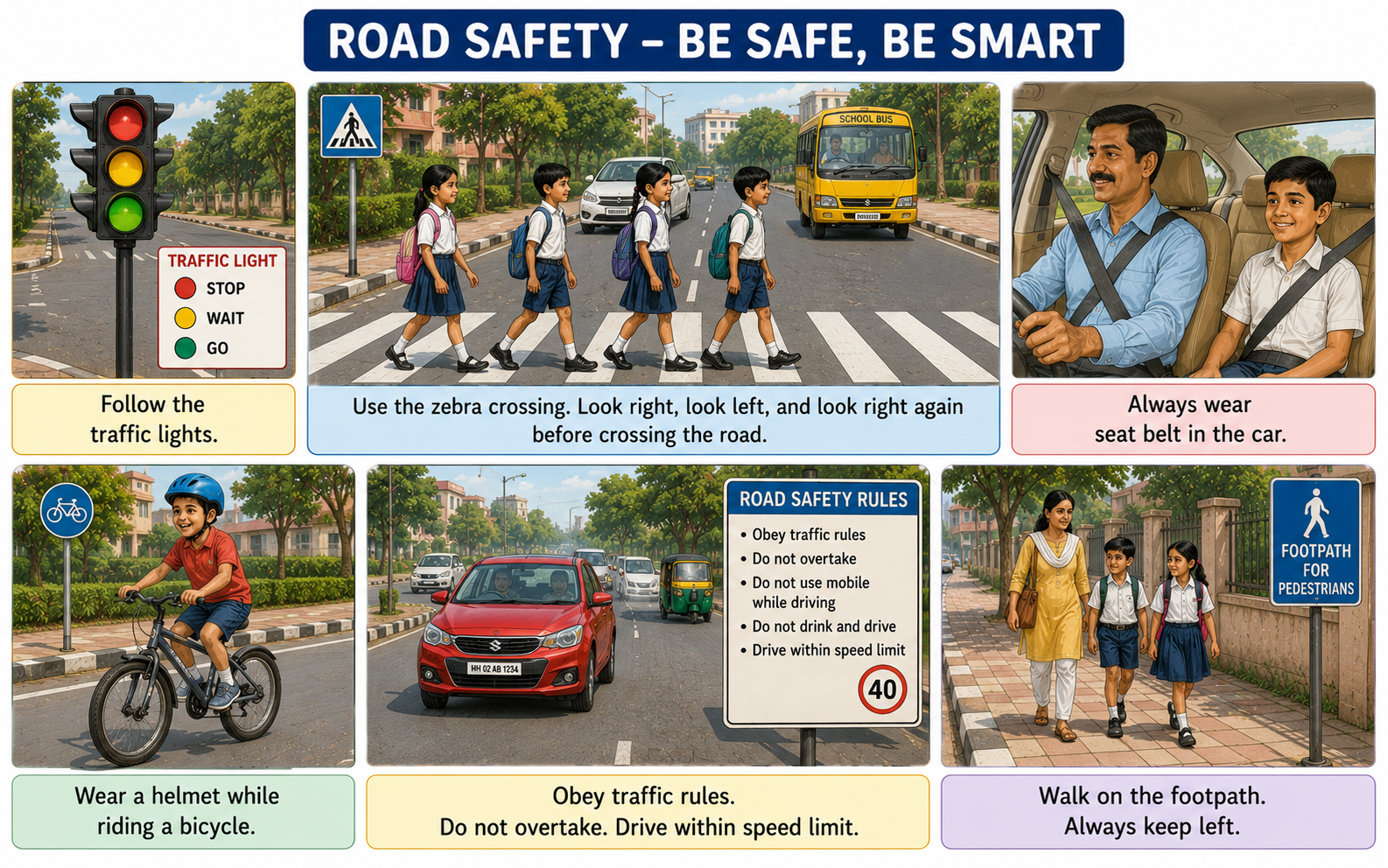
Roads can be dangerous if we don't follow rules. Traffic rules keep everyone safe!
Traffic Lights (Traffic Signals)
| Light | Meaning | What to Do |
|---|---|---|
| 🔴 Red | STOP | All vehicles must stop. Do not cross. |
| 🟡 Yellow | GET READY | Slow down. Be ready to stop or go. |
| 🟢 Green | GO | Vehicles can move. Pedestrians wait. |
Important Road Safety Rules
- Always cross the road at the zebra crossing (black and white stripes).
- Look right, then left, then right again before crossing.
- Always wear a seat belt in a car.
- Always wear a helmet when riding a bicycle or sitting on a motorcycle.
- Never put your hands or head outside a moving vehicle.
- Walk on the footpath (pavement). If no footpath, walk on the left side facing traffic.
- Do not play on the road or near traffic.
- Follow the instructions of the traffic police.
Indian Railways and Metro
India has one of the largest railway networks in the world! Here are some amazing facts:
- Indian Railways carries over 2 crore (20 million) passengers every day!
- The railway network covers more than 68,000 km of tracks.
- India has over 7,000 railway stations.
- The first Indian train ran from Mumbai to Thane on 16 April 1853.
- Mumbai local trains carry about 75 lakh (7.5 million) people daily — the busiest suburban railway!
- The Rajdhani Express connects Delhi to state capitals.
- The Shatabdi Express is a fast day-train between nearby cities.
Metro Rail
Metro trains run in big cities to reduce traffic and pollution:
| City | Metro Name | Special Feature |
|---|---|---|
| Kolkata | Kolkata Metro | India's first metro (started 1984) |
| Delhi | Delhi Metro | Largest metro network in India |
| Mumbai | Mumbai Metro | Helps reduce crowding on local trains |
| Bengaluru | Namma Metro | Elevated metro (runs above ground) |
| Chennai | Chennai Metro | Underground + elevated sections |
Fuels Used by Vehicles
Vehicles need fuel (energy) to move. Different vehicles use different fuels:
| Fuel | Vehicles That Use It | Good or Bad for Environment? |
|---|---|---|
| Petrol | Cars, motorcycles, scooters, auto-rickshaws | Causes air pollution (smoke) |
| Diesel | Buses, trucks, trains, some cars | Causes more pollution than petrol |
| CNG (Compressed Natural Gas) | Auto-rickshaws, buses (Delhi, Mumbai) | Less pollution than petrol/diesel |
| Electricity | Electric cars, metro trains, electric buses, e-rickshaws | Very clean — no smoke! |
| Solar energy | Solar-powered vehicles (new technology) | Cleanest — uses sunlight! |
| No fuel (human power) | Bicycle, cycle-rickshaw, walking | Best for environment — zero pollution! |
Key Words
| Word | Meaning |
|---|---|
| Transport | Carrying people or goods from one place to another |
| Vehicle | A machine used for transport (bus, car, train, etc.) |
| Fuel | Material burned to give energy to a vehicle (petrol, diesel, CNG) |
| Traffic | Movement of vehicles on a road |
| Pedestrian | A person walking on the road or footpath |
| Zebra crossing | Black and white stripes on road where people cross safely |
| Public transport | Vehicles shared by many people (bus, train, metro) |
| Private transport | Vehicles owned by one person or family (car, scooter) |
| Pollution | Harmful smoke and gases that dirty the air |
| Railway network | System of railway tracks connecting different places |
- Transport means carrying people or goods from one place to another.
- Three types: Land (bus, car, train, metro), Water (boat, ship, ferry), Air (aeroplane, helicopter).
- Public transport is shared by many; private transport is for one family.
- Old transport used animals (bullock cart, horse); modern transport uses engines.
- Traffic lights: Red = Stop, Yellow = Get Ready, Green = Go.
- Always use zebra crossing, wear seat belt/helmet, walk on footpath.
- Indian Railways is one of the largest rail networks in the world (68,000+ km).
- Fuels: petrol, diesel, CNG, electricity, solar. Electric vehicles cause no pollution.
- Cycling and walking are the best for the environment — zero pollution!
Practice Questions
| Column A | Column B |
|---|---|
| 1. Aeroplane | a. Water transport |
| 2. Ship | b. Runs on tracks in cities |
| 3. Metro | c. Air transport |
| 4. Bullock cart | d. India's busiest suburban rail |
| 5. Mumbai local | e. Old means of land transport |
Activity 1: Transport Survey
Ask 5 friends or family members how they travel to school or work. Fill in the table:
| Person | Where They Go | Transport Used | Type (Land/Water/Air) |
|---|---|---|---|
Activity 2: Draw a road scene showing: a traffic light, a zebra crossing, a bus, a car, and a person crossing safely. Label all the parts.
Want a printable worksheet? Switch to the Worksheet View, then print.