Addition and Subtraction
Learning Objectives
- Add 3-digit and 4-digit numbers with carrying (regrouping).
- Subtract 3-digit and 4-digit numbers with borrowing (regrouping).
- Understand step-by-step working of carrying and borrowing.
- Learn properties of addition (commutative, zero property).
- Check subtraction answers using addition.
- Solve word problems using addition and subtraction.
Let Us Begin!
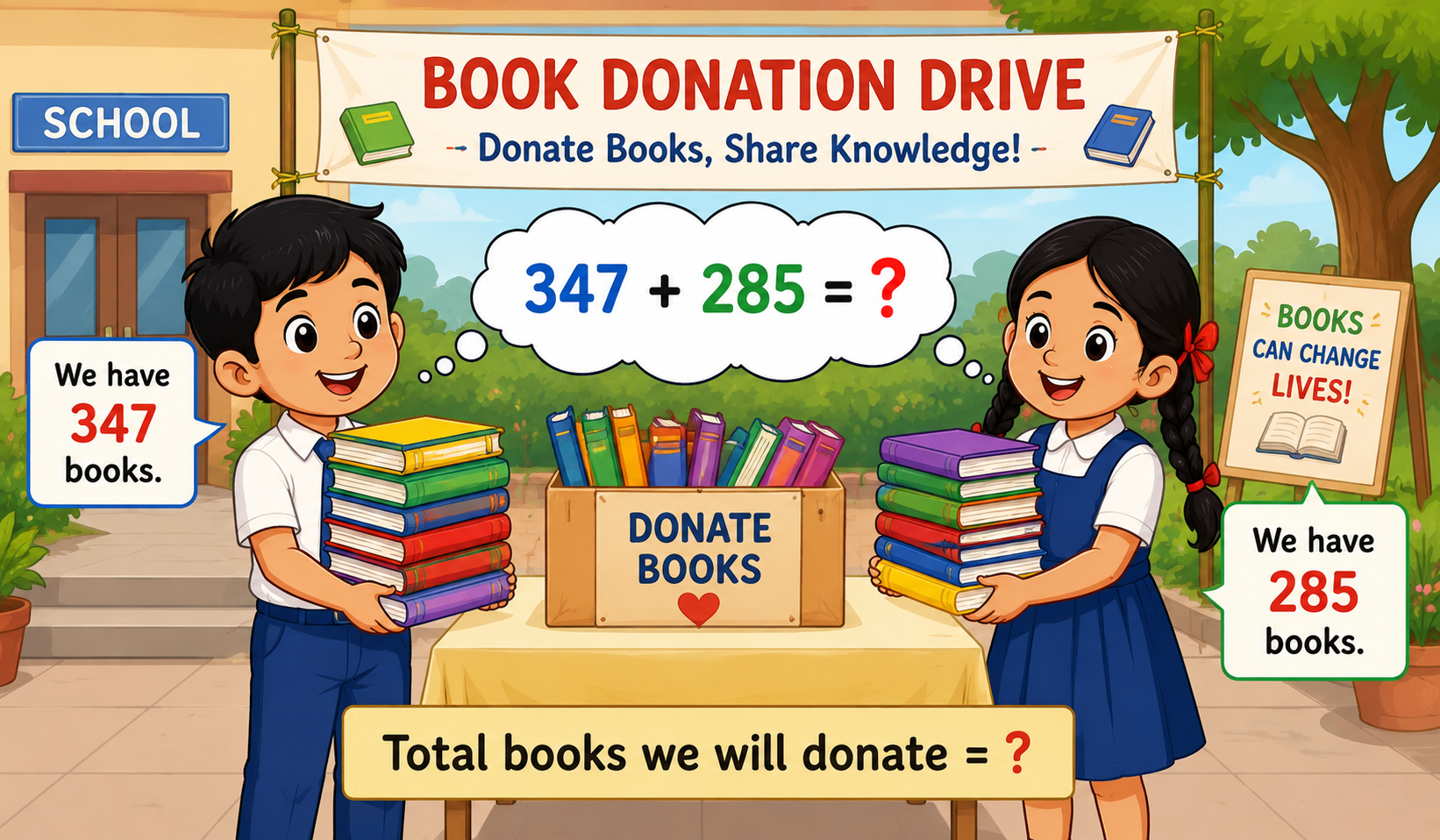
Meena's school collected 347 books in the first week and 285 books in the second week for a book donation drive. How many books were collected in all? To find out, we add the two numbers.
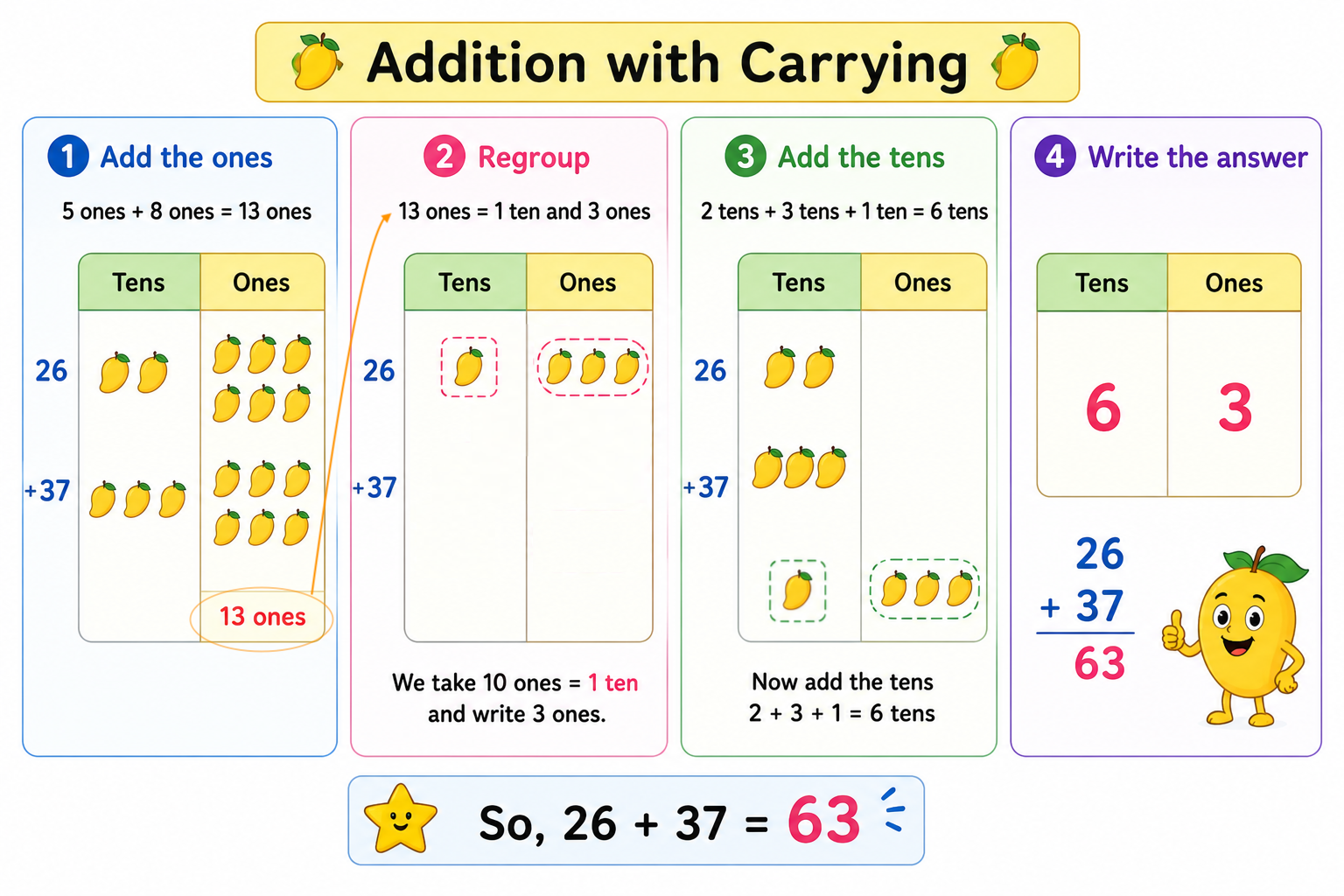
Sometimes when we add, the total in a column is more than 9. Then we carry the extra to the next column. This is called regrouping.
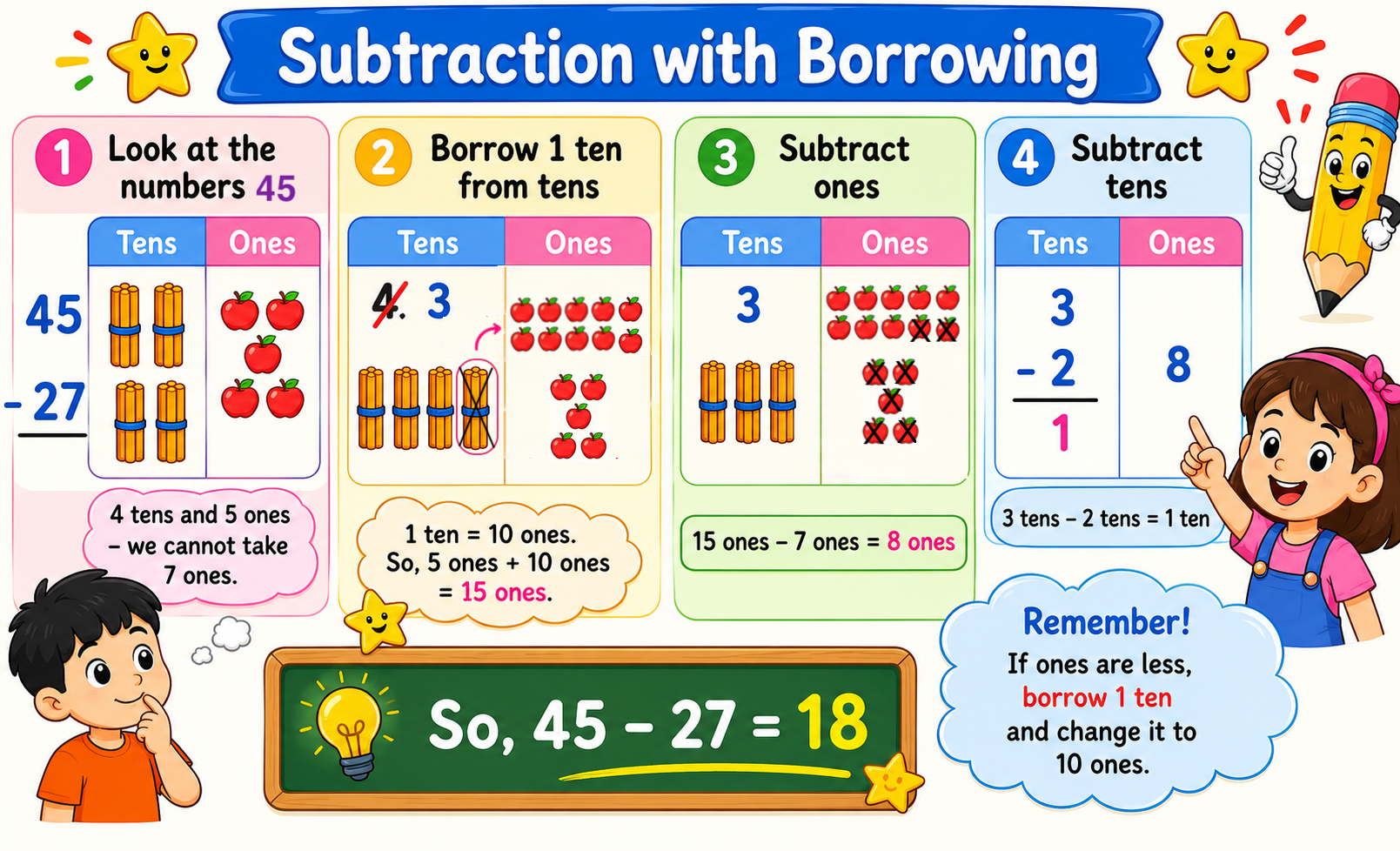
If the school gave away 268 books from a stock of 503, how many are left? We subtract. Sometimes the top digit is smaller, so we borrow from the next column.
Step-by-Step: Addition with Carrying
Example 1: 347 + 285
| H | T | O | |
|---|---|---|---|
| 3 | 4 | 7 | |
| + | 2 | 8 | 5 |
| = | 6 | 3 | 2 |
Step 1 (Ones): 7 + 5 = 12. Write 2 in the Ones column. Carry 1 to the Tens column.
Step 2 (Tens): 4 + 8 = 12, plus the carried 1 = 13. Write 3 in the Tens column. Carry 1 to the Hundreds column.
Step 3 (Hundreds): 3 + 2 = 5, plus the carried 1 = 6. Write 6 in the Hundreds column.
Answer: 347 + 285 = 632
Addition with Carrying: More Examples
Ones: 6 + 8 = 14, write 4, carry 1. Tens: 5 + 7 = 12, + 1 = 13, write 3, carry 1. Hundreds: 4 + 3 = 7, + 1 = 8.
Answer: 456 + 378 = 834
Ones: 9 + 6 = 15, write 5, carry 1. Tens: 8 + 7 = 15, + 1 = 16, write 6, carry 1. Hundreds: 5 + 2 = 7, + 1 = 8.
Answer: 589 + 276 = 865
4-Digit Addition with Carrying
In Class 3, we also add 4-digit numbers. The method is the same — start from the Ones column and move left.
Example 4: 2,456 + 1,378
| Th | H | T | O | |
|---|---|---|---|---|
| 2 | 4 | 5 | 6 | |
| + | 1 | 3 | 7 | 8 |
| = | 3 | 8 | 3 | 4 |
Step 1 (Ones): 6 + 8 = 14. Write 4, carry 1.
Step 2 (Tens): 5 + 7 = 12, + 1 = 13. Write 3, carry 1.
Step 3 (Hundreds): 4 + 3 = 7, + 1 = 8. Write 8.
Step 4 (Thousands): 2 + 1 = 3. Write 3.
Answer: 2,456 + 1,378 = 3,834
Ones: 7 + 5 = 12, write 2, carry 1. Tens: 6 + 9 = 15, + 1 = 16, write 6, carry 1. Hundreds: 5 + 8 = 13, + 1 = 14, write 4, carry 1. Thousands: 4 + 3 = 7, + 1 = 8.
Answer: 4,567 + 3,895 = 8,462
Step-by-Step: Subtraction with Borrowing
Example 1: 503 − 268
| H | T | O | |
|---|---|---|---|
| 5 | 0 | 3 | |
| − | 2 | 6 | 8 |
| = | 2 | 3 | 5 |
Step 1 (Ones): 3 − 8? We cannot! Borrow 1 ten from the Tens column. But Tens column is 0, so borrow 1 hundred from the Hundreds column first. H becomes 4, T becomes 10. Now borrow 1 ten for Ones: T becomes 9, O becomes 13. Now 13 − 8 = 5.
Step 2 (Tens): 9 − 6 = 3.
Step 3 (Hundreds): 4 − 2 = 2.
Answer: 503 − 268 = 235
Subtraction with Borrowing: More Examples
Ones: 0 − 6? Cannot! Borrow from Tens. Tens is 0, so borrow from Hundreds first. H becomes 6, T becomes 10. Now borrow 1 for Ones: T becomes 9, O becomes 10. 10 − 6 = 4.
Tens: 9 − 5 = 4. Hundreds: 6 − 3 = 3.
Answer: 700 − 356 = 344
Ones: 2 − 7? Cannot! Borrow from Tens: T becomes 0, O becomes 12. 12 − 7 = 5.
Tens: 0 − 6? Cannot! Borrow from Hundreds: H becomes 7, T becomes 10. 10 − 6 = 4.
Hundreds: 7 − 4 = 3.
Answer: 812 − 467 = 345
4-Digit Subtraction with Borrowing
Example 4: 5,003 − 2,768
| Th | H | T | O | |
|---|---|---|---|---|
| 5 | 0 | 0 | 3 | |
| − | 2 | 7 | 6 | 8 |
| = | 2 | 2 | 3 | 5 |
Step 1 (Ones): 3 − 8? Cannot! Tens is 0, Hundreds is 0. Borrow from Thousands: Th becomes 4, H becomes 10. Now borrow from H for T: H becomes 9, T becomes 10. Now borrow from T for O: T becomes 9, O becomes 13. 13 − 8 = 5.
Step 2 (Tens): 9 − 6 = 3.
Step 3 (Hundreds): 9 − 7 = 2.
Step 4 (Thousands): 4 − 2 = 2.
Answer: 5,003 − 2,768 = 2,235
Ones: 0 − 6? Cannot! Borrow step by step. T becomes 9, O becomes 10. 10 − 6 = 4.
Tens: 9 − 5 = 4. Hundreds: 1 − 8? Cannot! Borrow from Th: Th becomes 6, H becomes 11. 11 − 8 = 3. Thousands: 6 − 3 = 3.
Answer: 7,200 − 3,856 = 3,344
Checking Subtraction Using Addition
Rule: Difference + Smaller Number = Bigger Number. If this is true, your subtraction is correct.
812 − 467 = 345. Check: 345 + 467 = 812 ✓ Correct!
5,003 − 2,768 = 2,235. Check: 2,235 + 2,768 = 5,003 ✓ Correct!
Properties of Addition
Addition has some special rules that always work:
| Property | What It Means | Example |
|---|---|---|
| Commutative Property (Order Property) | We can add two numbers in any order and the sum stays the same. | 347 + 285 = 285 + 347 = 632 |
| Zero Property (Identity Property) | Adding 0 to any number gives the same number. | 456 + 0 = 456 0 + 789 = 789 |
| Associative Property | When adding three numbers, we can group them in any way. | (2 + 3) + 4 = 2 + (3 + 4) = 9 |
Word Problems (Indian Context)
Ravi's father gave him ₹475 for books and ₹368 for a school bag. How much money did Ravi get in all?
Solution: ₹475 + ₹368 = ₹843. Ravi got ₹843 in all.
In a cricket match, India scored 256 runs in the first innings and 189 runs in the second innings. What was the total score?
Solution: 256 + 189 = 445 runs.
A train had 1,250 passengers. At Delhi station, 486 passengers got down. How many passengers are still on the train?
Solution: 1,250 − 486 = 764 passengers are still on the train.
Meena's school library has 2,345 Hindi books and 1,678 English books. How many books are there in all?
Solution: 2,345 + 1,678 = 4,023 books in all.
Key Words
| Word | Meaning |
|---|---|
| Carrying (Regrouping) | When the sum in a column is 10 or more, we write the ones digit and carry the tens digit to the next column |
| Borrowing (Regrouping) | When the top digit is smaller, we take 1 from the next column to make it bigger |
| Sum | The answer we get after adding |
| Difference | The answer we get after subtracting |
| Place Value | The value of a digit based on its position (Ones, Tens, Hundreds, Thousands) |
| Commutative Property | Numbers can be added in any order: a + b = b + a |
| Zero Property | Adding 0 to any number gives the same number |
- Always start adding or subtracting from the Ones column (right side).
- In addition, if a column total is 10 or more, carry to the next column.
- In subtraction, if the top digit is smaller, borrow from the next column.
- Check your subtraction: add the answer to the smaller number. You should get the bigger number.
- Commutative property: a + b = b + a (order does not matter in addition).
- Zero property: any number + 0 = the same number.
- The same method works for 3-digit and 4-digit numbers.
Practice Questions
| Column A | Column B |
|---|---|
| 1. 456 + 378 | (a) 235 |
| 2. 503 − 268 | (b) 344 |
| 3. 700 − 356 | (c) 834 |
| 4. 389 + 0 | (d) 3,834 |
| 5. 2,456 + 1,378 | (e) 389 |
Number Detective: Solve each subtraction below. Then check your answer by adding the difference to the smaller number. Write "Correct" or "Try Again" next to each.
1. 704 − 389 = _________ Check: _________ + 389 = _________
2. 561 − 275 = _________ Check: _________ + 275 = _________
3. 830 − 462 = _________ Check: _________ + 462 = _________
Challenge: Write your own 4-digit addition sum where carrying happens in all four columns. Solve it and ask a friend to check!
My sum: _________ + _________ = _________
Want to use this as a worksheet? Switch to the A4 printable view.