Estimation
Learning Objectives
- Understand what estimation means and why it is useful.
- Round numbers to the nearest 10.
- Round numbers to the nearest 100.
- Estimate the sum of two numbers by rounding.
- Estimate the difference of two numbers by rounding.
- Use estimation in everyday situations like shopping and travel.
- Know when an exact answer is needed and when an estimate is enough.
What is Estimation?
Sometimes we do not need the exact answer. We just need a number that is close to the actual answer. This is called estimation.
Estimation means making a smart guess. It helps us find answers quickly without doing long calculations. We use estimation every day — when we guess how many sweets are in a jar, how long a trip will take, or how much money we need at a shop.
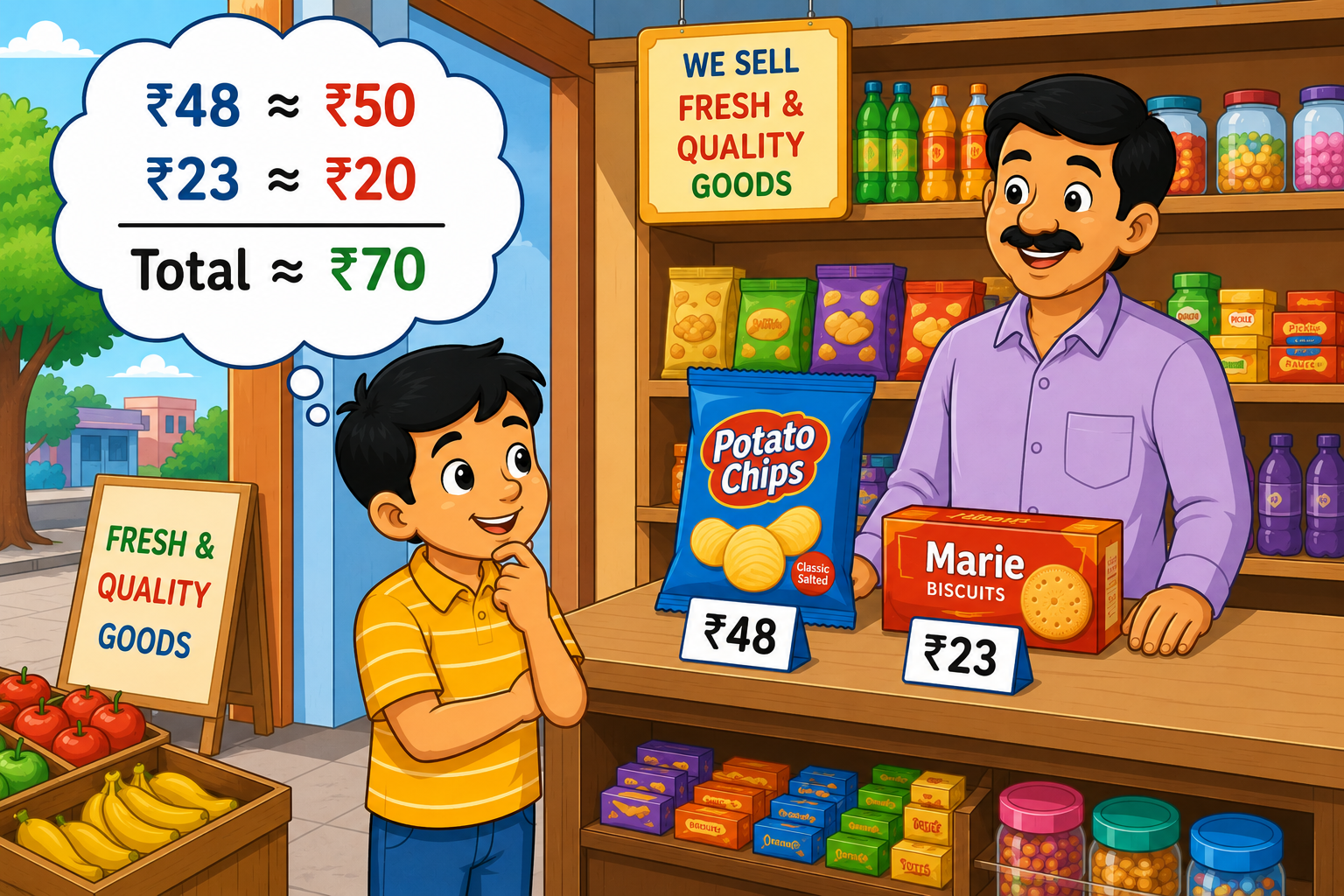
For example, Ravi goes to a mela (fair) with ₹100. He wants to buy a toy car for ₹48 and a balloon for ₹23. He quickly thinks: ₹48 is close to ₹50, and ₹23 is close to ₹20. So he needs about ₹50 + ₹20 = ₹70. He has enough money!
Rounding to the Nearest 10
To estimate, we first learn to round numbers. Rounding means replacing a number with the nearest "easy" number (like 10, 20, 30, 40...).
The Rule for Rounding to the Nearest 10:
- Look at the ones digit (the last digit).
- If the ones digit is 1, 2, 3, or 4 → round down (keep the tens digit the same, make ones 0).
- If the ones digit is 5, 6, 7, 8, or 9 → round up (add 1 to the tens digit, make ones 0).
Examples:
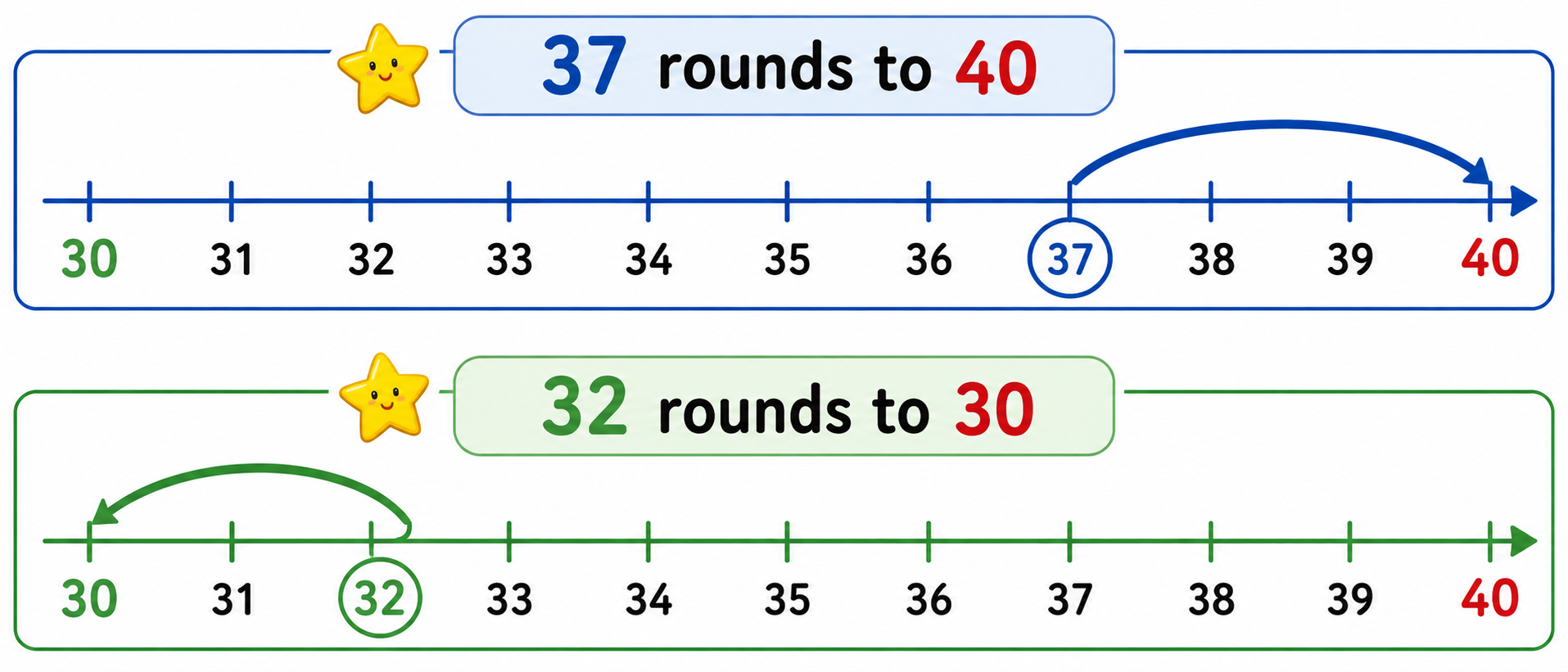
32 → The ones digit is 2 (less than 5) → Round down → 30
37 → The ones digit is 7 (5 or more) → Round up → 40
45 → The ones digit is 5 (5 or more) → Round up → 50
84 → The ones digit is 4 (less than 5) → Round down → 80
68 → The ones digit is 8 (5 or more) → Round up → 70
Think of it this way: The number is standing between two tens. Which ten is it closer to? That is the answer!
| Number | Ones Digit | Round Up or Down? | Rounded to Nearest 10 |
|---|---|---|---|
| 23 | 3 | Down (3 < 5) | 20 |
| 47 | 7 | Up (7 ≥ 5) | 50 |
| 55 | 5 | Up (5 ≥ 5) | 60 |
| 61 | 1 | Down (1 < 5) | 60 |
| 89 | 9 | Up (9 ≥ 5) | 90 |
| 74 | 4 | Down (4 < 5) | 70 |
Rounding to the Nearest 100
Sometimes we round to the nearest hundred (100, 200, 300...). This is useful for bigger numbers.
The Rule for Rounding to the Nearest 100:
- Look at the tens digit.
- If the tens digit is 0, 1, 2, 3, or 4 → round down.
- If the tens digit is 5, 6, 7, 8, or 9 → round up.
Examples:
230 → Tens digit is 3 (less than 5) → Round down → 200
370 → Tens digit is 7 (5 or more) → Round up → 400
450 → Tens digit is 5 (5 or more) → Round up → 500
812 → Tens digit is 1 (less than 5) → Round down → 800
567 → Tens digit is 6 (5 or more) → Round up → 600
| Number | Tens Digit | Round Up or Down? | Rounded to Nearest 100 |
|---|---|---|---|
| 340 | 4 | Down (4 < 5) | 300 |
| 678 | 7 | Up (7 ≥ 5) | 700 |
| 150 | 5 | Up (5 ≥ 5) | 200 |
| 423 | 2 | Down (2 < 5) | 400 |
| 985 | 8 | Up (8 ≥ 5) | 1000 |
Estimating Sums
To estimate a sum (addition), we round each number first, then add the rounded numbers.
Example 1: Estimate 48 + 23
Step 1: Round 48 to the nearest 10 → 50
Step 2: Round 23 to the nearest 10 → 20
Step 3: Add the rounded numbers → 50 + 20 = 70
The estimated sum is about 70. (The exact answer is 71 — very close!)
Example 2: Estimate 234 + 587
Step 1: Round 234 to the nearest 100 → 200
Step 2: Round 587 to the nearest 100 → 600
Step 3: Add → 200 + 600 = 800
The estimated sum is about 800. (The exact answer is 821.)
Estimating Differences
To estimate a difference (subtraction), we round each number first, then subtract the rounded numbers.
Example 1: Estimate 73 − 28
Step 1: Round 73 to the nearest 10 → 70
Step 2: Round 28 to the nearest 10 → 30
Step 3: Subtract → 70 − 30 = 40
The estimated difference is about 40. (The exact answer is 45.)
Example 2: Estimate 762 − 389
Step 1: Round 762 to the nearest 100 → 800
Step 2: Round 389 to the nearest 100 → 400
Step 3: Subtract → 800 − 400 = 400
The estimated difference is about 400. (The exact answer is 373.)
When is Estimation Useful?
We use estimation in many everyday situations:
- Shopping: Ravi has ₹200. He wants to buy items costing ₹78, ₹45, and ₹62. He rounds: ₹80 + ₹50 + ₹60 = ₹190. He has enough!
- Time: Meena's bus takes about 25 minutes. She rounds to 30 minutes to plan her morning.
- Distance: The school is 480 metres away. We say it is "about 500 metres."
- Counting: Meena sees a basket of mangoes. She estimates there are about 40 mangoes without counting each one.
- Checking answers: After solving 47 + 32, you can estimate: 50 + 30 = 80. If your answer is far from 80, you may have made a mistake!
Think about it: When do we need the exact answer? When a doctor gives medicine, or when we count money at a bank — we need exact numbers, not estimates!
Key Words
| Word | Meaning |
|---|---|
| Estimation | Finding a number close to the exact answer; a smart guess |
| Rounding | Replacing a number with the nearest ten or hundred |
| Round up | Going to the next higher ten or hundred (when digit is 5 or more) |
| Round down | Staying at the same ten or hundred (when digit is less than 5) |
| Nearest ten | The closest multiple of 10 (10, 20, 30, 40...) |
| Nearest hundred | The closest multiple of 100 (100, 200, 300...) |
| Approximate | Close to the exact value but not exact |
Key Points
- Estimation gives us a number close to the exact answer.
- To round to the nearest 10: look at the ones digit. If it is 5 or more, round up. If less than 5, round down.
- To round to the nearest 100: look at the tens digit. Same rule applies.
- To estimate a sum: round each number, then add.
- To estimate a difference: round each number, then subtract.
- Estimation is useful for quick calculations in shopping, travel, and checking answers.
- An estimate is not the exact answer — it is an approximate answer.
Practice Questions
| Column A | Column B |
|---|---|
| 1. 38 rounded to nearest 10 | a) 500 |
| 2. 72 rounded to nearest 10 | b) 40 |
| 3. 450 rounded to nearest 100 | c) 80 |
| 4. 55 rounded to nearest 10 | d) 70 |
| 5. 812 rounded to nearest 100 | e) 60 |
Activity: Estimation Game
Estimation at the Market
Pretend you are at a vegetable market. Your parent gives you ₹200. Here are the prices:
- Potatoes: ₹38 per kg
- Tomatoes: ₹52 per kg
- Onions: ₹29 per kg
- Carrots: ₹44 per kg
Task: Round each price to the nearest 10. Then estimate the total cost if you buy 1 kg of each vegetable. Do you have enough money?
Bonus: Now find the exact total. How close was your estimate?
Want a printable worksheet? Switch to the Worksheet View, then print.