Measurement (Length, Weight, Capacity)
Learning Objectives
- Understand standard units of length — centimetre (cm), metre (m), and kilometre (km).
- Convert between units of length: 1 m = 100 cm, 1 km = 1000 m.
- Understand standard units of weight — gram (g) and kilogram (kg), and convert: 1 kg = 1000 g.
- Understand standard units of capacity — millilitre (mL) and litre (L), and convert: 1 L = 1000 mL.
- Measure objects using a ruler, weighing scale, and measuring cup.
- Choose the correct unit for measuring different objects and quantities.
- Solve word problems involving measurement in everyday Indian contexts.
Introduction
Ravi and Meena are planning a trip from their home to school. Ravi says, "My school is far away!" Meena asks, "But how far exactly?" Without proper units, we cannot describe distances, weights, or amounts clearly.
In our daily life, we measure many things. A tailor measures cloth in metres. A vegetable seller weighs tomatoes in kilograms. A milkman measures milk in litres. All of these use standard units of measurement so that everyone understands the same amount.
In this chapter, we will learn about the standard units for length, weight, and capacity, and how to convert between bigger and smaller units.
1. Measuring Length
Length tells us how long, how tall, or how far something is. We use three main units to measure length:
| Unit | Symbol | Used For | Example |
|---|---|---|---|
| Centimetre | cm | Small lengths | Length of a pencil (15 cm) |
| Metre | m | Medium lengths | Height of a door (2 m) |
| Kilometre | km | Very long distances | Distance between two cities (150 km) |
Conversions
1 metre (m) = 100 centimetres (cm)
1 kilometre (km) = 1000 metres (m)
Using a Ruler
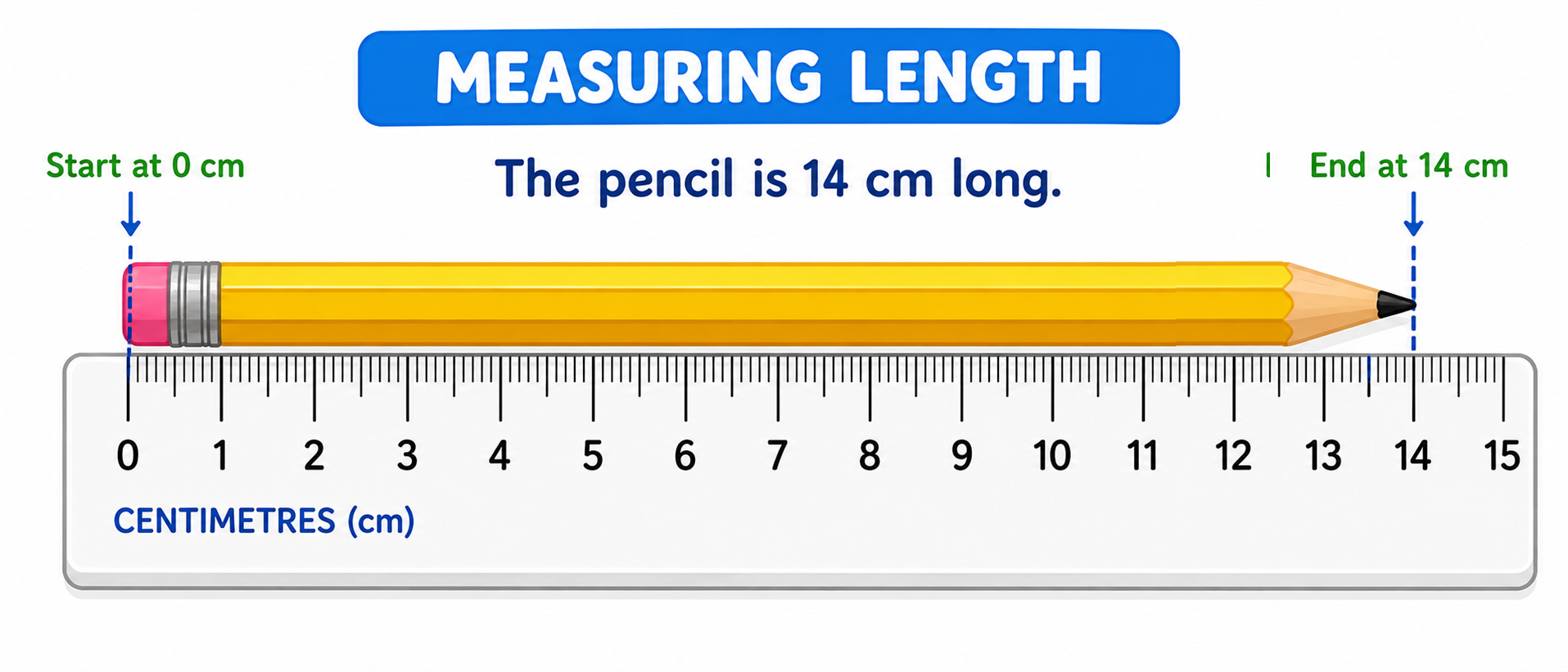
A ruler is used to measure small lengths in centimetres. To measure correctly:
- Place the object with one end at the 0 mark of the ruler.
- Look at the number where the other end of the object reaches.
- That number tells you the length in centimetres.
For example, if a pencil reaches from 0 to 14 on the ruler, the pencil is 14 cm long.
When to Use Which Unit?
Centimetre (cm) — for small objects you can hold in your hand: eraser, crayon, notebook, spoon.
Metre (m) — for bigger things: height of a person, length of a classroom, width of a cricket pitch.
Kilometre (km) — for very long distances: distance from home to school, distance between cities.
Converting Length Units
Arjun's classroom is 8 m long. How many centimetres is that?
Solution: 1 m = 100 cm, so 8 m = 8 × 100 = 800 cm
A rope is 500 cm long. How many metres is that?
Solution: 100 cm = 1 m, so 500 cm = 500 ÷ 100 = 5 m
The distance from Sita's home to her school is 2 km. How many metres is that?
Solution: 1 km = 1000 m, so 2 km = 2 × 1000 = 2000 m
2. Measuring Weight
Weight tells us how heavy or light something is. We use two main units:
| Unit | Symbol | Used For | Example |
|---|---|---|---|
| Gram | g | Light objects | A biscuit (10 g) |
| Kilogram | kg | Heavy objects | A bag of rice (5 kg) |
Conversion
1 kilogram (kg) = 1000 grams (g)
Using a Weighing Scale
At the vegetable market, the shopkeeper uses a weighing scale (tarazu) to measure how heavy fruits and vegetables are. Modern shops use digital weighing machines.
We place the object on one side and standard weights (like 500 g, 1 kg, 2 kg) on the other side until both sides are balanced.
When to Use Which Unit?
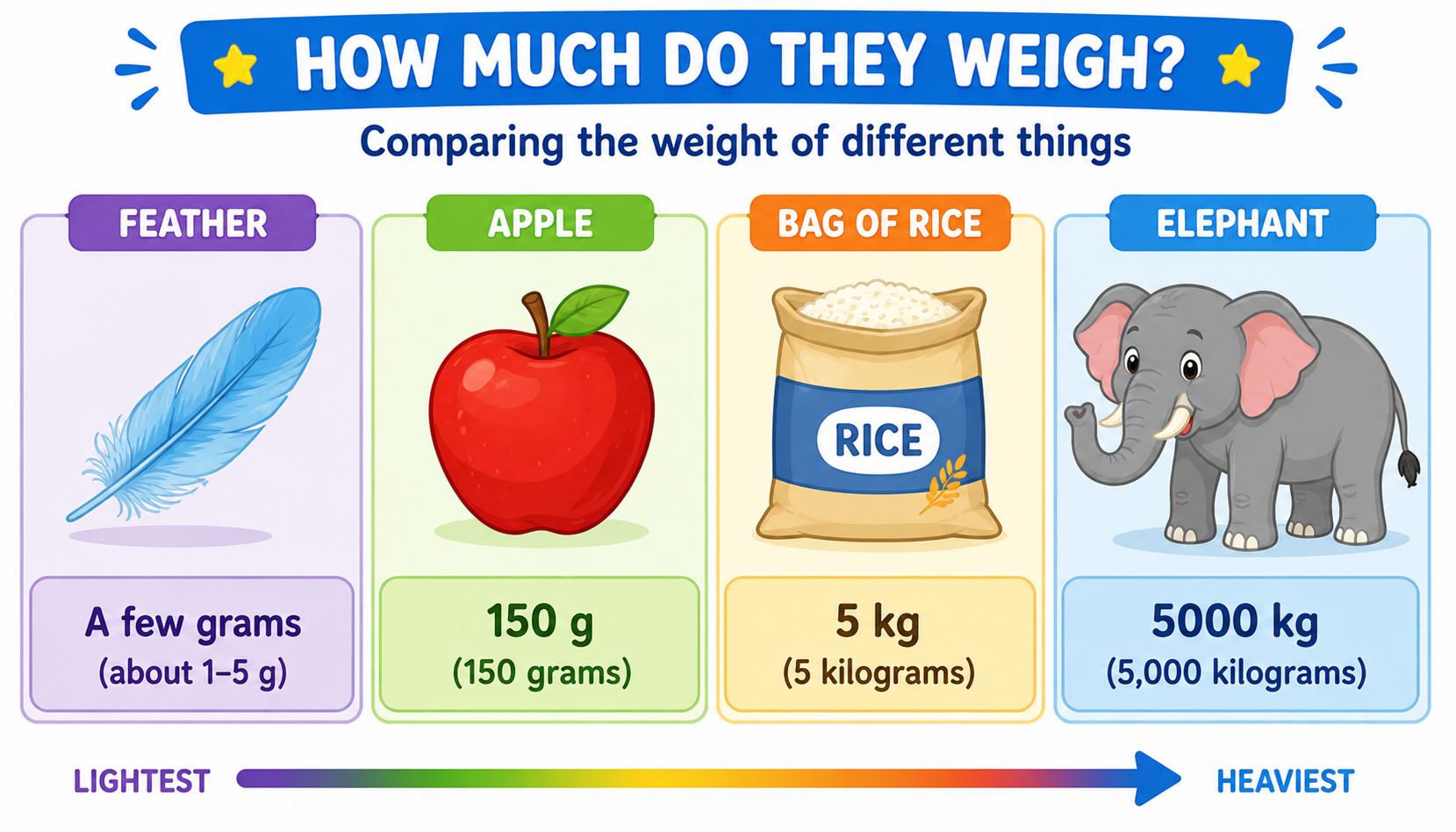
Gram (g) — for light things: a feather, a coin, a packet of chips, a small box of spices.
Kilogram (kg) — for heavy things: a bag of wheat, a watermelon, a suitcase, a person.
Converting Weight Units
Ravi bought 3 kg of sugar. How many grams is that?
Solution: 1 kg = 1000 g, so 3 kg = 3 × 1000 = 3000 g
A packet of dal weighs 2000 g. How many kilograms is that?
Solution: 1000 g = 1 kg, so 2000 g = 2000 ÷ 1000 = 2 kg
Sita bought 1 kg 200 g of mangoes and 800 g of grapes. What is the total weight?
Solution: 1 kg 200 g = 1200 g. Total = 1200 g + 800 g = 2000 g = 2 kg
3. Measuring Capacity
Capacity tells us how much liquid a container can hold. We use two main units:
| Unit | Symbol | Used For | Example |
|---|---|---|---|
| Millilitre | mL | Small amounts of liquid | A spoon of medicine (5 mL) |
| Litre | L | Large amounts of liquid | A bucket of water (10 L) |
Conversion
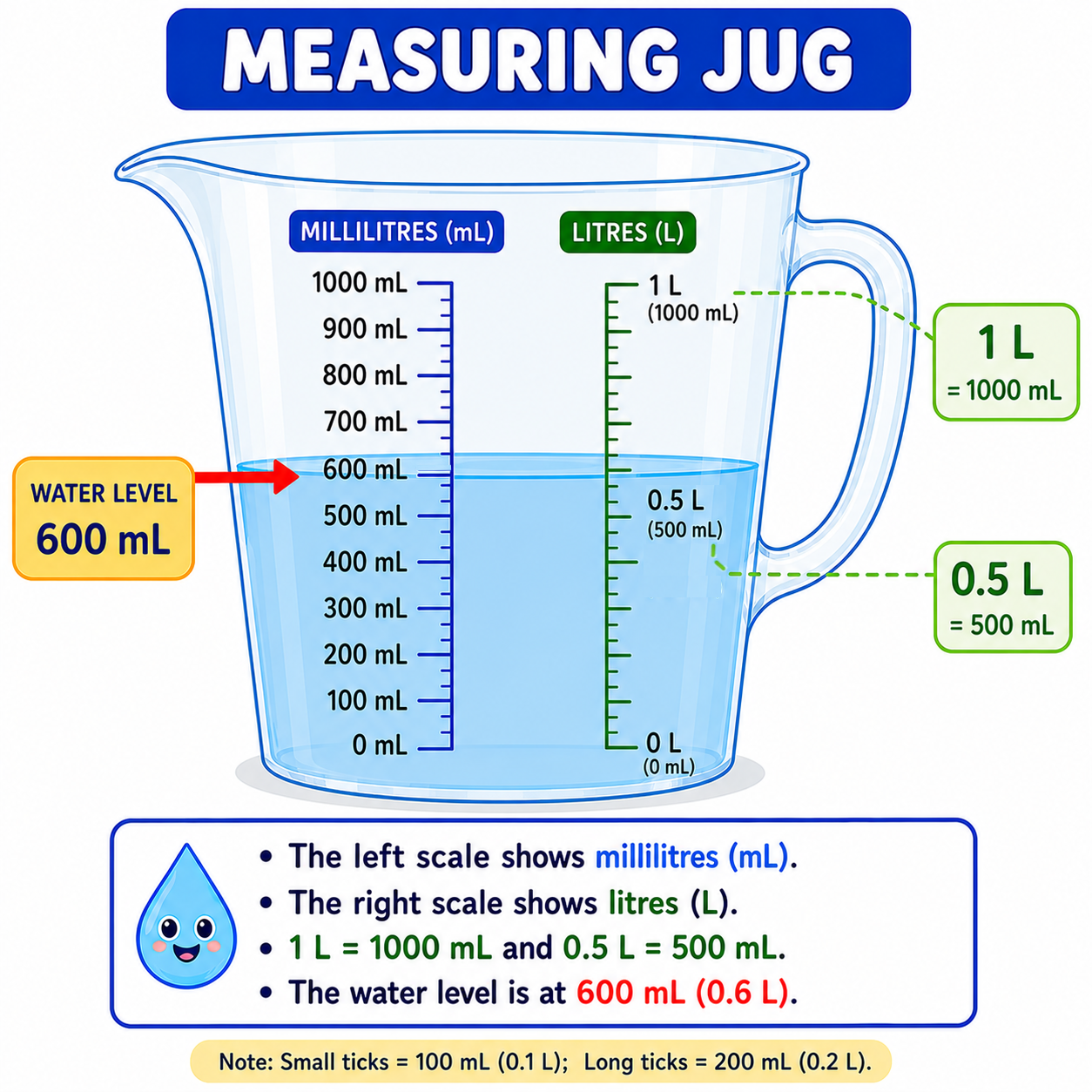
1 litre (L) = 1000 millilitres (mL)
Using a Measuring Cup / Jug
A measuring cup or jug has markings on the side that show millilitres and litres. We pour liquid into the cup and read the marking at the top of the liquid level.
In India, milk is often sold in packets of 500 mL or 1 litre. Cooking oil comes in bottles of 1 L, 2 L, or 5 L.
When to Use Which Unit?
Millilitre (mL) — for small amounts: medicine, perfume, eye drops, a cup of tea (150 mL).
Litre (L) — for large amounts: water in a bucket (15 L), petrol in a car (40 L), milk in a tank.
Converting Capacity Units
A water tank holds 5 L of water. How many millilitres is that?
Solution: 1 L = 1000 mL, so 5 L = 5 × 1000 = 5000 mL
A bottle contains 3000 mL of juice. How many litres is that?
Solution: 1000 mL = 1 L, so 3000 mL = 3000 ÷ 1000 = 3 L
Meena's mother makes 2 L of lemonade. She pours 250 mL into each glass. How many glasses can she fill?
Solution: 2 L = 2000 mL. Number of glasses = 2000 ÷ 250 = 8 glasses
4. Choosing the Right Unit — Summary
| What to Measure | Unit | Example |
|---|---|---|
| Length of a pencil | cm | 15 cm |
| Height of a classroom door | m | 2 m |
| Distance from Delhi to Jaipur | km | 280 km |
| Weight of a coin | g | 5 g |
| Weight of a school bag | kg | 4 kg |
| Medicine in a spoon | mL | 5 mL |
| Water in a bucket | L | 15 L |
5. Word Problems with Indian Context
Arjun's house is 2 km from his school. He walks to school and back every day. How many metres does he walk in total each day?
Solution: 1 km = 1000 m. Distance one way = 2 km = 2000 m. Total (to and back) = 2000 + 2000 = 4000 m = 4 km
Meena's father buys 2 kg of tomatoes at ₹40 per kg and 500 g of coriander at ₹30. What is the total weight of vegetables?
Solution: 2 kg = 2000 g. Total weight = 2000 g + 500 g = 2500 g = 2 kg 500 g
Sita fills a 12 L bucket with water. She uses 3 L 500 mL for washing clothes. How much water is left?
Solution: 12 L = 12000 mL. 3 L 500 mL = 3500 mL. Water left = 12000 − 3500 = 8500 mL = 8 L 500 mL
Key Words
| Word | Meaning |
|---|---|
| Centimetre (cm) | A small unit of length; used for measuring short objects |
| Metre (m) | A unit of length; 1 m = 100 cm |
| Kilometre (km) | A large unit of length for long distances; 1 km = 1000 m |
| Gram (g) | A small unit of weight; used for light objects |
| Kilogram (kg) | A unit of weight; 1 kg = 1000 g |
| Millilitre (mL) | A small unit of capacity; used for small amounts of liquid |
| Litre (L) | A unit of capacity; 1 L = 1000 mL |
| Conversion | Changing from one unit to another (e.g., m to cm) |
| Weighing scale | A tool used to measure how heavy something is |
| Measuring cup | A container with markings to measure liquids |
- Length: 1 km = 1000 m, 1 m = 100 cm. Use cm for small, m for medium, km for long distances.
- Weight: 1 kg = 1000 g. Use g for light objects, kg for heavy objects.
- Capacity: 1 L = 1000 mL. Use mL for small amounts, L for large amounts of liquid.
- To convert from a bigger unit to a smaller unit, multiply. (e.g., 3 km = 3 × 1000 = 3000 m)
- To convert from a smaller unit to a bigger unit, divide. (e.g., 5000 g = 5000 ÷ 1000 = 5 kg)
- Always start measuring from the 0 mark on a ruler.
- A cricket pitch is about 20 m long. The distance from Mumbai to Pune is about 150 km.
Practice Questions
| Column A | Column B |
|---|---|
| 1. Distance between cities | a. Gram |
| 2. Weight of a feather | b. Litre |
| 3. Water in a tank | c. Centimetre |
| 4. Length of an eraser | d. Kilometre |
| 5. Weight of a suitcase | e. Kilogram |
Materials needed: A ruler, a kitchen weighing scale (if available), and a measuring cup.
Instructions:
- Measure the length of 5 objects at home using a ruler. Write the object name and length in cm.
- Find 3 items in your kitchen and check their weight on the packet (e.g., a packet of salt = 1 kg).
- Fill a glass with water and pour it into a measuring cup. Note how many mL it holds.
| Object | Length / Weight / Capacity | Unit Used |
|---|---|---|
Challenge: Can you find something at home that weighs exactly 1 kg? What about a container that holds exactly 1 litre?
Want a printable worksheet? Switch to the Worksheet View, then print.