Money
Learning Objectives
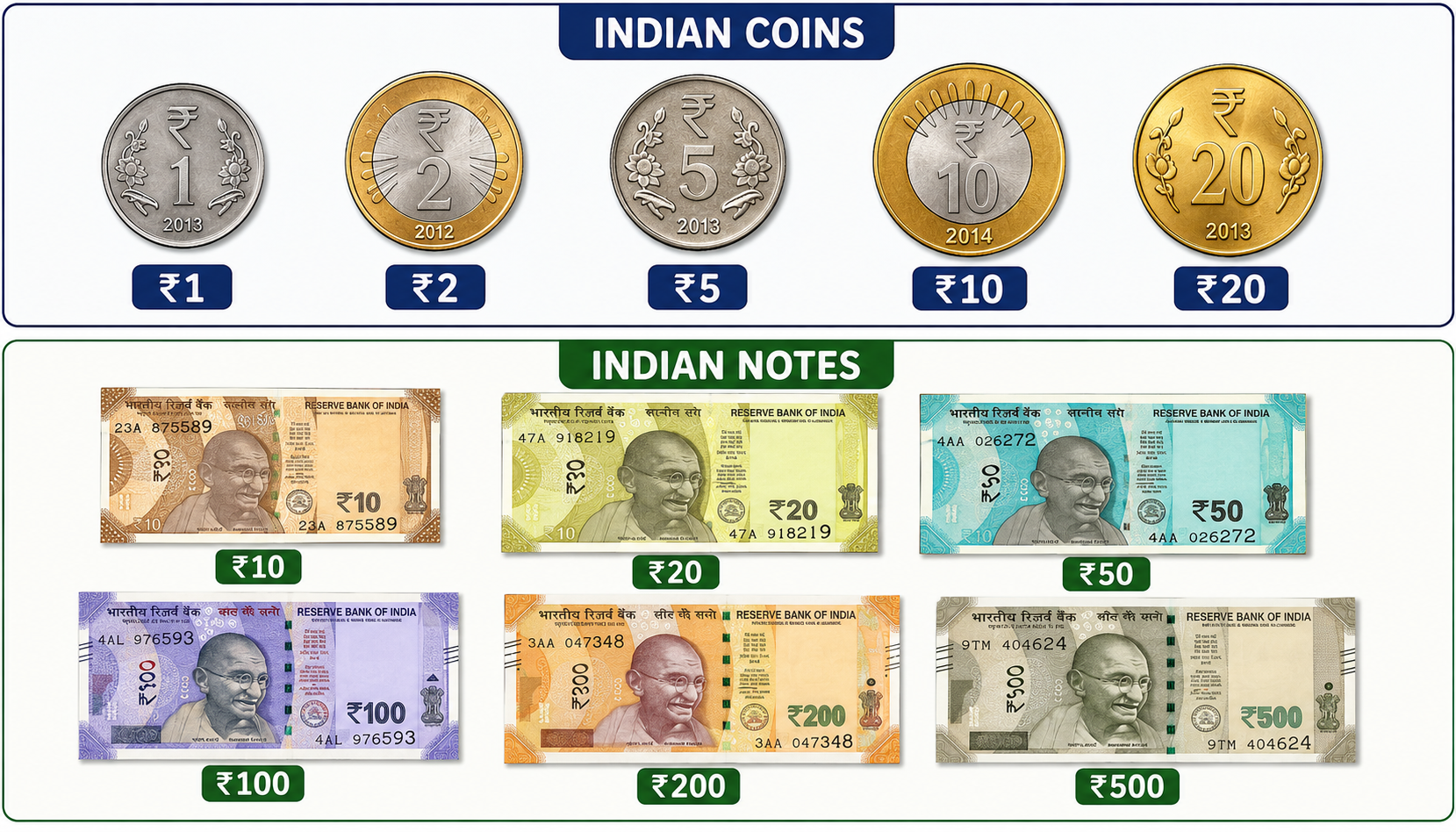
- Identify Indian coins (₹1, ₹2, ₹5, ₹10) and notes (₹10, ₹20, ₹50, ₹100, ₹200, ₹500).
- Understand the relationship between rupees and paise (₹1 = 100 paise).
- Convert rupees to paise and paise to rupees.
- Add and subtract amounts of money (with paise).
- Calculate change to be returned after a purchase.
- Solve word problems related to buying, selling, saving and pocket money.
Introduction
We use money every day to buy things we need — food, books, toys, clothes and more. In India, our money is called Indian Rupee. The symbol for rupee is ₹.
When Arjun goes to the kirana store near his house, he pays using coins and notes. The shopkeeper gives him back the extra money as change. Let us learn all about Indian money!
The Reserve Bank of India (RBI) prints all the notes and the Government of India makes the coins we use.
Indian Coins and Notes
In India, we use both coins and notes (also called currency notes or bills).
Coins We Use
| Coin | Value | What It Looks Like |
|---|---|---|
| ₹1 coin | 1 rupee | Small, round, silver-coloured |
| ₹2 coin | 2 rupees | Slightly bigger, silver-coloured |
| ₹5 coin | 5 rupees | Round, silver-coloured, thicker |
| ₹10 coin | 10 rupees | Two-toned (silver centre, gold ring) |
Notes We Use
| Note | Value | Colour |
|---|---|---|
| ₹10 note | 10 rupees | Chocolate brown |
| ₹20 note | 20 rupees | Greenish-yellow |
| ₹50 note | 50 rupees | Fluorescent blue |
| ₹100 note | 100 rupees | Lavender (light purple) |
| ₹200 note | 200 rupees | Bright yellow |
| ₹500 note | 500 rupees | Stone grey |
Converting Rupees and Paise
Just like 1 metre = 100 centimetres, we have:
₹1 = 100 paise
Paise is the smaller unit of Indian money. We write paise after a dot (decimal point). For example, ₹5.50 means 5 rupees and 50 paise.
Rupees to Paise
To convert rupees to paise, multiply by 100.
₹1 = 1 × 100 = 100 paise
₹3 = 3 × 100 = 300 paise
₹5.50 = 5 rupees 50 paise = (5 × 100) + 50 = 550 paise
₹7.25 = 7 rupees 25 paise = (7 × 100) + 25 = 725 paise
Paise to Rupees
To convert paise to rupees, divide by 100.
350 paise = ₹3.50 (3 rupees and 50 paise)
825 paise = ₹8.25 (8 rupees and 25 paise)
1250 paise = ₹12.50 (12 rupees and 50 paise)
Adding Money
When we add money, we add rupees with rupees and paise with paise. If paise add up to 100 or more, we convert them to rupees.
| ₹ | . | P | |
|---|---|---|---|
| 45 | . | 50 | |
| + | 23 | . | 75 |
| = | 69 | . | 25 |
Step 1 (Paise): 50 + 75 = 125 paise. Since 125 > 100, write 25 paise and carry ₹1 to the rupees column.
Step 2 (Rupees): 45 + 23 = 68, plus carried ₹1 = ₹69.
Answer: ₹45.50 + ₹23.75 = ₹69.25
Paise: 60 + 40 = 100 paise = ₹1 and 00 paise. Write 00, carry ₹1.
Rupees: 125 + 84 = 209, + 1 = 210.
Answer: ₹125.60 + ₹84.40 = ₹210.00
Paise: 00 + 50 = 50 paise.
Rupees: 250 + 175 = 425.
Answer: ₹250 + ₹175.50 = ₹425.50
Subtracting Money
When we subtract money, we subtract paise from paise and rupees from rupees. If the paise on top are less, we borrow ₹1 (= 100 paise) from the rupees column.
| ₹ | . | P | |
|---|---|---|---|
| 100 | . | 00 | |
| − | 67 | . | 50 |
| = | 32 | . | 50 |
Step 1 (Paise): 00 − 50? Cannot! Borrow ₹1 from rupees. Rupees become 99, paise become 100. Now 100 − 50 = 50 paise.
Step 2 (Rupees): 99 − 67 = 32.
Answer: ₹100 − ₹67.50 = ₹32.50
Paise: 00 − 75? Cannot! Borrow ₹1. Rupees become 499, paise become 100. 100 − 75 = 25 paise.
Rupees: 499 − 235 = 264.
Answer: ₹500 − ₹235.75 = ₹264.25
Making Change
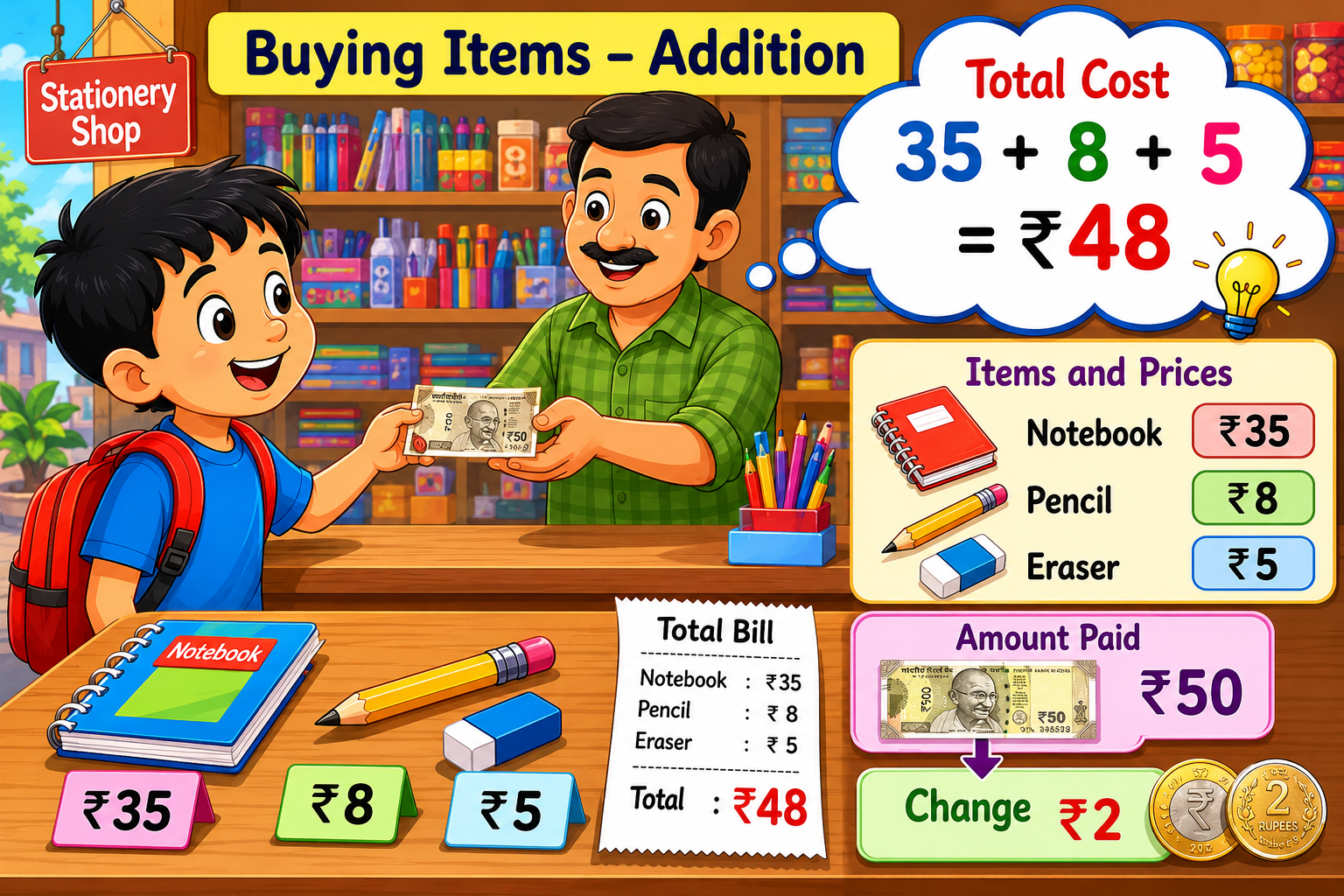
When you buy something and give more money than the price, the shopkeeper gives back the extra money. This extra money is called change.
Change = Money Given − Price of Item
Sita buys a pencil box for ₹45. She gives a ₹50 note. How much change will she get?
Change = ₹50 − ₹45 = ₹5
Ravi buys a notebook for ₹32.50. He gives a ₹50 note. How much change?
Change = ₹50 − ₹32.50 = ₹17.50
Meena buys a water bottle for ₹85 and a tiffin box for ₹120. She gives ₹500. How much change?
Total cost = ₹85 + ₹120 = ₹205
Change = ₹500 − ₹205 = ₹295
Word Problems
Arjun goes to the stationery shop. He buys a geometry box for ₹75.50 and a drawing book for ₹40.25. How much does he spend in all?
Solution: ₹75.50 + ₹40.25 = ₹115.75. Arjun spends ₹115.75 in all.
Priya gets ₹200 as pocket money every week. She spends ₹85.50 on snacks and ₹45 on a story book. How much money is left with her?
Solution: Total spent = ₹85.50 + ₹45 = ₹130.50. Money left = ₹200 − ₹130.50 = ₹69.50.
Ravi saves ₹15 every day in his piggy bank. How much money will he save in one week (7 days)?
Solution: ₹15 × 7 = ₹105. Ravi will save ₹105 in one week.
Meena's mother buys the following from the kirana store:
| Item | Price |
|---|---|
| Rice (1 kg) | ₹55 |
| Dal (1 kg) | ₹120 |
| Oil (1 litre) | ₹145.50 |
| Sugar (1 kg) | ₹42 |
Total = ₹55 + ₹120 + ₹145.50 + ₹42 = ₹362.50
She gives ₹500. Change = ₹500 − ₹362.50 = ₹137.50
Key Words
| Word | Meaning |
|---|---|
| Rupee (₹) | The main unit of Indian money |
| Paise (p) | The smaller unit of Indian money; 100 paise = ₹1 |
| Currency | The money used in a country (India uses Indian Rupee) |
| Coin | Small round metal money (₹1, ₹2, ₹5, ₹10) |
| Note (Bill) | Paper money printed by RBI (₹10, ₹20, ₹50, ₹100, ₹200, ₹500) |
| Change | Money returned when you pay more than the price |
| Price / Cost | How much money an item costs |
| Total | The sum of all amounts added together |
| Savings | Money kept aside and not spent |
| Decimal Point | The dot (.) that separates rupees from paise (e.g., ₹5.50) |
- ₹1 = 100 paise. This is the most important rule about Indian money.
- Indian coins: ₹1, ₹2, ₹5, ₹10. Indian notes: ₹10, ₹20, ₹50, ₹100, ₹200, ₹500.
- When adding money, add paise first. If paise ≥ 100, carry ₹1 to the rupees column.
- When subtracting money, if paise on top are less, borrow ₹1 (= 100 paise) from rupees.
- Change = Money Given − Total Cost.
- Always write the ₹ symbol before the number and align the decimal points when adding or subtracting.
- The Reserve Bank of India (RBI) prints all Indian currency notes.
Practice Questions
Set up your own shop at home!
1. Collect 5–6 items from your house (pencil, eraser, toy, cup, book, spoon).
2. Write a price tag for each item (between ₹5 and ₹100).
3. Use play money (or real coins) to buy and sell items with a friend or family member.
4. Take turns being the shopkeeper and the customer.
5. The shopkeeper must calculate the total and give correct change!
Challenge: Make a bill (receipt) for each purchase. Write the item name, price, total, money given, and change returned.
| Item | Price |
|---|---|
| _____________ | ₹ _______ |
| _____________ | ₹ _______ |
| _____________ | ₹ _______ |
| Total: ₹ _______ | |
| Money Given: ₹ _______ | Change: ₹ _______ | |
Want to use this as a worksheet? Switch to the A4 printable view.