Multiplication Tables
Learning Objectives
- Learn and memorise multiplication tables from 2 to 12.
- Understand multiplication as repeated addition.
- Identify patterns in multiplication tables (5s, 9s, doubles).
- Use tables for quick multiplication and division.
- Apply multiplication tables to solve real-life problems.
- Develop speed and accuracy in recalling table facts.
Introduction
Multiplication tables are one of the most important tools in mathematics. When you know your tables well, you can solve problems quickly — whether it is calculating the cost of 7 notebooks at ₹12 each, or finding how many runs a batsman scored in 8 overs at 6 runs per over.
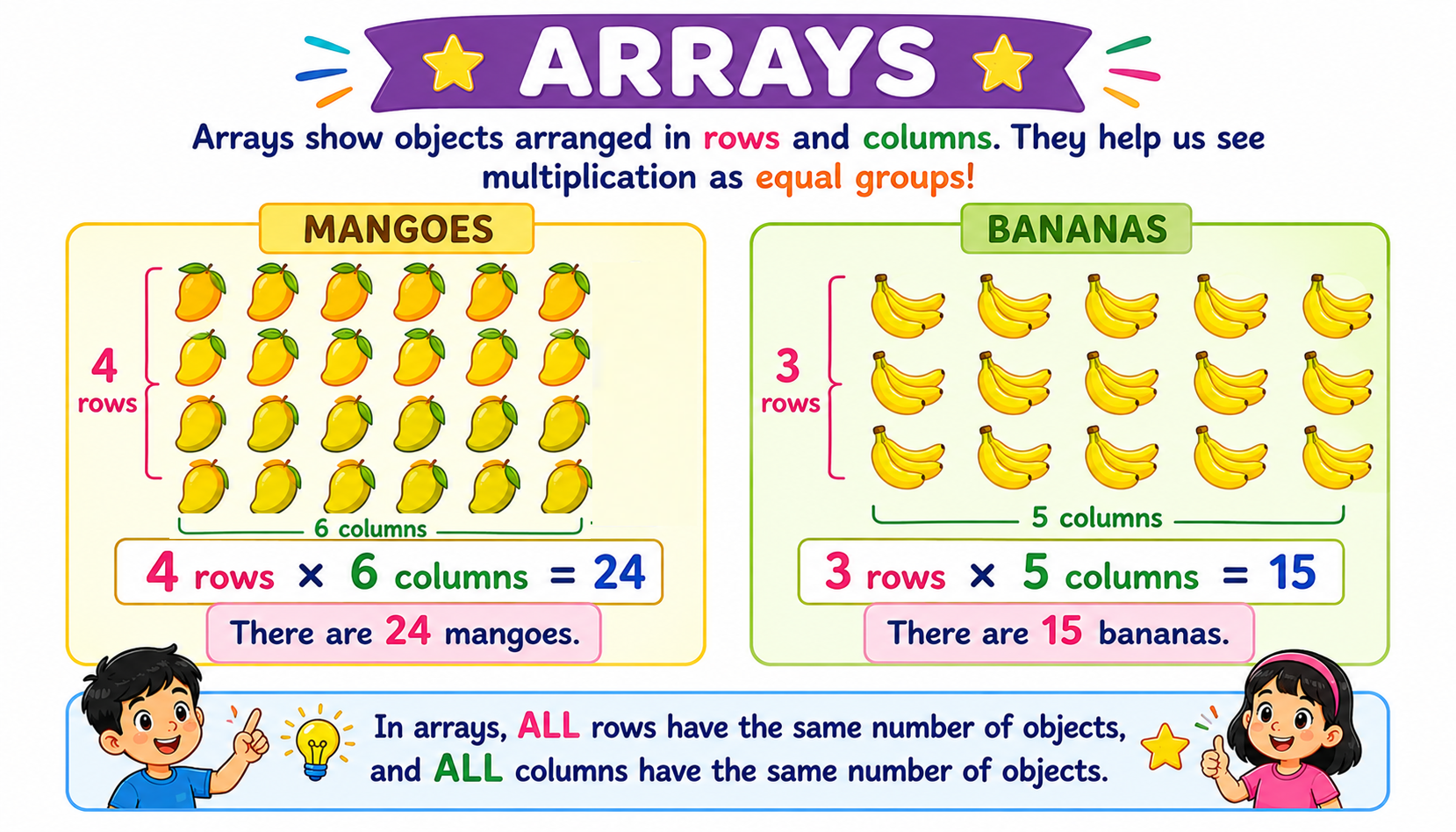
Multiplication is repeated addition. For example, 4 × 3 means adding 4 three times: 4 + 4 + 4 = 12. But adding again and again takes time. That is why we learn tables — so we can find the answer instantly!
In Class 3, you will learn tables from 2 to 12. Once you memorise them, maths becomes much faster and easier. Let us begin!
Multiplication Tables: 2 to 12
Here are the complete multiplication tables from 2 to 12. Read them aloud, write them down, and practise daily!
Table of 2
| 2 × 1 = 2 | 2 × 2 = 4 | 2 × 3 = 6 | 2 × 4 = 8 | 2 × 5 = 10 |
| 2 × 6 = 12 | 2 × 7 = 14 | 2 × 8 = 16 | 2 × 9 = 18 | 2 × 10 = 20 |
Table of 3
| 3 × 1 = 3 | 3 × 2 = 6 | 3 × 3 = 9 | 3 × 4 = 12 | 3 × 5 = 15 |
| 3 × 6 = 18 | 3 × 7 = 21 | 3 × 8 = 24 | 3 × 9 = 27 | 3 × 10 = 30 |
Table of 4
| 4 × 1 = 4 | 4 × 2 = 8 | 4 × 3 = 12 | 4 × 4 = 16 | 4 × 5 = 20 |
| 4 × 6 = 24 | 4 × 7 = 28 | 4 × 8 = 32 | 4 × 9 = 36 | 4 × 10 = 40 |
Table of 5
| 5 × 1 = 5 | 5 × 2 = 10 | 5 × 3 = 15 | 5 × 4 = 20 | 5 × 5 = 25 |
| 5 × 6 = 30 | 5 × 7 = 35 | 5 × 8 = 40 | 5 × 9 = 45 | 5 × 10 = 50 |
Table of 6
| 6 × 1 = 6 | 6 × 2 = 12 | 6 × 3 = 18 | 6 × 4 = 24 | 6 × 5 = 30 |
| 6 × 6 = 36 | 6 × 7 = 42 | 6 × 8 = 48 | 6 × 9 = 54 | 6 × 10 = 60 |
Table of 7
| 7 × 1 = 7 | 7 × 2 = 14 | 7 × 3 = 21 | 7 × 4 = 28 | 7 × 5 = 35 |
| 7 × 6 = 42 | 7 × 7 = 49 | 7 × 8 = 56 | 7 × 9 = 63 | 7 × 10 = 70 |
Table of 8
| 8 × 1 = 8 | 8 × 2 = 16 | 8 × 3 = 24 | 8 × 4 = 32 | 8 × 5 = 40 |
| 8 × 6 = 48 | 8 × 7 = 56 | 8 × 8 = 64 | 8 × 9 = 72 | 8 × 10 = 80 |
Table of 9
| 9 × 1 = 9 | 9 × 2 = 18 | 9 × 3 = 27 | 9 × 4 = 36 | 9 × 5 = 45 |
| 9 × 6 = 54 | 9 × 7 = 63 | 9 × 8 = 72 | 9 × 9 = 81 | 9 × 10 = 90 |
Table of 10
| 10 × 1 = 10 | 10 × 2 = 20 | 10 × 3 = 30 | 10 × 4 = 40 | 10 × 5 = 50 |
| 10 × 6 = 60 | 10 × 7 = 70 | 10 × 8 = 80 | 10 × 9 = 90 | 10 × 10 = 100 |
Table of 11
| 11 × 1 = 11 | 11 × 2 = 22 | 11 × 3 = 33 | 11 × 4 = 44 | 11 × 5 = 55 |
| 11 × 6 = 66 | 11 × 7 = 77 | 11 × 8 = 88 | 11 × 9 = 99 | 11 × 10 = 110 |
Table of 12
| 12 × 1 = 12 | 12 × 2 = 24 | 12 × 3 = 36 | 12 × 4 = 48 | 12 × 5 = 60 |
| 12 × 6 = 72 | 12 × 7 = 84 | 12 × 8 = 96 | 12 × 9 = 108 | 12 × 10 = 120 |
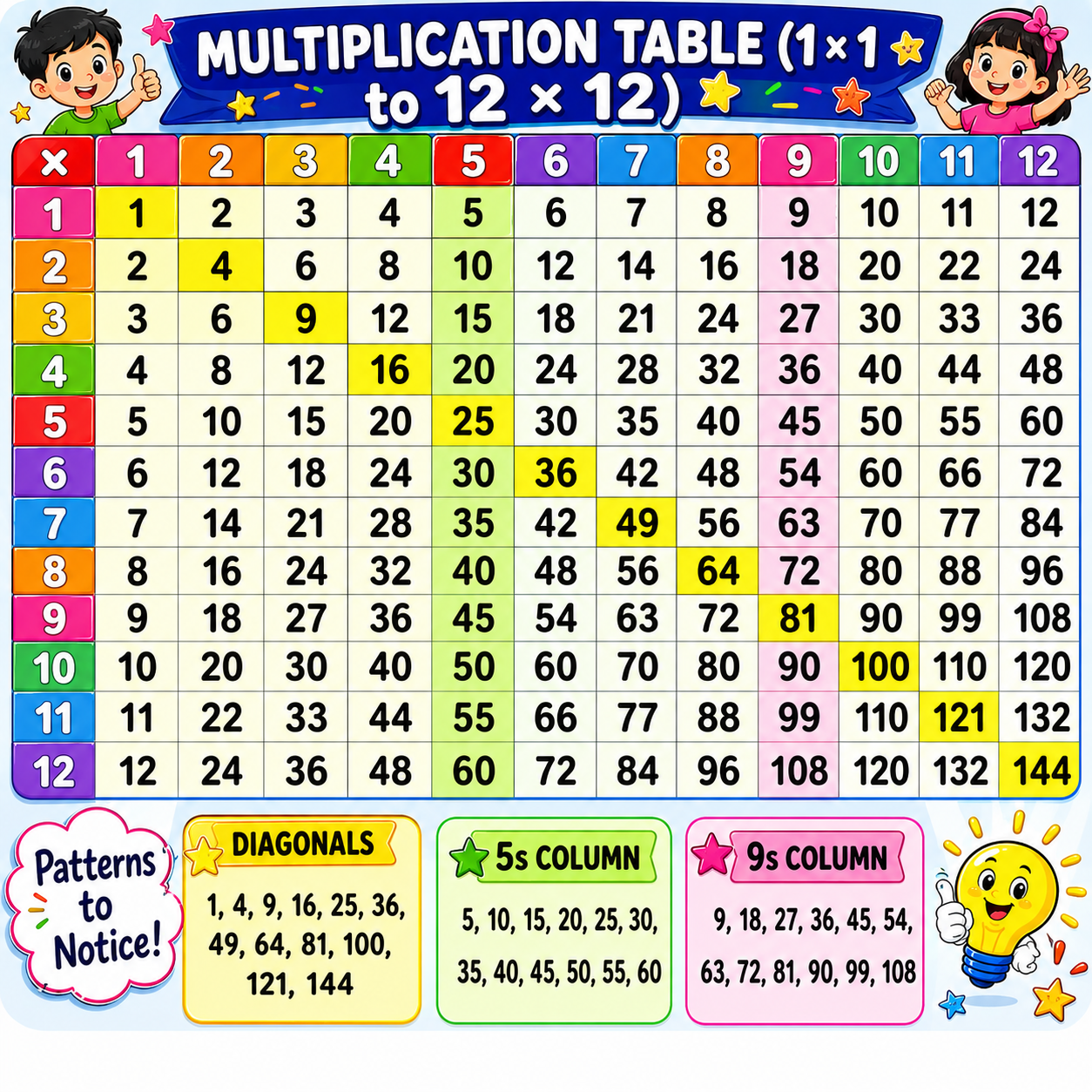
Tips to Remember Tables
Learning tables becomes easy when you notice patterns. Here are some helpful tricks:
🔢 Pattern 1: Table of 5 — Always ends in 0 or 5
5, 10, 15, 20, 25, 30, 35, 40, 45, 50
If you multiply 5 by an even number, the answer ends in 0 (5×2=10, 5×4=20, 5×6=30).
If you multiply 5 by an odd number, the answer ends in 5 (5×1=5, 5×3=15, 5×7=35).
🔢 Pattern 2: Table of 9 — Digit sum is always 9
9, 18, 27, 36, 45, 54, 63, 72, 81, 90
Add the digits of any answer: 1+8=9, 2+7=9, 3+6=9, 4+5=9, 5+4=9, 6+3=9, 7+2=9, 8+1=9. Always 9!
Finger trick for 9s: Hold up 10 fingers. To find 9×4, fold down the 4th finger. Count fingers on the left (3) and right (6). Answer: 36!
🔢 Pattern 3: Doubles — Table of 2, 4, and 8
Table of 4 is double of table of 2: 2×3=6, so 4×3=12 (double of 6).
Table of 8 is double of table of 4: 4×3=12, so 8×3=24 (double of 12).
If you know table of 2, you can find table of 4 by doubling. Double again for table of 8!
🔢 Pattern 4: Table of 10 — Just add a zero
10×1=10, 10×2=20, 10×3=30... Just write the number and put a 0 after it!
🔢 Pattern 5: Table of 11 — Repeat the digit (up to 9)
11×1=11, 11×2=22, 11×3=33, 11×4=44... up to 11×9=99. The digit just repeats!
Using Tables for Quick Multiplication and Division
Once you know your tables, you can solve multiplication AND division problems instantly!
Quick Multiplication
Arjun buys 8 notebooks at ₹9 each. Total cost = 8 × 9 = ₹72 (from table of 8 or 9).
Virat hit 6 sixes in a match. Total runs from sixes = 6 × 6 = 36 runs (from table of 6).
Quick Division Using Tables
Division is the reverse of multiplication. If you know that 7 × 8 = 56, then:
- 56 ÷ 7 = 8
- 56 ÷ 8 = 7
Meena has 48 toffees to share equally among 6 friends. How many does each get?
Think: 6 × ? = 48. From table of 6: 6 × 8 = 48. So each friend gets 8 toffees.
A teacher has 72 students. She wants to arrange them in rows of 9. How many rows?
Think: 9 × ? = 72. From table of 9: 9 × 8 = 72. So there will be 8 rows.
Key Words
| Word | Meaning |
|---|---|
| Multiplication | Finding the total when equal groups are combined (repeated addition) |
| Product | The answer we get after multiplying two numbers |
| Factor | The numbers being multiplied (in 4 × 3 = 12, the factors are 4 and 3) |
| Times | Another word for "multiplied by" (4 times 3 = 4 × 3) |
| Table | A list of products of a number with 1, 2, 3, ... 10 |
| Division | Splitting a number into equal groups (reverse of multiplication) |
| Commutative Property | Order does not matter: 3 × 4 = 4 × 3 = 12 |
- Multiplication is repeated addition: 5 × 4 = 5 + 5 + 5 + 5 = 20.
- Table of 5: answers always end in 0 or 5.
- Table of 9: the digit sum of every answer is 9.
- Table of 10: just add a zero to the number.
- Table of 11 (up to ×9): the digit repeats (11×3=33, 11×7=77).
- Table of 4 = double of table of 2. Table of 8 = double of table of 4.
- Commutative property: 3 × 7 = 7 × 3 = 21. Order does not matter!
- Division is the reverse of multiplication: if 6×8=48, then 48÷6=8.
- If you forget a table fact, add the table number one more time to the previous product.
Practice Questions
| Column A | Column B |
|---|---|
| 1. 7 × 9 | (a) 48 |
| 2. 12 × 5 | (b) 63 |
| 3. 8 × 6 | (c) 36 |
| 4. 9 × 4 | (d) 60 |
| 5. 11 × 8 | (e) 88 |
How fast can you answer? Ask a parent or friend to time you. Try to answer all 20 questions in under 2 minutes!
1. 3 × 7 = ___ 2. 8 × 5 = ___ 3. 6 × 9 = ___ 4. 4 × 8 = ___ 5. 9 × 3 = ___
6. 7 × 7 = ___ 7. 5 × 6 = ___ 8. 12 × 3 = ___ 9. 11 × 5 = ___ 10. 9 × 8 = ___
11. 6 × 6 = ___ 12. 8 × 4 = ___ 13. 7 × 9 = ___ 14. 3 × 12 = ___ 15. 4 × 7 = ___
16. 9 × 5 = ___ 17. 11 × 9 = ___ 18. 6 × 8 = ___ 19. 12 × 7 = ___ 20. 7 × 4 = ___
My time: _________ minutes _________ seconds
Score: _________ out of 20
Tip: Practise every day and try to beat your own time!
Want to use this as a worksheet? Switch to the A4 printable view.