Ordering Numbers
Learning Objectives
- Compare two numbers using > (greater than), < (less than), and = (equal to) symbols.
- Compare 3-digit and 4-digit numbers by checking digits from left to right.
- Arrange numbers in ascending order (smallest to largest).
- Arrange numbers in descending order (largest to smallest).
- Form the greatest and smallest numbers from a given set of digits.
- Apply comparison skills to real-life situations like cricket scores, prices, and populations.
- Understand the rule: a number with more digits is always greater.
Introduction
In a cricket match, India scored 287 runs and Australia scored 264 runs. Which team scored more? To answer this, we need to compare the two numbers. Comparing and ordering numbers is something we do every day — checking prices at a shop, reading cricket scores, or finding which city has more people!
In this chapter, we will learn how to compare 3-digit and 4-digit numbers, arrange them from smallest to largest (ascending order) and largest to smallest (descending order), and even form the biggest and smallest numbers from given digits.
Understanding Comparison Symbols
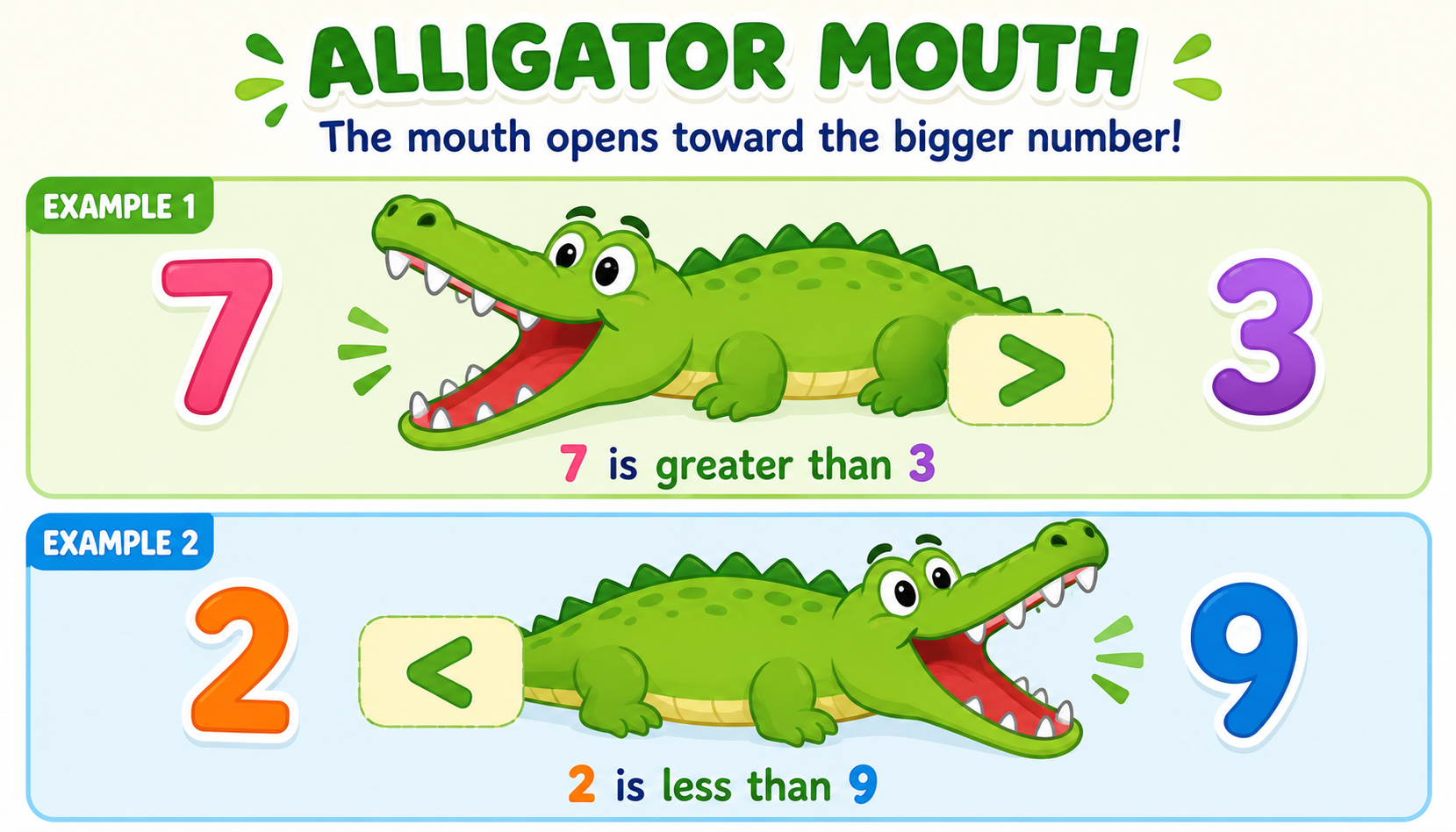
We use three special symbols to compare numbers:
| Symbol | Name | Meaning | Example |
|---|---|---|---|
| > | Greater than | The number on the left is bigger | 56 > 34 |
| < | Less than | The number on the left is smaller | 23 < 45 |
| = | Equal to | Both numbers are the same | 50 = 50 |
Image: The Crocodile Rule
Comparing 3-Digit Numbers
To compare two 3-digit numbers, we check the digits from left to right:
Step 1: Compare the hundreds digit first. The number with the bigger hundreds digit is greater.
Step 2: If the hundreds digits are the same, compare the tens digit.
Step 3: If the tens digits are also the same, compare the ones digit.
Hundreds: 5 > 3 → So 547 > 382
(We don't need to check tens or ones because hundreds are already different.)
Hundreds: 4 = 4 (same, move to tens)
Tens: 6 < 8 → So 463 < 489
Hundreds: 7 = 7 (same)
Tens: 2 = 2 (same)
Ones: 5 > 3 → So 725 > 723
Comparing 4-Digit Numbers
For 4-digit numbers, we follow the same rule — compare from left to right:
Step 1: Compare the thousands digit first.
Step 2: If thousands are the same, compare hundreds.
Step 3: If hundreds are the same, compare tens.
Step 4: If tens are the same, compare ones.
Thousands: 3 > 2 → So 3,456 > 2,789
Thousands: 5 = 5 (same)
Hundreds: 2 = 2 (same)
Tens: 3 < 8 → So 5,230 < 5,280
Thousands: 3 = 3 (same)
Hundreds: 2 = 1? No! 2 > 1 → India scored more! 3,245 > 3,198
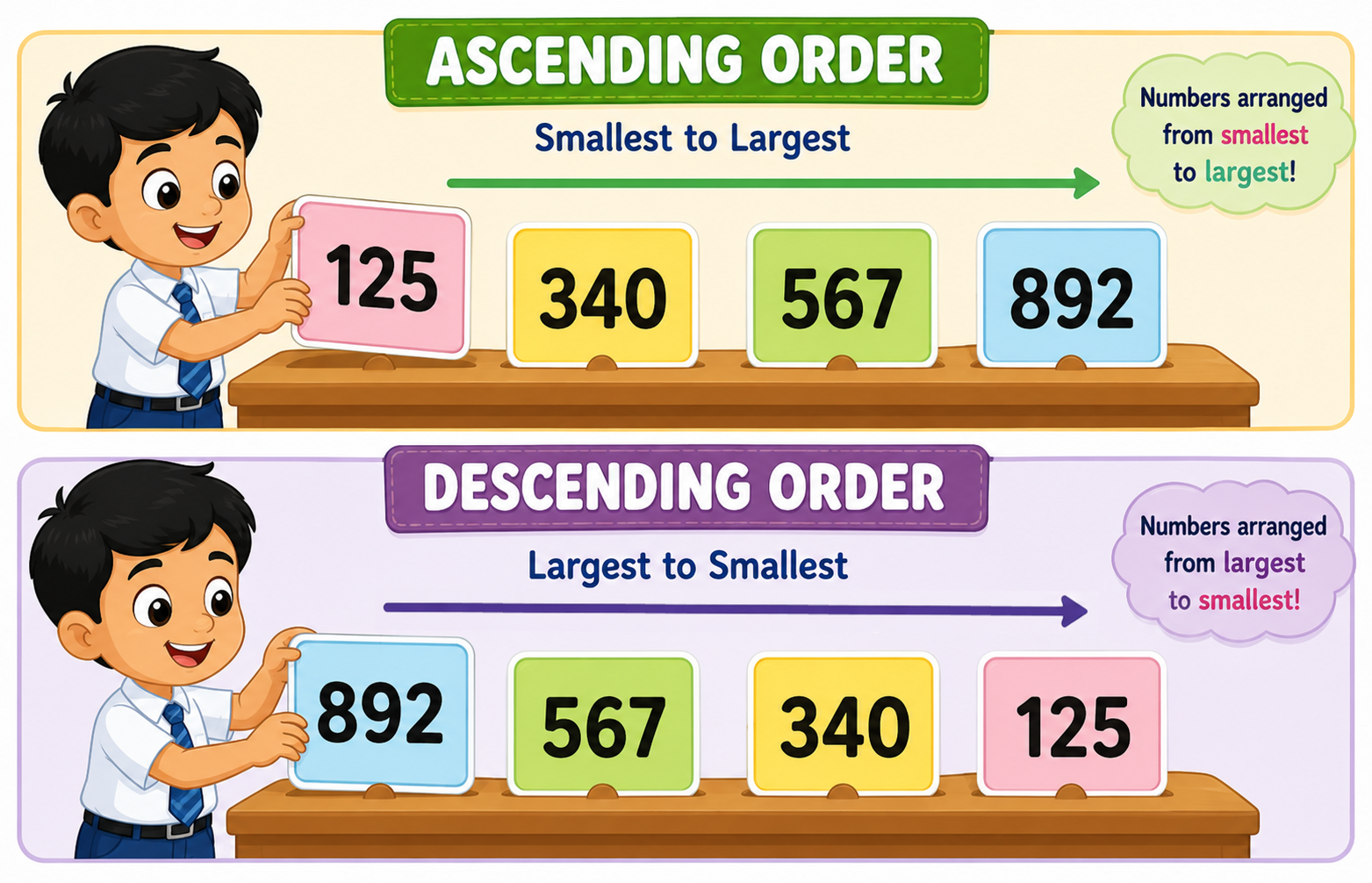
Ascending Order (Smallest to Largest)
When we arrange numbers from the smallest to the largest, it is called ascending order. Think of it as climbing up a staircase — each step is higher than the last.
We use the symbol < between numbers in ascending order.
Compare all: 102 is smallest, then 231, then 456, then 789.
Answer: 102 < 231 < 456 < 789
Compare thousands first: 1,890 (1 thousand) is smallest.
Then 2,200 and 2,450 (both 2 thousand — compare hundreds: 2 < 4).
Then 3,100 is largest.
Answer: 1,890 < 2,200 < 2,450 < 3,100
Answer: ₹850 < ₹1,200 < ₹2,100 < ₹3,500
Descending Order (Largest to Smallest)
When we arrange numbers from the largest to the smallest, it is called descending order. Think of it as coming down a staircase — each step is lower than the last.
We use the symbol > between numbers in descending order.
Answer: 890 > 678 > 345 > 123
Answer: 6,100 > 4,500 > 2,300 > 1,800
Answer: 3,046 > 2,817 > 2,049 > 1,798 (Jaipur > Lucknow > Patna > Bhopal)
Image: Ascending and Descending Order
How to Compare Step by Step
Here is a simple method to compare any two numbers:
| Step | What to Do | Example: 4,356 vs 4,329 |
|---|---|---|
| 1 | Count the digits. More digits = greater number. | Both have 4 digits. Move to step 2. |
| 2 | Compare thousands place. | 4 = 4. Move to step 3. |
| 3 | Compare hundreds place. | 3 = 3. Move to step 4. |
| 4 | Compare tens place. | 5 > 2. So 4,356 > 4,329 ✓ |
Forming the Greatest and Smallest Numbers
Given a set of digits, we can form the greatest and smallest possible numbers.
Rules for Forming the Greatest Number:
Arrange the digits from largest to smallest (left to right).
Rules for Forming the Smallest Number:
Arrange the digits from smallest to largest (left to right).
Special Rule: If one of the digits is 0, it cannot be the first digit (because a number doesn't start with 0). Put the next smallest digit first, then place 0 after it.
Greatest number: 8 > 5 > 3 → 853
Smallest number: 3 < 5 < 8 → 358
Greatest number: 7 > 4 > 0 → 740
Smallest number: Can't start with 0! Next smallest is 4. → 407
Greatest number: 9 > 6 > 2 > 1 → 9,621
Smallest number: 1 < 2 < 6 < 9 → 1,269
Greatest number: 5 > 3 > 0 > 0 → 5,300
Smallest number: Can't start with 0! Next smallest is 3. → 3,005
Real-Life Comparisons (Indian Context)
Chennai Super Kings scored 185 runs. Mumbai Indians scored 179 runs.
Compare: Hundreds same (1=1), Tens: 8 > 7 → 185 > 179. CSK wins!
Rani wants to buy the cheaper notebook. Shop A sells it for ₹45 and Shop B for ₹38.
Compare: Tens: 4 > 3 → 45 > 38. So Shop B is cheaper (₹38 < ₹45).
Nanda Devi: 7,816 m | Kangchenjunga: 8,586 m | K2: 8,611 m
Ascending order: 7,816 < 8,586 < 8,611
(Nanda Devi < Kangchenjunga < K2)
Key Words
| Word | Meaning |
|---|---|
| Compare | To find which number is greater, smaller, or equal |
| Greater than (>) | The number on the left is bigger than the number on the right |
| Less than (<) | The number on the left is smaller than the number on the right |
| Equal to (=) | Both numbers have the same value |
| Ascending order | Arranging numbers from smallest to largest |
| Descending order | Arranging numbers from largest to smallest |
| Digits | The symbols 0, 1, 2, 3, 4, 5, 6, 7, 8, 9 used to write numbers |
| Place value | The value of a digit based on its position (ones, tens, hundreds, thousands) |
- A number with more digits is always greater (e.g., 1,000 > 999).
- To compare numbers with the same number of digits, start from the leftmost digit and move right.
- The crocodile mouth (> or <) always opens towards the bigger number.
- Ascending order = smallest to largest (going up). Descending order = largest to smallest (going down).
- To form the greatest number, arrange digits from largest to smallest.
- To form the smallest number, arrange digits from smallest to largest. If 0 is a digit, it cannot come first.
- Always compare place by place: Thousands → Hundreds → Tens → Ones.
Practice Questions
What you need: 10 small cards numbered 0 to 9.
How to play:
1. Shuffle the cards and pick any 4 cards.
2. Write down the digits you picked: , , ,
3. Form the greatest 4-digit number:
4. Form the smallest 4-digit number:
5. Now pick 3 more sets of 4 cards. Write all four greatest numbers and arrange them in descending order!
Challenge: Can you find the difference between your greatest and smallest number?
Want a printable worksheet? Switch to the Worksheet View, then print.