Place Value
Learning Objectives
- Understand the place value of digits in 4-digit numbers (Thousands, Hundreds, Tens, Ones).
- Write numbers in expanded form (e.g., 2345 = 2000 + 300 + 40 + 5).
- Differentiate between face value and place value of a digit.
- Compare 4-digit numbers using >, <, and = signs.
- Form the largest and smallest numbers from given digits.
- Find the successor and predecessor of a number.
Introduction
Ravi's father bought a television for ₹4,567. This number has four digits. Each digit has a different value depending on its position (place) in the number. This is called place value.
In Class 2, we learned about 3-digit numbers (up to 999). Now in Class 3, we will learn about 4-digit numbers — from 1,000 to 9,999. The Indian number system uses the same places: Ones (O), Tens (T), Hundreds (H), and Thousands (Th).
Understanding place value helps us read, write, compare, and do calculations with large numbers correctly.
Place Value of 4-Digit Numbers
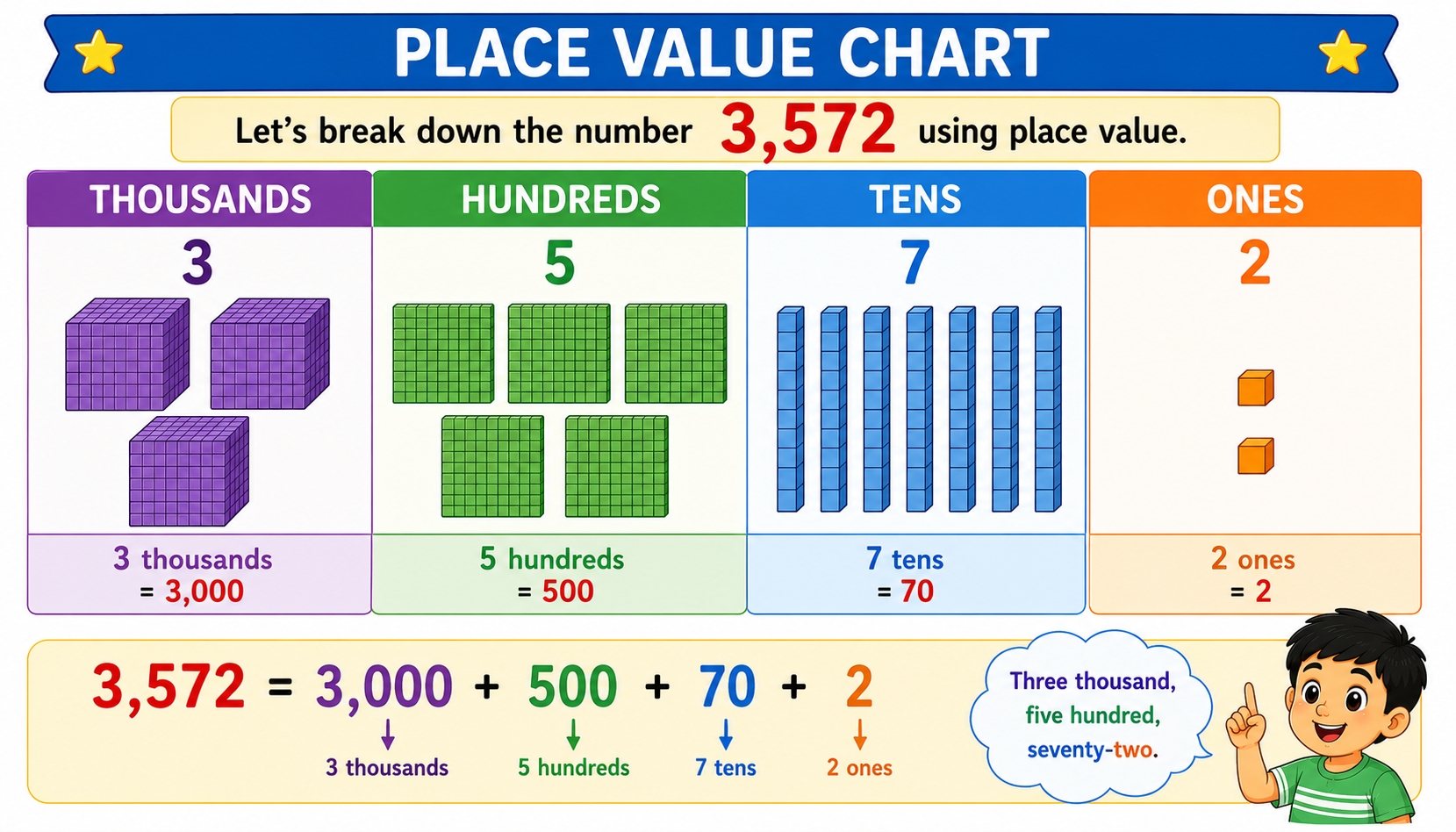
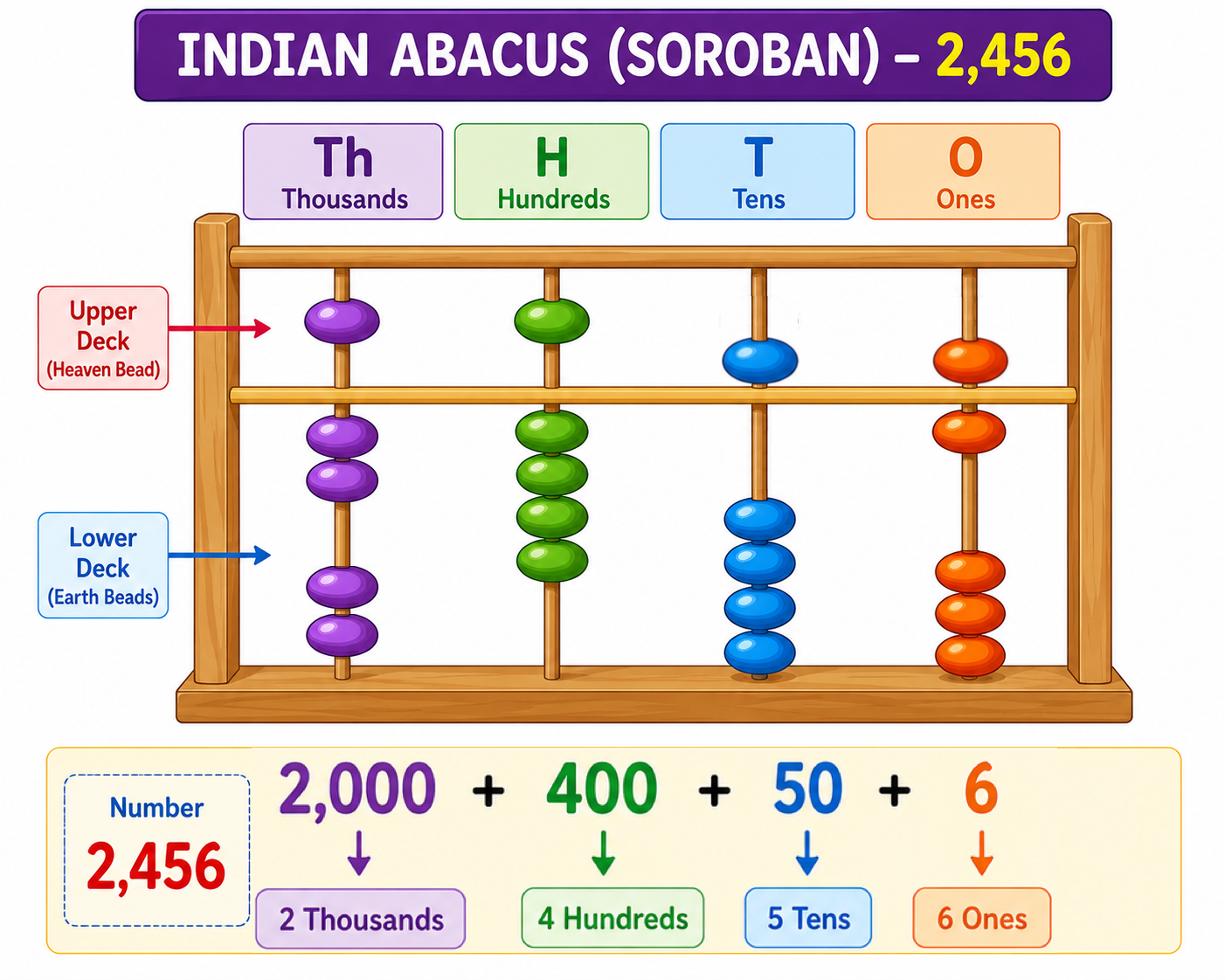
Every digit in a number has a place. The place tells us the value of that digit. Let us look at the number 2,345:
| Thousands (Th) | Hundreds (H) | Tens (T) | Ones (O) |
|---|---|---|---|
| 2 | 3 | 4 | 5 |
- 2 is in the Thousands place → its value is 2 × 1000 = 2000
- 3 is in the Hundreds place → its value is 3 × 100 = 300
- 4 is in the Tens place → its value is 4 × 10 = 40
- 5 is in the Ones place → its value is 5 × 1 = 5
7 → Thousands place → 7 × 1000 = 7000
6 → Hundreds place → 6 × 100 = 600
8 → Tens place → 8 × 10 = 80
9 → Ones place → 9 × 1 = 9
4 is in the Thousands place. So its place value = 4 × 1000 = 4000.
Expanded Form
When we write a number as the sum of the values of each digit, it is called the expanded form.
2,345 = 2000 + 300 + 40 + 5
We can also write: 2 × 1000 + 3 × 100 + 4 × 10 + 5 × 1
6,078 = 6000 + 0 + 70 + 8 = 6000 + 70 + 8
Note: The digit 0 in the Hundreds place means there are no hundreds. We can skip it.
5000 + 400 + 20 + 1 = 5,421
9,006 = 9000 + 0 + 0 + 6 = 9000 + 6
Face Value vs Place Value
Every digit has two values:
- Face Value: The digit itself, no matter where it is placed. The face value of 5 is always 5.
- Place Value: The value of the digit based on its position. The place value of 5 changes depending on where it sits.
| Number | Digit | Face Value | Place Value |
|---|---|---|---|
| 3,572 | 5 | 5 | 500 (Hundreds place) |
| 5,372 | 5 | 5 | 5000 (Thousands place) |
| 7352 | 5 | 5 | 50 (Tens place) |
| 7355 | 5 | 5 | 5 (Ones place) |
Face value of 8 = 8. Place value of 8 = 800 (it is in the Hundreds place).
Face value of 4 = 4. Place value of 4 = 4000 (it is in the Thousands place).
Comparing Numbers
We use three symbols to compare numbers:
- > means "greater than" (e.g., 5 > 3)
- < means "less than" (e.g., 2 < 7)
- = means "equal to" (e.g., 4 = 4)
Rules for comparing 4-digit numbers:
- Step 1: Count the digits. A number with more digits is always greater. (e.g., 1000 > 999)
- Step 2: If both numbers have the same number of digits, compare from the leftmost digit (Thousands place).
- Step 3: If the Thousands digits are the same, compare the Hundreds digits, then Tens, then Ones.
Both are 4-digit numbers. Compare Thousands: 4 > 3. So 4,567 > 3,892.
Thousands: 5 = 5 (same). Hundreds: 2 = 2 (same). Tens: 3 < 7. So 5,234 < 5,278.
All digits are the same. So 6,405 = 6,405.
Forming Largest and Smallest Numbers
Given a set of digits, we can arrange them to form the largest and smallest numbers.
Rules:
- Largest number: Arrange digits in descending order (biggest first).
- Smallest number: Arrange digits in ascending order (smallest first). If 0 is one of the digits, it cannot come first — put the next smallest digit first, then 0.
Largest: Arrange in descending order → 7,531
Smallest: Arrange in ascending order → 1,357
Largest: 8 > 6 > 2 > 0 → 8,620
Smallest: 0 cannot come first! Next smallest is 2. Then 0, 6, 8 → 2,068
Largest: 9 > 4 > 4 > 1 → 9,441
Smallest: 1 < 4 < 4 < 9 → 1,449
Successor and Predecessor
The successor of a number is the number that comes just after it (number + 1).
The predecessor of a number is the number that comes just before it (number − 1).
| Number | Predecessor (−1) | Successor (+1) |
|---|---|---|
| 4,567 | 4,566 | 4,568 |
| 3,000 | 2,999 | 3,001 |
| 9,999 | 9,998 | 10,000 |
| 1,000 | 999 | 1,001 |
| 5,100 | 5,099 | 5,101 |
Successor of 7,009 = 7,009 + 1 = 7,010
Predecessor of 7,009 = 7,009 − 1 = 7,008
Key Words
| Word | Meaning |
|---|---|
| Place Value | The value of a digit based on its position in a number |
| Face Value | The digit itself, regardless of its position |
| Expanded Form | Writing a number as the sum of the values of each digit |
| Successor | The number that comes just after (number + 1) |
| Predecessor | The number that comes just before (number − 1) |
| Ascending Order | Arranging numbers from smallest to largest |
| Descending Order | Arranging numbers from largest to smallest |
| Digit | The symbols 0, 1, 2, 3, 4, 5, 6, 7, 8, 9 used to write numbers |
| Compare | Finding which number is greater, smaller, or equal |
| Indian Number System | The system of Ones, Tens, Hundreds, Thousands used in India |
- In a 4-digit number, the places from right to left are: Ones, Tens, Hundreds, Thousands.
- Place value = digit × value of its place (e.g., 3 in Hundreds place = 3 × 100 = 300).
- Face value of a digit is always the digit itself.
- Expanded form: 2,345 = 2000 + 300 + 40 + 5.
- To compare numbers, start from the leftmost digit and move right.
- For the largest number, arrange digits in descending order.
- For the smallest number, arrange digits in ascending order (0 cannot be the first digit).
- Successor = number + 1. Predecessor = number − 1.
- The smallest 4-digit number is 1,000. The largest is 9,999.
Practice Questions
Place Value Puzzle with ₹ Notes:
Imagine you have these Indian currency notes: ₹1000, ₹100, ₹10, and ₹1 coins.
1. Show ₹3,254 using the fewest notes and coins possible. How many of each do you need?
₹1000 notes: _______ ₹100 notes: _______ ₹10 notes: _______ ₹1 coins: _______
2. Show ₹7,089 using notes and coins:
₹1000 notes: _______ ₹100 notes: _______ ₹10 notes: _______ ₹1 coins: _______
3. Your friend has 4 notes of ₹1000, 2 notes of ₹100, 0 notes of ₹10, and 6 coins of ₹1. What number does this make? _______
Challenge: Write your house number or phone number's last 4 digits. Find the place value of each digit. Write it in expanded form!
My number: _______ Expanded form: _______________________________
Want to use this as a worksheet? Switch to the A4 printable view.