Shapes (2D and 3D Shapes)
Learning Objectives
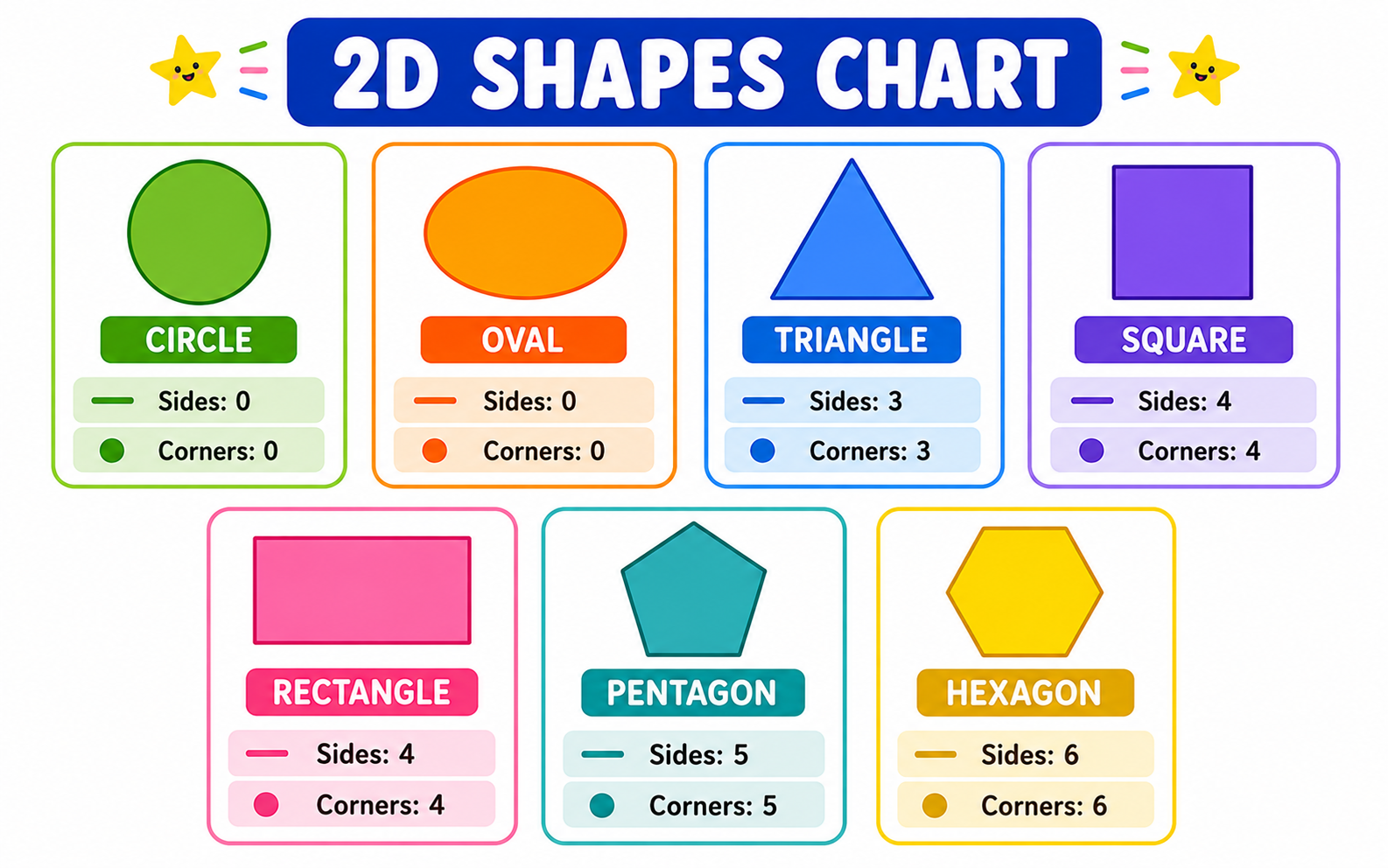
- Identify and name 2D shapes: circle, square, rectangle, triangle, pentagon, hexagon, and oval.
- Describe properties of 2D shapes — number of sides, corners (vertices), and curved/straight edges.
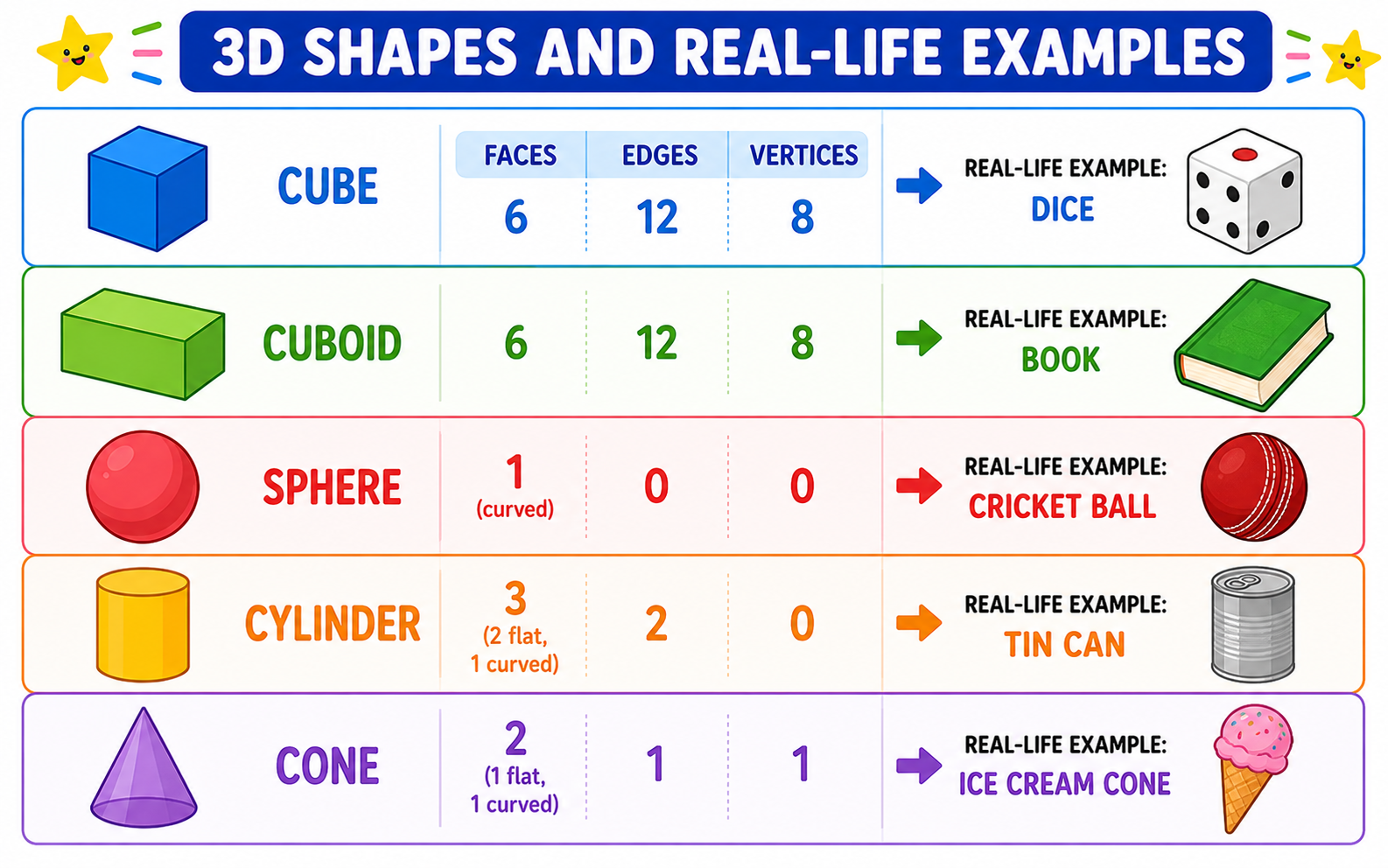
- Identify and name 3D shapes: cube, cuboid, sphere, cylinder, and cone.
- Describe properties of 3D shapes — number of faces, edges, and vertices.
- Understand the difference between 2D (flat) and 3D (solid) shapes.
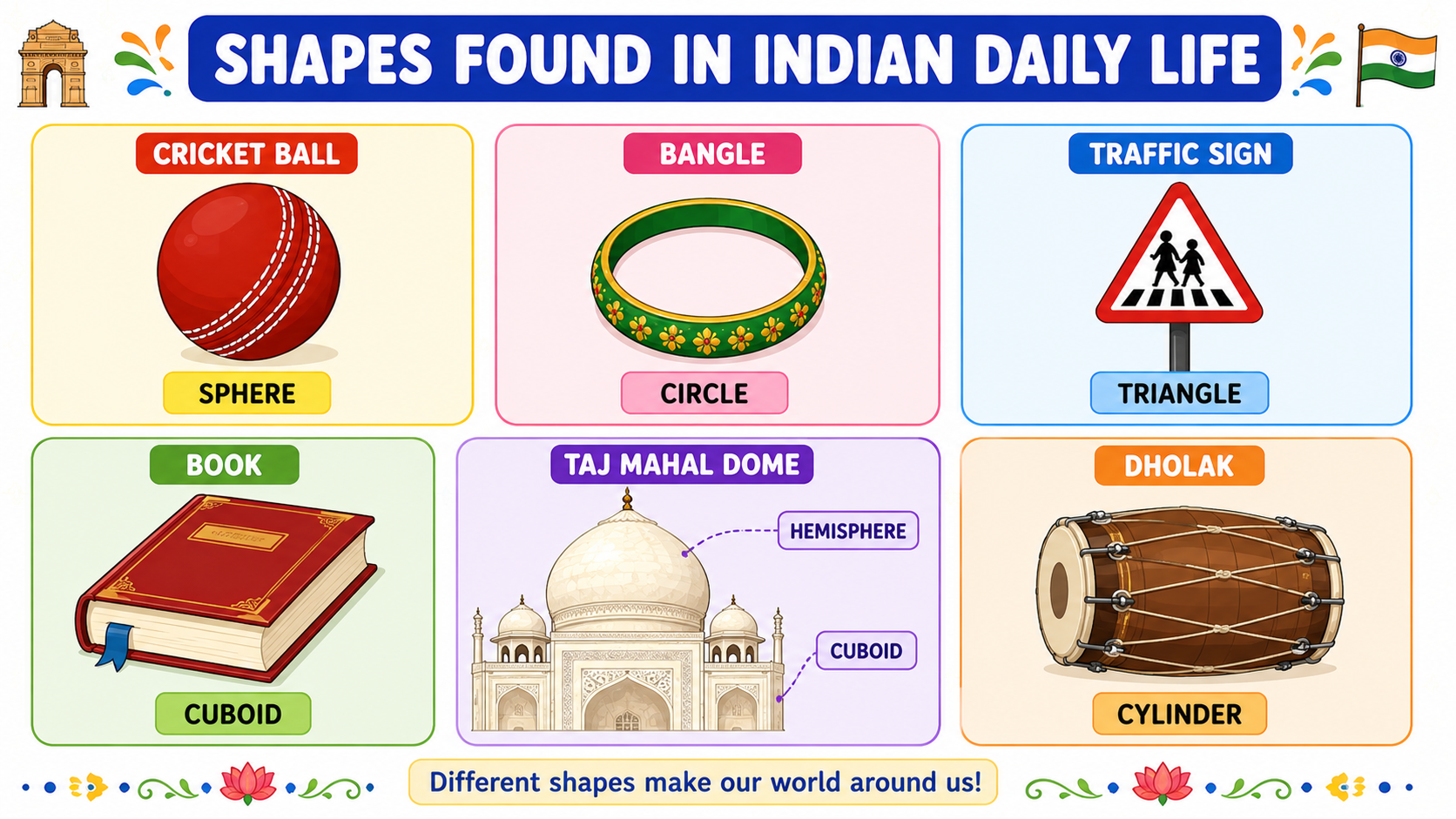
- Recognise shapes in everyday Indian life — cricket ball, bangle, Taj Mahal, traffic cone, dice.
- Identify lines of symmetry in basic shapes.
Introduction
Look around your classroom, your home, and the playground. Everything you see has a shape! The clock on the wall is a circle. Your notebook is a rectangle. The slice of pizza is a triangle. A cricket ball is a sphere. A dice is a cube.
Shapes are divided into two groups: 2D shapes (flat shapes that can be drawn on paper) and 3D shapes (solid shapes that you can hold in your hands). In Class 3, we will learn more shapes like pentagon and hexagon, count faces, edges, and vertices of 3D shapes, and even discover lines of symmetry!
What Are 2D Shapes?
2D stands for two-dimensional. These shapes are flat — they have only length and breadth (width). You can draw them on paper. They have sides (straight or curved lines) and corners (also called vertices — the point where two sides meet).
Properties of 2D Shapes
| Shape | Sides | Corners (Vertices) | Special Properties | Real-life Examples |
|---|---|---|---|---|
| Circle | 0 (1 curved edge) | 0 | Perfectly round; all points are the same distance from the centre | Bangle, coin, wheel, roti, clock face |
| Oval (Ellipse) | 0 (1 curved edge) | 0 | Like a stretched circle; longer in one direction | Egg, cricket ground, mirror, mango shape |
| Triangle | 3 | 3 | Fewest sides of any polygon; angles add up to 180° | Samosa, traffic yield sign, tent, slice of pizza |
| Square | 4 (all equal) | 4 | All sides equal; all angles are 90° (right angles) | Carrom board, floor tile, handkerchief, chess board square |
| Rectangle | 4 (opposite sides equal) | 4 | Opposite sides equal and parallel; all angles 90° | Notebook, door, TV screen, blackboard |
| Pentagon | 5 | 5 | Five equal sides in a regular pentagon | Some star-shaped rangoli patterns, home plate in baseball |
| Hexagon | 6 | 6 | Six equal sides in a regular hexagon; found in nature | Honeycomb cell, some floor tiles, nut/bolt head |
What Are 3D Shapes?
3D stands for three-dimensional. These shapes are solid — they have length, breadth, and height (or depth). You can pick them up and hold them. They take up space.
3D shapes have three important properties:
- Faces — the flat or curved surfaces of a 3D shape
- Edges — the lines where two faces meet
- Vertices (corners) — the points where edges meet
Properties of 3D Shapes
| Shape | Faces | Edges | Vertices | Real-life Examples |
|---|---|---|---|---|
| Cube | 6 (all squares) | 12 | 8 | Dice, Rubik's cube, ice cube, sugar cube |
| Cuboid | 6 (rectangles) | 12 | 8 | Brick, book, matchbox, tiffin box, eraser |
| Sphere | 1 (curved) | 0 | 0 | Cricket ball, football, globe, marble, orange |
| Cylinder | 3 (2 flat circles + 1 curved) | 2 | 0 | Tin can, drum, pipe, glass, candle |
| Cone | 2 (1 flat circle + 1 curved) | 1 | 1 (apex/tip) | Ice cream cone, traffic cone, birthday cap, funnel |
Example: Cube (like a dice)
- Pick up a dice. Count the flat surfaces → 6 faces (top, bottom, front, back, left, right)
- Run your finger along the lines where two faces meet → 12 edges
- Touch the pointed corners → 8 vertices
Example: Cone (like a birthday cap)
- It has 1 flat circular face at the bottom and 1 curved surface
- The curved surface meets the flat face along 1 circular edge
- The pointed tip at the top is 1 vertex (apex)
Difference Between 2D and 3D Shapes
| Feature | 2D Shapes (Flat) | 3D Shapes (Solid) |
|---|---|---|
| Dimensions | Length and breadth only | Length, breadth, and height |
| Can you draw it on paper? | Yes | No (only a picture of it) |
| Can you hold it? | No (it's flat) | Yes (it takes up space) |
| Parts | Sides and corners (vertices) | Faces, edges, and vertices |
| Examples | Circle, square, triangle, rectangle, pentagon, hexagon | Cube, cuboid, sphere, cylinder, cone |
| Thickness | No thickness | Has thickness/depth |
Shapes in Everyday Indian Life
Shapes are all around us! Here are some shapes you can spot in your daily life in India:
| Object | Shape | Type |
|---|---|---|
| Cricket ball | Sphere | 3D |
| Dice (ludo game) | Cube | 3D |
| Bangle (चूड़ी) | Circle | 2D shape of the ring |
| Traffic cone on roads | Cone | 3D |
| Taj Mahal dome | Hemisphere (half sphere) on a cuboid base | 3D |
| Roti / Chapati | Circle | 2D (flat) |
| Samosa | Triangle (roughly) | 3D (triangular pyramid) |
| Diya (oil lamp) | Cone-like | 3D |
| Honeycomb | Hexagons | 2D pattern |
| Stop sign / Yield sign | Hexagon / Triangle | 2D |
| Drum (dholak) | Cylinder | 3D |
| Book / Notebook | Cuboid | 3D |
Lines of Symmetry
A line of symmetry is an imaginary line that divides a shape into two equal halves that are mirror images of each other. If you fold the shape along this line, both halves will match exactly.
Lines of Symmetry in 2D Shapes
| Shape | Lines of Symmetry | Explanation |
|---|---|---|
| Circle | Infinite (unlimited) | You can fold a circle along any line through its centre |
| Square | 4 | 2 through opposite corners (diagonals) + 2 through midpoints of opposite sides |
| Rectangle | 2 | 1 horizontal (through midpoints of longer sides) + 1 vertical (through midpoints of shorter sides) |
| Equilateral Triangle | 3 | Each line goes from a vertex to the midpoint of the opposite side |
| Regular Pentagon | 5 | Each line goes from a vertex to the midpoint of the opposite side |
| Regular Hexagon | 6 | 3 through opposite vertices + 3 through midpoints of opposite sides |
| Oval | 2 | 1 along the longer axis + 1 along the shorter axis |
Take a square piece of paper. Fold it in half from top to bottom — both halves match! Now fold it from left to right — they match again! Now fold along a diagonal — still matching! A square has 4 lines of symmetry.
Now take a rectangular piece of paper. Fold it top to bottom — matches! Left to right — matches! But fold along a diagonal — the halves do NOT match. A rectangle has only 2 lines of symmetry.
Relationship Between 2D and 3D Shapes
Every 3D shape is made up of 2D shapes! The faces of a 3D shape are 2D shapes:
| 3D Shape | 2D Shapes in Its Faces |
|---|---|
| Cube | 6 squares |
| Cuboid | 6 rectangles (or 4 rectangles + 2 squares) |
| Cylinder | 2 circles (top and bottom) |
| Cone | 1 circle (base) |
| Sphere | No flat face (all curved) |
Rolling and Sliding
Some 3D shapes can roll (because they have curved surfaces) and some can only slide (because they have only flat surfaces).
| Shape | Can Roll? | Can Slide? | Why? |
|---|---|---|---|
| Sphere | Yes (any direction) | No | Entirely curved surface |
| Cylinder | Yes (one direction) | Yes | Has curved + flat surfaces |
| Cone | Yes (in a circle) | Yes | Has curved + flat surfaces |
| Cube | No | Yes | Only flat surfaces |
| Cuboid | No | Yes | Only flat surfaces |
Key Words
| Word | Meaning |
|---|---|
| 2D (Two-dimensional) | A flat shape with only length and breadth; can be drawn on paper |
| 3D (Three-dimensional) | A solid shape with length, breadth, and height; takes up space |
| Side | A straight line that forms part of a 2D shape |
| Vertex (plural: Vertices) | A corner — the point where two sides or edges meet |
| Face | A flat or curved surface of a 3D shape |
| Edge | The line where two faces of a 3D shape meet |
| Polygon | A closed 2D shape made of straight lines (triangle, square, pentagon, etc.) |
| Line of Symmetry | A line that divides a shape into two equal mirror-image halves |
| Pentagon | A polygon with 5 sides and 5 vertices |
| Hexagon | A polygon with 6 sides and 6 vertices |
| Apex | The pointed tip of a cone or pyramid |
- 2D shapes are flat (circle, square, rectangle, triangle, pentagon, hexagon, oval). 3D shapes are solid (cube, cuboid, sphere, cylinder, cone).
- A circle has 0 sides and 0 corners. A triangle has 3 sides and 3 corners. A square has 4 equal sides. A pentagon has 5 sides. A hexagon has 6 sides.
- 3D shapes have faces (surfaces), edges (where faces meet), and vertices (corners).
- A cube has 6 faces, 12 edges, and 8 vertices. A sphere has 1 curved face, 0 edges, and 0 vertices.
- 2D shapes have length and breadth. 3D shapes have length, breadth, and height.
- Shapes with curved surfaces can roll. Shapes with only flat surfaces can only slide.
- A line of symmetry divides a shape into two equal mirror halves. A circle has infinite lines of symmetry. A square has 4. A rectangle has 2.
- The faces of 3D shapes are 2D shapes (cube faces are squares, cuboid faces are rectangles).
Practice Questions
| Object | Shape |
|---|---|
| 1. Honeycomb cell | a) Sphere |
| 2. Globe | b) Cylinder |
| 3. Drum (dholak) | c) Hexagon |
| 4. Traffic cone | d) Cuboid |
| 5. Brick | e) Cone |
Materials needed: A notebook, pencil, and objects from around your home.
Instructions:
- Walk around your home and find at least 2 objects for each 3D shape: cube, cuboid, sphere, cylinder, and cone.
- For each object, write its name, draw it, and write how many faces, edges, and vertices it has.
- Now take a square piece of paper. Fold it to find all 4 lines of symmetry. Draw dotted lines where you folded.
- Take a rectangular piece of paper. Can you find its 2 lines of symmetry? Try folding along the diagonal — does it work?
- Make a table in your notebook: Object | Shape | Faces | Edges | Vertices
Want a printable worksheet? Switch to the Worksheet View, then print.