Understand what a word problem is and how it differs from a plain sum.
Identify the correct operation (addition, subtraction, multiplication, or division) from the problem.
Recognise key words that signal which operation to use.
Solve addition and subtraction word problems involving 3-digit and 4-digit numbers.
Solve multiplication and division word problems using tables up to 10.
Solve multi-step word problems that need more than one operation.
Check answers by re-reading the problem and verifying the solution makes sense.
📖 What is a Word Problem?
A word problem is a maths question written as a story. Instead of just seeing numbers and signs like "25 + 18 = ?", you read a short story and figure out what to do with the numbers.
Word problems help us use maths in real life — when we go shopping, share sweets with friends, count cricket runs, or plan for a school trip!
Every word problem has three parts: information (what you know), a question (what you need to find), and a solution (the maths you do to get the answer).
🧠 How to Solve a Word Problem
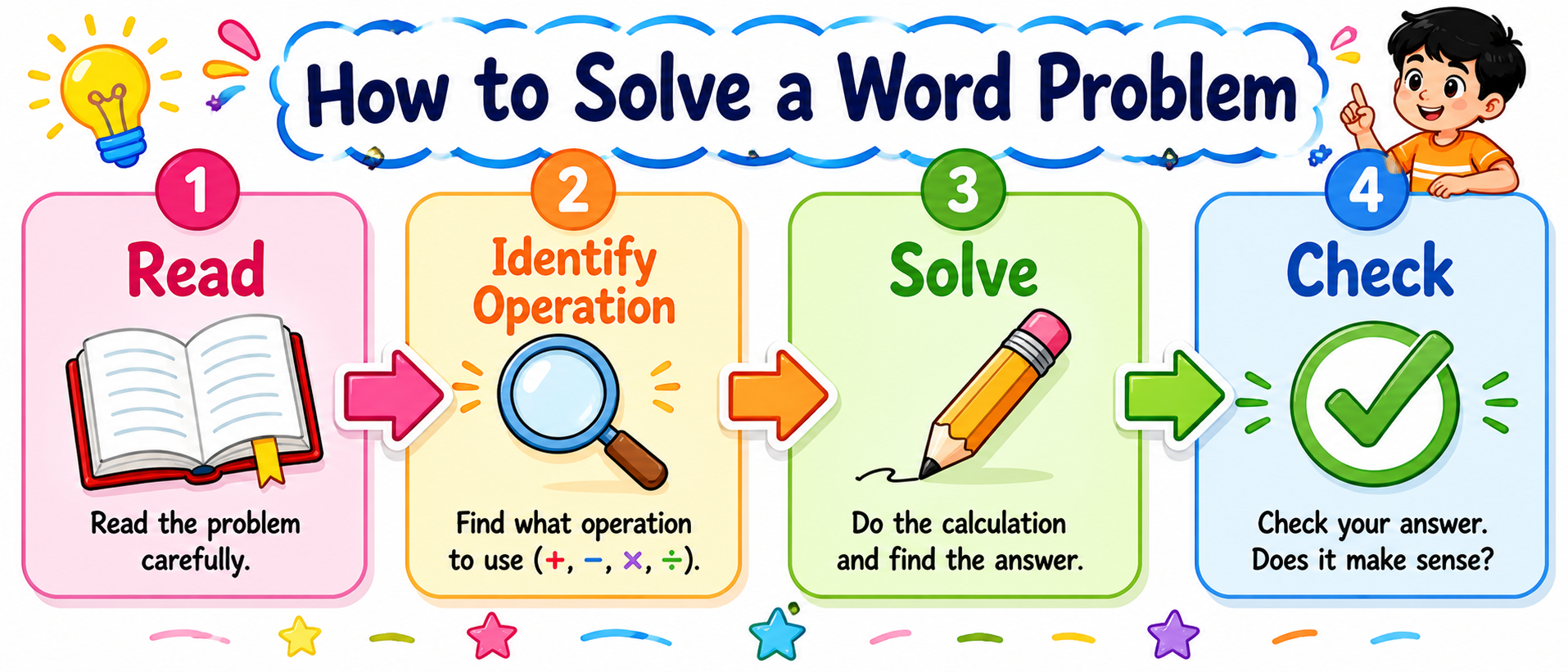
Follow these 4 simple steps every time you see a word problem:
Step 1: READ — Read the problem carefully. Read it twice if needed. Understand the story.
Step 2: IDENTIFY — Find the numbers. Look for key words. Decide which operation to use (add, subtract, multiply, or divide).
Step 3: SOLVE — Write the number sentence (equation). Do the calculation carefully.
Step 4: CHECK — Does your answer make sense? Re-read the question. Is the answer too big or too small? Write the answer in a complete sentence.
Remember: The most important step is READING carefully. Many mistakes happen because students don't read the full problem!
🔑 Key Words That Tell You Which Operation to Use
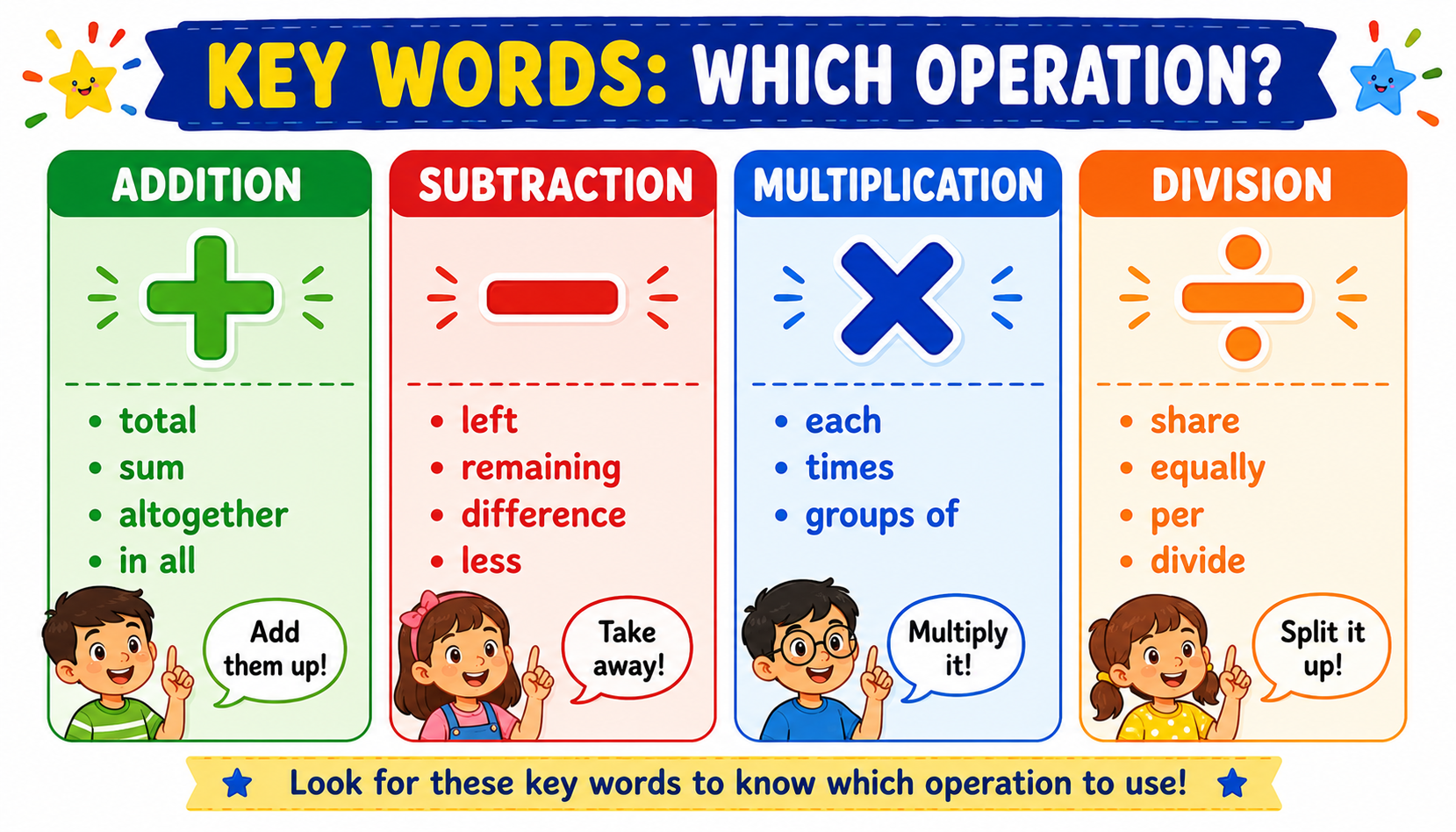
Certain words in a problem give you a clue about which operation to use. Here is a helpful chart:
Operation
Key Words
What It Means
Addition (+)
total, sum, altogether, in all, combined, both, more than, increased by
Putting things together to find how many in all
Subtraction (−)
left, remaining, difference, less than, fewer, took away, gave away, how many more
share, divide, equally, per, split, distribute, each gets, how many groups
Splitting into equal parts or groups
⚠️ Be careful! Sometimes "more" can mean addition OR subtraction. "How many more does Ravi have than Sita?" means SUBTRACT to find the difference!
➕ Addition Word Problems
Use addition when you need to find the total or put things together.
Problem 1: Aarav bought a notebook for ₹45 and a pencil box for ₹78 from the school stationery shop. How much did he spend in all?
Key word: "in all" → Addition Solution: ₹45 + ₹78 = ₹123 Answer: Aarav spent ₹123 in all.
Problem 2: In a cricket match, India scored 246 runs in the first innings and 189 runs in the second innings. What was India's total score?
Key word: "total" → Addition Solution: 246 + 189 = 435 Answer: India's total score was 435 runs.
Problem 3: During Diwali, Meena made 156 diyas and her sister made 127 diyas. How many diyas did they make altogether?
Key word: "altogether" → Addition Solution: 156 + 127 = 283 Answer: They made 283 diyas altogether.
Problem 4: A train from Delhi to Jaipur carries 385 passengers. At Gurgaon station, 148 more passengers board the train. How many passengers are on the train now?
Key word: "more... board" → Addition Solution: 385 + 148 = 533 Answer: There are 533 passengers on the train now.
➖ Subtraction Word Problems
Use subtraction when you need to find what is left, the difference, or how much more/less.
Problem 1: Priya had ₹500. She bought a book for ₹175 at the bazaar. How much money is left with her?
Subtraction: finding what's left, difference, how many more.
Multiplication: equal groups, repeated addition, "each" or "every".
Division: sharing equally, splitting into groups, "per" or "each gets".
Some problems need two steps — solve one part first, then use that answer for the next part.
Always write your answer in a complete sentence with the correct unit (₹, km, kg, etc.).
Check: Does your answer make sense? Is it too big or too small?
✏️ Practice Questions
A. Solve These Word Problems (Show Your Working)
1. Arjun has ₹350. His uncle gives him ₹275 as a birthday gift. How much money does Arjun have now?
2. A school library has 865 books. If 347 books are story books, how many are not story books?
3. There are 8 teams in a cricket tournament. Each team has 11 players. How many players are there in all?
4. Mother made 48 gulab jamuns for a party. She divided them equally on 6 plates. How many gulab jamuns are on each plate?
5. A train has 456 passengers. At Lucknow station, 189 passengers get down. How many passengers are still on the train?
6. Meena bought 7 bangles. Each bangle costs ₹9. How much did she pay in total?
7. There are 72 sweets to be shared equally among 8 children at a birthday party. How many sweets will each child get?
8. Ravi collected 234 stamps in January and 189 stamps in February. How many stamps did he collect altogether?
9. A shopkeeper had 500 kg of rice. He sold 235 kg. How much rice is remaining?
10. Father plants 6 rows of mango trees. Each row has 9 trees. How many mango trees are there in all?
B. Identify the Operation (Write +, −, × or ÷)
1. Sita has 45 marbles. She gives 18 to her friend. How many are left? Operation:
2. There are 5 baskets with 7 apples each. How many apples in all? Operation:
3. Ravi has ₹120 and Priya has ₹85. How much do they have together? Operation:
4. 63 toffees are shared equally among 9 children. How many does each get? Operation:
5. A bus has 52 seats. 38 are occupied. How many seats are empty? Operation:
C. Choose the Correct Answer
1. Anu has 156 beads. She buys 97 more. How many beads does she have now?
(a) 253(b) 243(c) 59(d) 263
2. A farmer has 84 coconuts. He sells them in bags of 7. How many bags can he fill?
(a) 11(b) 12(c) 77(d) 91
3. Rohit scored 78 runs. Virat scored 95 runs. How many more runs did Virat score?
(a) 173(b) 17(c) 27(d) 7
4. There are 9 packets of biscuits. Each packet has 6 biscuits. Total biscuits?
(a) 15(b) 45(c) 54(d) 63
5. Grandpa has ₹400. He gives ₹125 to Ravi and ₹150 to Sita. How much is left?
(a) ₹275(b) ₹125(c) ₹175(d) ₹225
D. Multi-Step Problems
1. Aarav bought 3 pens at ₹15 each and 2 erasers at ₹5 each. How much did he spend in total?
2. A baker made 80 samosas. He sold 45 in the morning and 23 in the evening. How many samosas are left?
3. There are 4 classrooms. Each classroom has 6 rows of desks with 5 desks in each row. How many desks are there in all 4 classrooms?
4. Priya had ₹300. She bought a toy for ₹95 and saved the rest. Her mother then gave her ₹50 more. How much does Priya have now?
5. A school has 240 students. 120 students go by bus, 80 walk, and the rest come by auto. How many students come by auto?
E. Create Your Own Word Problem
1. Write an addition word problem using the numbers 245 and 178.
2. Write a subtraction word problem about shopping at a bazaar.
3. Write a multiplication word problem about rows of chairs.
4. Write a division word problem about sharing sweets equally.
5. Write a multi-step word problem about a school trip.
🎨 Activity: Word Problem Detective
Play this game with a friend or family member!
Step 1: Look around your house or school. Find real-life situations that can become word problems.
Step 2: Write 4 word problems (one for each operation) based on what you see. For example:
"There are 3 shelves in the kitchen. Each shelf has 8 jars. How many jars in all?" (Multiplication)
"I had ₹50. I bought a samosa for ₹15. How much is left?" (Subtraction)
Step 3: Exchange problems with your friend. Solve each other's problems!
Challenge: Can you write a multi-step problem using two different operations?
Want a printable worksheet? Switch to Worksheet View, then print.
Maths
Word Problems
Class 3 | CBSE / NCERT / ICSE
Name: Class / Sec: Date:
🎯 Learning Objectives
Understand what a word problem is and how it differs from a plain sum.
Identify the correct operation (addition, subtraction, multiplication, or division).
Recognise key words that signal which operation to use.
Solve addition and subtraction word problems involving 3-digit and 4-digit numbers.
Solve multiplication and division word problems using tables up to 10.
Solve multi-step word problems that need more than one operation.
Check answers by re-reading the problem and verifying the solution makes sense.
📖 What is a Word Problem?
A word problem is a maths question written as a story. Instead of just seeing "25 + 18 = ?", you read a short story and figure out what to do with the numbers. Word problems help us use maths in real life — shopping, sharing sweets, counting cricket runs, or planning trips!
🧠 How to Solve a Word Problem — 4 Steps
Step 1: READ — Read the problem carefully. Understand the story. Step 2: IDENTIFY — Find the numbers. Look for key words. Decide the operation. Step 3: SOLVE — Write the equation. Do the calculation. Step 4: CHECK — Does your answer make sense? Write answer in a sentence.
🔑 Key Words Chart
Operation
Key Words
Meaning
Addition (+)
total, sum, altogether, in all, combined, more
Putting together
Subtraction (−)
left, remaining, difference, less, took away, how many more
Taking away / finding difference
Multiplication (×)
each, times, groups of, rows of, every, twice
Equal groups / repeated addition
Division (÷)
share, equally, per, split, distribute, each gets
Splitting into equal parts
➕ Addition Word Problems
1. Aarav bought a notebook for ₹45 and a pencil box for ₹78. Total spent: 45 + 78 = ₹123 2. India scored 246 runs + 189 runs = 435 runs total. 3. Meena made 156 diyas + sister made 127 = 283 diyas altogether. 4. Train: 385 passengers + 148 more board = 533 passengers.
➖ Subtraction Word Problems
1. Priya had ₹500, bought book for ₹175. Left: 500 − 175 = ₹325 2. School: 432 students − 198 girls = 234 boys. 3. Rohit 87 runs − Virat 63 runs = 24 more runs. 4. Shopkeeper: 650 packets − 278 sold = 372 remaining.
✖️ Multiplication Word Problems
1. 7 rows × 8 chairs each = 56 chairs. 2. 5 packets × 12 bindis each = 60 bindis. 3. 4 trips/day × 6 days = 24 trips. 4. 9 rotis/night × 7 days = 63 rotis.
➗ Division Word Problems
1. 36 laddoos ÷ 4 children = 9 each. 2. 45 notebooks ÷ 9 students = 5 each. 3. 56 mangoes ÷ 8 per bag = 7 bags. 4. 150 km ÷ 3 hours = 50 km/hour.