Story Sequencing
Learning Objectives
- Students will understand what sequencing means.
- Students will learn sequence words: first, then, next, after that, finally.
- Students will put story events in the correct order.
- Students will write a short story using sequence words.
Let Us Begin!
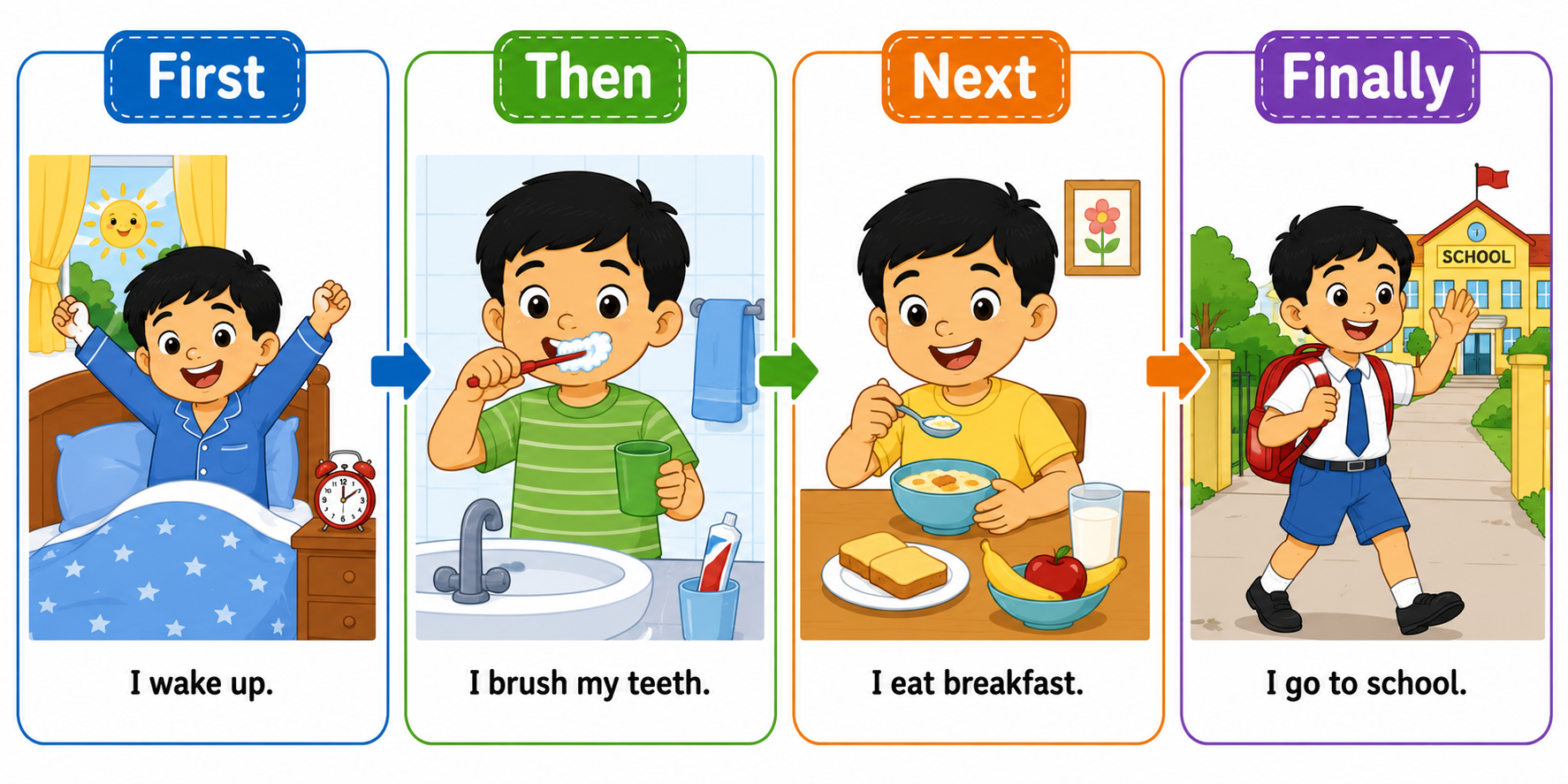
Think about how you get ready for school. You do not put on your shoes before you wake up! Everything happens in a certain order. First you wake up, then you brush your teeth, next you eat breakfast, and finally you go to school. Putting events in the right order is called sequencing. It helps us tell stories clearly!
What Is Sequencing?
Sequencing means putting events in the right order — from what happens first to what happens last.
When we tell a story, we must tell events in the order they happened. This makes the story easy to understand.
Sequence Words
We use special words to show the order of events. These are called sequence words.
| Sequence Word | When to Use It | Example |
|---|---|---|
| First | The very first thing that happens | First, Ravi woke up. |
| Then | The next thing after "first" | Then, he brushed his teeth. |
| Next | What happens after "then" | Next, he ate breakfast. |
| After that | What happens after "next" | After that, he put on his bag. |
| Finally | The last thing that happens | Finally, he went to school. |
Story 1: Meena Plants a Seed
Read these events. They are in the wrong order. Can you put them in the right order?
Jumbled events:
— The plant grew tall and had flowers.
— Meena watered the seed every day.
— Meena dug a small hole in the ground.
— A tiny green shoot came out of the soil.
— Meena put a seed in the hole and covered it with soil.
The Story in the Right Order
First, Meena dug a small hole in the ground.
Then, she put a seed in the hole and covered it with soil.
Next, Meena watered the seed every day.
After that, a tiny green shoot came out of the soil.
Finally, the plant grew tall and had flowers.
Story 2: Arjun Makes a Sandwich
First, Arjun took two slices of bread.
Then, he spread butter on one slice.
Next, he put a slice of cheese and some vegetables on top.
After that, he placed the second slice of bread on top.
Finally, Arjun ate his yummy sandwich!
Story 3: Sita's Birthday Party
First, Sita's mother baked a big chocolate cake.
Then, Sita's friends came to her house.
Next, they played musical chairs and other games.
After that, Sita cut the cake and everyone sang "Happy Birthday".
Finally, Sita opened her gifts and thanked everyone.
Key Words
| Word | Meaning |
|---|---|
| Sequencing | Putting events in the right order |
| First | The very first event in a story |
| Then / Next | Events that come after the first |
| After that | An event that follows the previous one |
| Finally | The last event in a story |
| Order | The way things are arranged — from first to last |
- Sequencing means putting events in the right order.
- Sequence words help us show the order: first, then, next, after that, finally.
- Always think about what must happen before something else can happen.
- A story told in the right order is easy to understand.
- Use sequence words when you write a story or describe your day.
- Every story has a beginning, a middle, and an end.
Practice Questions
| Sequence Word | Meaning |
|---|---|
| 1. First | a. The last event |
| 2. Then | b. The very first event |
| 3. Next | c. What happens after "then" |
| 4. After that | d. What happens after "first" |
| 5. Finally | e. What follows the previous event |
These sentences tell a story about Ravi's day at the market. Write the correct order (1 to 5) in the box.
| Order | Event |
|---|---|
| Ravi paid the shopkeeper and said thank you. | |
| Ravi walked to the market with his mother. | |
| Ravi chose five big mangoes. | |
| They reached home and ate the sweet mangoes. | |
| Ravi and his mother went to the fruit shop. |
Now write the story in order using sequence words:
Want to use this as a worksheet? Switch to the A4 printable view.